|
|
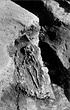
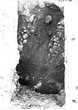
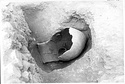
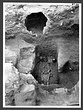
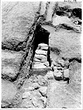
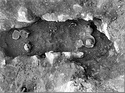
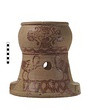
| Susan Rotroff ... Grave 1. Burial of a child perhaps 6 years old, covered by broken amphora. Skeleton lay extended on its back, oriented N-S, with head at south. No grave gifts. PD 2207 ... Final Mycenaean/Submycenaean ... Hesperia 44 (1975), pp. 373-374, pl. 84, j ... Agora XXXVI, Tomb 65, pp. 431-434, 551, figs. 2.290, 2.314-2.318, pl. 1. |
| Dorothy Burr Thompson ... Grave 23 in notebook (E.L. Smithson: Grave IV: SM). Few bones: discarded. JP says 46/ΜΖ-MΗ
Negs. KK 99, KK 100, KK 101, X-61, X-62, X-63 PD 433 ... Final Mycenaean/Submycenaean ... Agora XXXVI, Tomb 36, pp. 289-293, figs. 2.193-2.198, pl. 1. |
| John Travlos ... (Grave XXXII: EG) Urn cremation (trench-and-hole). Published as cremation burial of a warrior.
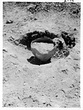
The tomb was probably originally oriented north-south, with the urn-hole at the south end. The north side ... Transitional Early Geometric II-Middle Geometric I ... Hesperia 16 (1947), pp. 196-197, fig. 1, pl. 41. |
| Eugene Vanderpool ... Rectangular pit, oriented east-west, cut party into filling of Early Protogeometric pit-well (I 18:4), to a preserved depth of about 0.30m. A late Byzantine wall founded below the floor of the grave destroyed ... Middle Geometric I ... Hesperia 17 (1948), pp. 158-159, pl. 41, 1. |
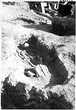
| E.D. Townsend Vermeule ... Protogeometric Grave no. 2 at North of Temple of Ares (Grave XXXVII). Rectangular stone-lined pit in filling of Mycenaean chamber tomb (J 7:2); the skeleton of a boy. Cf. P 21275 which is from the "preliminary ... Middle Protogeometric ... Hesperia 24 (1955), pp. 200-201, 218, fig. 1, pl. 77, nos. 37-38. |
| Dorothy Burr Thompson ... Grave 25 in notebook. (E.L. Smithson: Grave I: SM). Bones discarded. In some records as Grve XIV (JP)?
Notebook says (p. 947) contents: hard earth, no bones. Lisa's list says bones discarded.
Negs. X-75, ... Final Mycenaean/Submycenaean ... Agora XXXVI, Tomb 38, pp. 294-298, figs. 2.199-2.201, pl. 1. |
| RSY Grave 51.
The grave lay on the slope of the Areopagus in Roman house O, just east of the line where the hillside is scarped for the foundation of the west wall of the house.
Cutting:the pit cut in ... Archaic period/6th or 7th c. |
Mycenaean burial, disturbed (Piers 12-13 east). Plan unclear.
Bones discarded.
It was found in the trench for the east stylobate of the Square Building. It was so badly disturbed by the Classical builders ... Myc. IIIA:2 |
Mycenaean Tomb under Valerian wall (Burial 12).
It was impossible to fix the limits of the tomb in any direction, since at the north and south it was cut by the wall, an operations could not be extended ... Myc. III B |
Well a in west part of Odeion Cavea, probably unfinished. The dumped fill mostly potters' refuse including test pieces.
Well D. Diameter ca. 0.90m ... Early Protogeometric |
West Terrace, South End, Layers IV and V. Heavy dumped filling associated with terrace walls at the extreme south end of the excavations in the Areopagus industrial area. The proportion of figured and ... Ca. 420-390 B.C ... Hesperia 16 (1947), p. 210, pl. 47, 1 and 3. |
Diameter of top of well 0.80m.
An early well east of Roman Building, north of Temple of Ares and thus in the region of the Mycenaean cemetery. Sherds almost entirely Mycenaean with nothing later and a ... Mycenaean ... Hesperia 92 (2023), pp. 115, 173, 174, n. 257, fig. 1 ... Agora XIII, pp. 253-254, 274, pl. 61. |
Eugene Vanderpool ... Disturbed burial: Pocket in bedrock (Grave 11: PG). In some records as Grave XI. No remains. No cutting or traces of burning nearby
The coin listed here was found "cleaning bedrock", presumably at the ... Developed to Late Protogeometric |
| Grave cut into bedrock (L. 2m, W. 0.58m), head toward E; offerings at south end. Skeleton of a male about 40 years old, laid out with knees slightly bent.
Brann. PD 434, PD 1058 ... 750-725 B.C. |
"Fauvel Collection"
Collector's dump? Debris in the cellar of a modern house, probably once that of F.S. Fauvel.
The collection included vases of all periods, from Geometric to Turkish; a number of the ... Modern Context |
| John Camp ... Protogeometric Grave about 0.60m to the southeast of T 15:2.
Unlined roughly rectangular-elliptical pit, oriented north-south, neatly cut into bedrock to a depth of 0.70m, with rounded corners. The pit ... Early-Developed Protogeometric |
| Eugene Vanderpool ... E.L. Smithson: Grave XXXV. Adult female inhumation. Deposit summary and notebook write at 31/Θ-I ... Final Mycenaean/Submycenaean-Early Protogeometric |
| Dorothy Burr Thompson ... Grave 15 in notebook. Burial of child (E.L. Smithson: Grave XIV: PG). Single bone. Nb. says: few bones.
Skull fragment, few ribs and fingers (bones discarded). Negs. KK 24 and KK 30 431 ... Developed to Late Protogeometric ... Agora XXXVI, Tomb 45, pp. 322-328, figs. 2.224-2.227, pl. III ... Kerameikos V, 1, p. 47 as a "spätprotogeometrischen Grab". |
Well on south slope of Kolonos Agoraios. Coins:
23 March 1936 #5-#6
31 March 1936 #3
30 April 1936 #1
1 May 1936 #6
2 May 1936 #2
5 May 1936 #8
6 May 1936 #15-#16
14 May 1936 #5-#8 (#6 N 51520 is from ... 50 B.C-3rd c. A.D. |
| A well on the lower slope of the Hill of the Nymphs, (diam. 1.20m -water level -7m), to 7.90m. The scanty use filling at the bottom contained water jars and pitchers as well as the inventoried objects; ... Second quarter of 6th. c. B.C. |
|
|