|
|
A fair-sized pit in bedrock in Stoa Terrace opposite Pier 18, which contained a good deal of pottery mostly coarse. A little additional material as late as second quarter 4th. c. B.C ... Ca. 425-400 B.C. |
Mycenaean Tomb under Valerian wall (Burial 12).
It was impossible to fix the limits of the tomb in any direction, since at the north and south it was cut by the wall, an operations could not be extended ... Myc. III B |
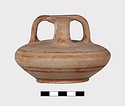
| Stone Slab. Hesperia, 35, 1966, pp. 77-78. Description of Tombs and Catalogue of Objects; The Tombs along The East Side Beneath the Stoa of Attalos; XXII-XXXVI; Tomb XXV; Chamber under Late Roman Fortification ... Agora 13 226 ST 593 P 23616 P 23617 R 7:1 ... Mycenaean III B |
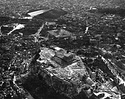
| The Acropolis and environs. Official U.S. Navy photograph ... southeast Horizontal (normal) ... October 1953 |
| The Acropolis and environs. Official U.S. Navy photograph ... Horizontal (normal) ... October 1953 |
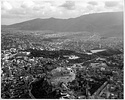
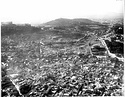
| Athens with the Agora in the center. Official U.S. Navy photograph ... south ... October 1953 |
| Lower part only preserved. Large flaring stand with plain rolled lower rim.
A siren and a sphinx face each other across a large lotus and palmette ornament. Of the siren only the feet, tail and part of ... 8 October 1953 |
| Part of inner edge of rim preserved. On top, lotus and palmette frieze, with red for hearts. Broad red band below rim inside. Archaic well. 5162 Leica ... 8 October 1953 |
| Fragment of rim and body.
The mid-parts of a feline to right. Incised rosettes in field. Added red on neck, belly and haunch. Archaic well. 5162 Leica ... 8 October 1953 |
Handle missing and chips for rim and foot; otherise intact. Flaring ring foot; high neck; trefoil lip.
Procession of swans to right, on body and on neck. Blobs in field. Traces of red on bodies. Archaic ... 8 October 1953 |
| Intact.
Concentric circles on top of false mouth; concentric semicircles on shoulder. Bands around body and outer edge of foot.
Pinkish-buff clay. Light red glaze paint, most flaked. Μικρός ψευδόστομος ... 7-8 October 1953 |
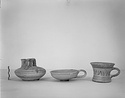
| Mended from several pieces; fragment from rim and bottom missing, restored in plaster. Mug with flat bottom, concave sides and single handle.
Handle zone decorated with pattern like a retrograde N; above ... 7 October 1953 |
| About half preserved. Restored in plaster. Shallow open cup; raised base, slightly concave beneath; one band handle.
Broad and narrow bands around lower wall; the rim, the handle outside and the edge ... 7 October 1953 |
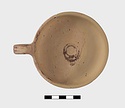
| Central medallion and some of low foot preserved. Medallion with gorgoneion. The fragment appears to have been deliberately chipped around the edges to reduce it to the size and shape of the gorgoneion ... October 1953 |
| Two non-joining fragments preserve some of heads and bodies of horses and some of the lotus bud pattern above. Red for mane. Found while digging drainage ditch just west of Stoa of Attalos near north end ... October 1953 |
All three handles and most of one side of the body missing; restored in plaster. Deep alabastron with rather tall neck spreading to narrow rim rounded on top.
Gray clay, very brittle and flaky. Remains ... 8 October 1953 |
[Originally identified as krater.]
One handle and some of rim and body missing. Small and rather open and shallow.
Black glaze on inside and rim considerably worn; no glaze band outside. Considerable ... October 1953 |
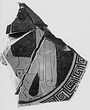
| Upper part of stem and some of bowl preserved.
Interior: lower parts of a draped seated and a draped standing figure; maeander border.
Exterior: lower part of figured scene.
A little relief contour ... October 1953 |
Fragment of lip and upper wall, probably from a sessile kantharos.
A zone of upright framed palmettes on wall.
Glaze reddish to greenish-black. Terrace opposite Pier 18. Pit in bedrock. 2762 Leica ... October 1953 |
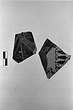
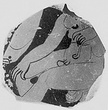
| Broken all around.
Part of a nude male figure, to left, seated on some drapery; in front of him, the hand of another figure, holding a large alabastron(?).
No relief contour.
Firm glaze top and bottom ... October 1953 |
A little 4th c. B.C.; Mycenaean kylix stem.
Ca. 100 fine ware and many coarse ware (largely discarded) sherds. Most belong to the final quarter of the 5th c. B.C. A few fragments are as late as the ... Late 5th c. B.C. |
|
|
.png.icon.jpg)