|
|
The right half of the head is preserved in two pieces.
The hair of the figure is parted in the middle and waves down on either side of the face, covered by a cap. Something which has now disappeared was ... 2 May 1933 |
Mended from six pieces; head and neck missing.
The bust, draped in a toga, rests on a circular pedestal with mouldings.
No remains of paint.
Yellow clay. Trench II, in house C. Leica ... 2 May 1933 |
Somewhat twisted handle with slightly arched upper part; worn bit of rim preserved.
Clay bright colored; core only slightly greyish; thin slip(?).
The die from which the boukranion is clear seems to ... 2 May 1933 |
| Part from neck of amphora.
Micaceous reddish-buff clay.
Impression incomplete above, broken away to right. Finished In this region the Byzantine sherds went almost to the bottom; overlying bedrock were ... 1 May 1933 |
No distinct core; slip thicker on top.
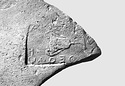
Worn impression. Black earth. Ἐπὶ Νικασιβ(ούλου)
Θευγένευ(ς)
Κνίδιον Leica ... 1 May 1933 |
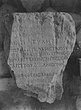
| Part of large inscribed block.
Two fragments; the smaller, which joins, comes from the uniscribed back.
Back rough picked; top picked fine, with a smooth dressed band along front and right side; right ... Ca. 200 A.D. |
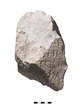
Inscribed fragment.
Broken all round; traces of rough picking behind.
Three lines of the inscription preserved.
Hymettian marble. Found in modern foundation, outside the southeast corner of the Stoa of ... 1 May 1933 |
Fragment from left side of inscribed stele.
Broken top, bottom and at right.
Left side dressed smooth, with the back edge beveled to the rough picked back; the front edge much chipped, so that the first ... 5th. century B.C. |
| Inscribed fragment.
Broken all around; from a large base.
Honorary monument of the council of the Areopagos.
Part of three letters preserved.
Pentelic marble.
ADDENDA Other fragments which belong or join: ... 1 May 1933 |
| Inscribed fragment.
The left side is preserved. Finely picked.
Parts of five lines of the inscription preserved.
Pentelic marble. Found in a moden wall, over the west part of the Library of Pantainos ... 1 May 1933 |
| Inscribed.
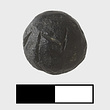
Small ball irregular, with deeply cut letters. West of Roman wall, footing trench. Leica ... 2 May 1933 |
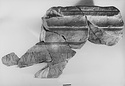
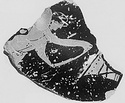
| Most of the lip and a fragment of the bottom missing. Large chips of glaze gone from right side. An animal, which cannot be recognized as any known quadruped, is running right in a frame of roughly circular ... 1 May 1933 |
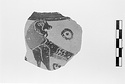
| The depicted figure (legs missing below the thighs, and back chipped) faces right toward a wool-basket set at right angles to him. A small bit of a wing(?) is preserved just above the small of his back ... 1 May 1933 |
Lidless lekanis. About one-sixth of the rim and side is preserved; the flaring ends of the applied ribbon handle have been broken away. Under the handle, a rosette with incised petals. To the right, an ... May 1933 |
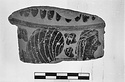
Lidless lekanis. About one-fifth of the rim and side preserved, including the greater part of the body and head of one sphinx and the wing of a second(?). The side below the rim is almost vertical. The ... May 1933 |
Lidless lekanis. A small fragment of the rim and side preserved. The greater part of the sphinx and the wing and part of the body of another creature, probably a siren, remain. The profile of the vase ... May 1933 |
| The original side edges of the foot are preserved, with a small part of the body of the base above. The foot itself is broken off at about half its height. A small groove between foot and vase, on the ... May 1933 |
A small fragment of the foot preserved. Depicts sphinxes or sirens heraldically opposed. More is left of the creature on the left than of that on the right. Vertical stripes on the outer edge of the foot; ... May 1933 |
| A tiny part of the rim and a larger section of the curving side is preserved. There is a strong convex bulge to the sides; the rim is indented for the reception of a lid covering it. Depicts lion facing ... May 1933 |
Fragment of discus and rim of lamp.
Only the forepart of the lion is preserved, as far as the beginning of the haunches.
The concave discus is outlined by a groove.
On the rim, concentric circle separated ... 1 May 1933 |
|
|