|
|
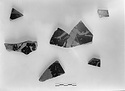
Wall fragment. Max. dim. 0.059.
The fragment shows the legs from thighs to calves of a youth to right. At the lower right break is part of another figure (drapery). Preliminary sketch. Dilute glaze: muscles ... Ca. 440 B.C. |
Thirty-two non-joining fragments of rim, wall, and cul. Narrow reserved band on inside of rim, another 0.082 below rim. Glaze pitted on some fragments; has a greenish cast here and there. Max. dim. P 7282 ... Ca. 440 B.C. |
| Nine fragments, not all certainly from the same pot.
a) Satyr running right; in front of him, a burning torch held in the hand of another figure. White for flame of torch.
b) Woman in Doric chiton moving ... 28 March 1936 |
Wall and shoulder fragment, mostly glazed on inside. Glaze splintered here and there; flaked in front of youth's shoulders. Max. dim. 0.051.
Nude youthful athlete (wreathed head, shoulders, start of arms) ... Ca. 470 B.C. |
Wall fragment. Max. dim. 0.026.
Woman (head with sakkos, shoulders) standing frontally, looking to left. She seems to wear a chiton decorated with dots. Relief contour.
Manner of the Icarus Painter (ARV2 ... Ca. 470 B.C. |
Two non-joining fragments, a of lower part of body and ring base, b of shoulder and neck with start of handle. Glaze misfired reddish in places, abraded in others. P.H. a) 0.09, b) 0.07. C. Boulter, Hesperia ... Ca. 470-460 B.C. |
Wall fragment. Max. dim. 0.029.
Head of woman (back missing) to right. She has a sakkos and an earring. Part of floral in front of her.
The namepiece of the Painter of Agora 7561 (ARV2 one 515, 2; ARV2 ... Ca. 450 B.C. |
Body fragment. Max. dim. 0.071.
Aphrodite(?) (drapery) on a goose or swan (head, neck, wings) shown frontally. Preliminary sketch. Dilute glaze: cover feathers.
For Aphrodite on a swan or goose, see ... Mid-5th century B.C. |
|
|