|
|
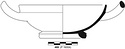
| Black glaze profiles for Brian A. Sparkes ... Nina Travlou Fred N. Ley Kathleen Lynch ... Linked image is a redrawn digital version (F. N. Ley and K. Lynch) of the original (N. Travlou) 82-671 82-671 ... 2008
1961 |
| Black glaze profiles for Brian A. Sparkes ... Nina Travlou Fred N. Ley Kathleen Lynch ... Linked image is a redrawn digital version (F. N. Ley and K. Lynch) of the original (N. Travlou) 82-671 82-671 ... 2008
1961 |
Spreading ring foot, lipped. Lip very lightly inset outside, plain inside. Reserved: underside with two circles and dot, resting surface, outer face of foot, handle-panels. Glaze mottled in parts ... Ca. 480-470 B.C. |
Spreading ring foot, lipped. Reserved: underside with circle and dot, resting surface, outer face of foot, handle- panels.
For the reserving of the outer face, compare, for example, Oxford 1885.495: CVA ... Ca. 480-470 B.C. |
Spreading ring foot, lipped. Reserved: underside with circle (exact center missing) and resting surface. Glaze worn on one side.
By the same potter, P 19408-9, from the same deposit. Cf. the four cups ... Ca. 470-450 B.C. |
Handles missing.
Spreading ring foot, lipped. Reserved: underside with circle and dot, resting surface ... Ca. 425 B.C. |
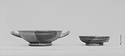
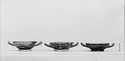
| Black glaze stemless cups ... AMS Horizontal (normal) |
| Part of one handle and fragments of body missing. Shape similar to P 19405 (ΟΟ 725) but smaller and the foot less projecting. Resting surface reserved and space within foot, with small central circle ... 1947 |
| About half the rim and both handles missing; one rim fragment does not join. Restored in plaster. Heavy ring foot; nearly flat floor sharply set off at its edge from straight flaring lip; outside, lip ... 20 March 1937 |
| Fragments missing from base, floor, lip and one handle; restored in plaster. Shallow cup on high heavy ring foot, flat on top and projecting well beyond wall. The lip concave outside, inside steeply flaring ... 2-19 May 1939 |
| A few fragments missing from wall and lip; and part of one handle; restored in plaster. Cup somewhat deeper and more rounded than P 16003 (ΓΓ 679); the foot similar but smaller in proportion and more carefully ... 2-19 May 1939 |
Spreading ring foot, lipped. Reserved: underside with two circles and dot.
By the same potter, P 19406, from the same deposit. Cf. also, for the size, Brussels A 3100: CVA 3(3) pl. 2(137) 17. For a stemless ... Ca. 470-450 B.C. |
The foot, both handles and more than half the rim preserved, but no join between them. Restored in plaster. Lip concave on outside, offset inside. Heavy ring foot, flat on top and projecting; grooved around ... 1947 |
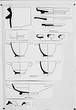
| Profile drawings of black-glazed vases and lamps ... PD 664 PD 665 PD 666 PF 667 PD 668 PD 670 PD 679 AMS Horizontal (normal) |
Construction filling of the Poros Building west of the Areopagus. Patch of stony fill beneath the courtyard. Accumulation of the second quarter of the 5th c., deposited in the last quarter ... Ca. 475-450 B.C. and later |
Well at 69/ΟΒ (Late 5th c.)
Lower fill dated to 420-400 B.C. in Agora XXX.
There were no use filling and the well was apparently not a success as a water-supply: there was no concentration of water-jars ... 420-400 B.C. |
| This filling is the largest deposit of its time found in the Agora. It may be compared with H 6:5 and with N 7:3.
Dug in soft bedrock to a depth of 11.40m; footholds cut on opposite sides of the shaft ... Ca. 490-450 B.C. |
|
|