|
|
Knob only.
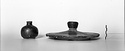
Pomegranate knob. Groove round stalk which is reserved on top. Small hole in top ... Ca. 500 B.C. |
Top of knob missing.
Lid. Nearly flat on top, offset near rim; inset flange beneath. Ring at base of acorn knob which is broken at the top and hollow inside. Reserved: the underside, junction of top and ... 480-450 B.C. |
Top of knob missing.
Lid. Domed top, inset flange beneath. Top offset from flat rim. Scraped groove on outer face of rim, one at junction of rim and dome, one at base of knob ... 4th c. B.C. |
| Originally identified as a vase:
Mouth broken away. Small globular vase; high stem finished smooth; no base; the stem is now pierced through from top to bottom; may have been attached to a base.
Fine ... 13 June 1932 |
| Black glazed potttery ... AMS Horizontal (normal) |
Top of handle broken off. Downturned flange set in from edge of rim. Flat narrow rim and convex top set off from rim and handle by narrow reserved bands. Reserved groove around outer face of rim.
Black ... April-May 1936 |
A few fragments missing from lip and from top of knob. Partly restored in plaster. A nearly flat lid with a ridge on undersurface set 0.025 m. in from edge for holding the lid in the mouth of the pot ... 2-19 May 1939 |
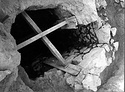
| At the northwest foot of Areopagus. Square stone-curbed well with no clear evidence for a period of use; appears to be a single dump ... Ca. 500 B.C. |
Well near west edge of level area south of the Hephaisteion. Dumped filling thrown in near end of 4th. c. but by far the greater part belonging to the 30 years before 350 B.C.
Diameter of shaft 0.98m ... Ca. 380-350 B.C. |
| This filling is the largest deposit of its time found in the Agora. It may be compared with H 6:5 and with N 7:3.
Dug in soft bedrock to a depth of 11.40m; footholds cut on opposite sides of the shaft ... Ca. 490-450 B.C. |
|
|