|
|
Small parts of rim and wall restored.
Flaring ring foot; rounded resting surface; nippled underside.
Deep lower body, concave and inclined upper body; no groove in wall.
Ivy-leaf thumb rests. Olive ... 250-240 |
P 18543 a, b
Bowl (b) and lid (a) each mended from three fragments; a few chips missing.
Concave underside. Concave-convex profile with high vertical rim above flange. Lid has slightly inturned rim, ... 325-300 |
Mended from sixteen fragments; a few chips missing.
Very slightly concave underside with string marks. Wall slightly concave at bottom. Rim slightly offset on inside. Dull brown glaze.
Similar: P 19869 ... 325-275 |
One handle restored.
Scraped groove in resting surface; concave underside. High, slightly concave stem. Tapering upper body. Rising, flaring spurs.
Lustrous black glaze. Illegible graffito under foot ... Ca. 275 ... Also similar: P 18456 (Young 1951b, no. 13:2, p. 129, pl. 54:a [C 17:2]), P 20859 (D 17:3). |
Intact.
Slightly concave underside with string marks. Rim slightly offset from floor. Thin glaze, mottled red to brown. Two kappas incised on floor before glazing.
Other glazed saucers of about this ... 325-300 |
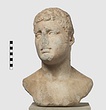
| A large piece missing at the back and left. Nose and mouth battered, ears chipped. Along the break, from the top of the head, is a vertical pinhole with traces of iron stain.
The wear on front and back ... Early Flavian period. |
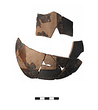
| Eleven pieces comprising two non-joining fragments. To Young's publication of six pieces are now added five more, two of which help to complete to inscription.
Part of the side wall with reserved panel ... 600 B.C ... Kerameikos VI, 2, pp. 272, 326.
... Line 3 continues boustophedon from line 2 and preserves only one word,έδρασεν. The ends of the three horizontals of the initial epsilon are preserved at the right edge.
Young would take the verb to be equivalent to έγραφσεν and translate the whole, "Androg ... , son of D ... ,made (i.e. wrote) ... |
|
|