|
|
Intact.
Slightly concave underside with string marks. Steep, convex wall.
Pink fabric (7.5YR 7/4); thin, dull black glaze.
Other fairly well glazed saucers of Hellenistic date: P 19872--P 19875 (Young ... 350-300 ... Other fairly well glazed saucers of Hellenistic date: P 19872--P 19875 (Young 1951b, nos. 11:12--15, p. 127, from same pyre), P 336 and P 337 (Rotroff 1983, nos. 12, 13, p. 284, pl. 51 [H 6:9, north chamber, lower fill]), P 16739 and P 16740 (Young 1951b, nos. 10:11, 12, p. 126 [B 22:3]), P 18550, P 18551, and P 18553 (Young 1951b, nos. 8:13, 14, 16, p. 125, pl. 52:b [B 19:5]), P 6360 and P 6361 (D 15:3). |
Mended from sixteen fragments; a few chips missing.
Very slightly concave underside with string marks. Wall slightly concave at bottom. Rim slightly offset on inside. Dull brown glaze.
Similar: P 19869 ... 325-275 |
P 18548 a, b
Body (a) mended from eight fragments and partly restored; lid (b) mended from nine fragments.
Flat underside with string marks. Very slightly concave lower wall.
Rim concave on inside, ... 325-300 ... D. B. Thompson 1971, fig. 52 ... Young 1951b, no. 8:11, p. 125, pl. 52:b |
Small parts of rim and wall restored.
Flaring ring foot; rounded resting surface; nippled underside.
Deep lower body, concave and inclined upper body; no groove in wall.
Ivy-leaf thumb rests. Olive ... 250-240 |
Intact.
Slightly concave underside with string marks. Rim slightly offset from floor. Thin glaze, mottled red to brown. Two kappas incised on floor before glazing.
Other glazed saucers of about this ... 325-300 |
Wall fragment. Max. dim. 0.061.
Woman (most of head with woolen fillet, shoulders with chiton) to right, looking down at a decorated chest she carries. She also wears a necklace. Preliminary sketch. Relief ... Ca. 430-420 B.C. |
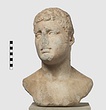
| A large piece missing at the back and left. Nose and mouth battered, ears chipped. Along the break, from the top of the head, is a vertical pinhole with traces of iron stain.
The wear on front and back ... Early Flavian period. |
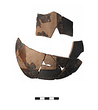
| Fragment of body of oinochoe. Head of young satyr wearing ivy garland bound with a ribbon of added white. Relief contour for profile.
Much added from sherds:
a) Three pieces joining above and to left ... 2 May 1939 |
| Intact save for end of nose and ancient chip from right ear and recent chips from hair and left ear.
Socket for fitting into body rough-picked; carried up high in back of neck.
Hair in marked waves above ... Julio-Claudian period. |
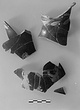
| Eleven pieces comprising two non-joining fragments. To Young's publication of six pieces are now added five more, two of which help to complete to inscription.
Part of the side wall with reserved panel ... 600 B.C ... Also strange is άναχτι instead of ανακτι although this is perhaps an early example of the Attic tendency to aspirate stops: cf. C. D. Buck, The Greek Dialects, Chicago, 1955, pp. 60-61.
... Hemberg, ΑΝΑΞ, ΑΝΑΣΣΑ, und ΑΝΑΚΕΣ, Uppsala, 1955, pp. 8, 11. But the tau after Δί may represent an elision of τεinstead of τοιin which case the title may belong to another deity mentioned in the missing part of line 2. ... The ends of the three horizontals of the initial epsilon are preserved at the right edge.
Young would take the verb to be equivalent to έγραφσεν and translate the whole, "Androg ... , son of D ... ,made (i.e. wrote) ... |
|
|