|
|
Less than half of rim and small part of wall preserved; restored.
Plain convex wall. Narrow rim does not project. Shiny black-to-brown glaze with metallic patches, on floor only ... Ca. 275? |
About half of rim restored.
Flat resting surface; abrupt transition from foot to slightly pointed underside. Convex wall with pronounced offset below rim. Narrow rim slopes down to inside. Thin, dull ... Ca. 300 ... Offset of wall as on 791, 792, P 20144 (Young 1951b, no. 12:5, p. 128, pl. 53:c [B 17:5]), P 6967 (D--E 8--9:1). |
One handle restored.
Scraped groove in resting surface; concave underside. High, slightly concave stem. Tapering upper body. Rising, flaring spurs.
Lustrous black glaze. Illegible graffito under foot ... Ca. 275 |
Thin, rough slab of hard, gray limestone. Upper, lower, and left sides roughly smooth, right side broken away; inscribed face smooth, back face rough.
In center of slab, running left to right, the letters ... 7th c. B.C.? |
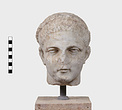
| Broken at neck. Nose broken; ears and chin chipped; a slice missing from back of head; otherwise in good condition.
Head of a young boy, life-size or slightly under, with short hair and a wreath about ... 3rd quarter of the 3rd c. A.D. |
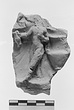
| On the front a raised ground line; on it, a nude young walking left, a pitcher in his right hand and in his left a shallow cup (?). Behind him a large krater.
Flattened behind, broken off all around.
No ... 18 April 1947 |
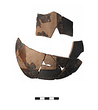
| Eleven pieces comprising two non-joining fragments. To Young's publication of six pieces are now added five more, two of which help to complete to inscription.
Part of the side wall with reserved panel ... 600 B.C ... Also strange is άναχτι instead of ανακτι although this is perhaps an early example of the Attic tendency to aspirate stops: cf. C. D. Buck, The Greek Dialects, Chicago, 1955, pp. 60-61.
... Hemberg, ΑΝΑΞ, ΑΝΑΣΣΑ, und ΑΝΑΚΕΣ, Uppsala, 1955, pp. 8, 11. But the tau after Δί may represent an elision of τεinstead of τοιin which case the title may belong to another deity mentioned in the missing part of line 2. ... The ends of the three horizontals of the initial epsilon are preserved at the right edge.
Young would take the verb to be equivalent to έγραφσεν and translate the whole, "Androg ... , son of D ... ,made (i.e. wrote) ... |
|
|