|
|
Mended from twenty-seven fragments, a few gaps restored; slight burning.
Rounded bottom. Lower wall pared. Traces of glaze near handle on rim. Hard, brown household fabric (7.5YR 5/4).
Similar: P 18585 ... 300-270 |
One handle, foot, and parts of wall restored.
Nearly hemispherical lower body with scraped groove at greatest diameter. Concave upper body, nearly vertical. Ivy-leaf thumb rests.
Ivy garland running ... 275-250 |
Mended from four pieces; slightly burned.
Slightly concave underside with string marks. Wall concave near base.
Reddish yellow fabric (ca. 7.5YR 6/6); unglazed.
Similar: P 18461--P 18463 (Young 1951b, ... 300-250 |
Parts of foot restored.
Sharply defined, flaring foot; beveled resting surface; pointed underside with unglazed patch. Upper and lower body meet at angle.
Old-man-mask thumb rests. Opposing olive garland ... 275-250 |
Mended from thirteen fragments, with a few gaps restored; burned.
Flat underside with slight string marks. Fairly deep body, slightly concave below rim. Prominent wheel ridging inside. Handles tightly ... 290-250 |
Handle and one fourth of body restored; burned.
Raised base, flat underneath. Irregular, ovoid body. Nearly cylindrical neck. Broad groove and ridge below plain rim. Trace of ivy garland in glaze on neck ... 275-250 |
Bowl (b) mended from five fragments, lid (a) from three fragments, with a few chips missing; burned.
Flaring foot, slightly concave with string marks underneath.
Horizontally projecting flange. Low, ... 270-260? |
Nothing of sides or bottom. Disk: long-beaked bird and a rearing animal (wolf?) facing each other across filling hole; rim: leaved tendril.
According to R. S. Young the scene on the disk is from one of ... 5th c. A.D. |
Mended from fifteen fragments, with small pieces missing; burned.
Slightly raised base with string marks. Wall slightly concave.
Handles tightly folded. Hard, light reddish brown fabric (5YR 6/4); handles ... 325-300 ... Hard, light reddish brown fabric (5YR 6/4); handles and surrounding rim dip-glazed dull brown to purple, splashes and dribbles of glaze on floor.
Nearly identical: P 28559 (from same pyre), P 20146 (Young 1951b, no.
12:7, p. 128, pl. 53:c [B 17:5]). |
Intact.
Slightly concave underside with string marks. Rim slightly offset from floor. Thin glaze, mottled red to brown. Two kappas incised on floor before glazing.
Other glazed saucers of about this ... 325-300 ... Thompson 1940, pp. 134--135, fig. 99:c [G 12:20]), P 19060 and P 19062 (Young 1951b, nos. 4:17, 19, p. 119 [B 18:1]), P 4457 (F 11:2, upper fill). |
Stroke polishing on neck.
Unglazed and handmade.
Small, unpainted votives are found in great quantities at many sanctuary sites. Only about 100 were saved from the dump on Hymettos, although the total ... 8th-7th c. B.C. |
One handle, over half of upper body, and part of lower body and foot restored.
Scraped groove in resting surface; concave underside with nipple.
High, slightly tapering stem. Cylindrical upper body ... 275-260 ... Similar but smaller: P 18456 (Young 1951b, no. 13:2, p. 129, pl. 54:a [C 17:2]).
... Braun 1970, no. 78, p. 139, pl. 56:4; Adriani 1952b, grave 20, no. 1, p. 147, pl. |
P 28496 a, b
Body (b) mended from ten fragments, lid (a) from six fragments, with several pieces of both missing; traces of burning on lid.
Flat underside with string marks. Convex wall, slightly concave ... 300-250 ... Pink household fabric (7.5YR 7/4) of medium hardness.
... Closely similar: P 9726 (Agora XII, no. 1562, p. 346, pl. 69 [F 5:2]), P 18475 (Young 1951b, no. 13:14, p. 130 [C 17:2]), P 26219 (body only [L 17:5]). |
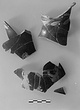
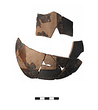
| Fragment of body of oinochoe. Head of young satyr wearing ivy garland bound with a ribbon of added white. Relief contour for profile.
Much added from sherds:
a) Three pieces joining above and to left ... 2 May 1939 |
| Eleven pieces comprising two non-joining fragments. To Young's publication of six pieces are now added five more, two of which help to complete to inscription.
Part of the side wall with reserved panel ... 600 B.C ... Also strange is άναχτι instead of ανακτι although this is perhaps an early example of the Attic tendency to aspirate stops: cf. C. D. Buck, The Greek Dialects, Chicago, 1955, pp. 60-61.
... The ends of the three horizontals of the initial epsilon are preserved at the right edge.
Young would take the verb to be equivalent to έγραφσεν and translate the whole, "Androg ... , son of D ... ,made (i.e. wrote) ... Jameson ,δράω should have more force, referring possibly to the performance of a rite, as it does in I.G., I, 4. The length of the lacuna at the end of line 2 and beginning of line cannot be determined but it seems clear that we are dealing with amore complex text that one involving the simple fact of writing.
|
|
|