|
|
Half of rim and wall restored; burned.
Small, high foot, somewhat damaged in production; flat resting surface; flat underside. Very shallow plate with convex wall with angle at top. Shallow groove on ... Ca. 250 ... Young 1951b, no. 9:3, p. 126, pl. 52:c. |
Mended from twenty-seven fragments, a few gaps restored; slight burning.
Rounded bottom. Lower wall pared. Traces of glaze near handle on rim. Hard, brown household fabric (7.5YR 5/4).
Similar: P 18585 ... 300-270 |
Parts of foot restored.
Sharply defined, flaring foot; beveled resting surface; pointed underside with unglazed patch. Upper and lower body meet at angle.
Old-man-mask thumb rests. Opposing olive garland ... 275-250 |
Mended from four pieces; slightly burned.
Slightly concave underside with string marks. Wall concave near base.
Reddish yellow fabric (ca. 7.5YR 6/6); unglazed.
Similar: P 18461--P 18463 (Young 1951b, ... 300-250 |
Mended from sixteen fragments, with two areas restored; burned.
Small, slightly concave bottom with string marks. Very thin wall, slightly concave above base. Hard, pinkish gray fabric (7.5YR 6/2) with ... 290-250 |
Mended from thirteen fragments, with a few gaps restored; burned.
Flat underside with slight string marks. Fairly deep body, slightly concave below rim. Prominent wheel ridging inside. Handles tightly ... 290-250 |
Handle and one fourth of body restored; burned.
Raised base, flat underneath. Irregular, ovoid body. Nearly cylindrical neck. Broad groove and ridge below plain rim. Trace of ivy garland in glaze on neck ... 275-250 |
One handle, foot, and parts of wall restored.
Nearly hemispherical lower body with scraped groove at greatest diameter. Concave upper body, nearly vertical. Ivy-leaf thumb rests.
Ivy garland running ... 275-250 |
Less than half of rim and small part of wall preserved; restored.
Plain convex wall. Narrow rim does not project. Shiny black-to-brown glaze with metallic patches, on floor only ... Ca. 275? |
About one-fourth of rim and wall restored.
Flat, narrow resting surface; nippled underside. Projecting, nearly horizontal rim. Metallic black glaze on floor only, stacking circle ... 275-250 |
Intact.
Mold for handle with short, flaring spur. Exterior pared, then smoothed. Micaceous, reddish yellow fabric (5YR 6/6).
Shape of spur as 20 and P 18456 (Young 1951b, no. 13:2, p. 129, pl. 54:a [C ... 290-260 |
Bowl (b) mended from five fragments, lid (a) from three fragments, with a few chips missing; burned.
Flaring foot, slightly concave with string marks underneath.
Horizontally projecting flange. Low, ... 270-260? |
Mended with missing pieces restored in plaster and painted. Handle completely restored. Thin, reddish wash on inside. H. 0.12; diam. 0.094. R. S. Young, Hesperia 20, 1951, pl. 77:c, d; Choes and Anthesteria, ... Ca. 400 B.C. |
Nothing of sides or bottom. Disk: long-beaked bird and a rearing animal (wolf?) facing each other across filling hole; rim: leaved tendril.
According to R. S. Young the scene on the disk is from one of ... 5th c. A.D. |
Thin, rough slab of hard, gray limestone. Upper, lower, and left sides roughly smooth, right side broken away; inscribed face smooth, back face rough.
In center of slab, running left to right, the letters ... 7th c. B.C.? |
One handle restored.
Scraped groove in resting surface; concave underside. High, slightly concave stem. Tapering upper body. Rising, flaring spurs.
Lustrous black glaze. Illegible graffito under foot ... Ca. 275 ... Also similar: P 18456 (Young 1951b, no. 13:2, p. 129, pl. 54:a [C 17:2]), P 20859 (D 17:3). |
Three of the legs restored.
Mane pinched to a sharp, straight ridge; tail applied against left rear leg. Faint traces of glaze show that the horse was glazed over most of its body, with reserved band ... 7th c. B.C. |
Intact.
Slightly concave underside with string marks. Rim slightly offset from floor. Thin glaze, mottled red to brown. Two kappas incised on floor before glazing.
Other glazed saucers of about this ... 325-300 |
Stroke polishing on neck.
Unglazed and handmade.
Small, unpainted votives are found in great quantities at many sanctuary sites. Only about 100 were saved from the dump on Hymettos, although the total ... 8th-7th c. B.C. |
One handle, over half of upper body, and part of lower body and foot restored.
Scraped groove in resting surface; concave underside with nipple.
High, slightly tapering stem. Cylindrical upper body ... 275-260 ... Similar but smaller: P 18456 (Young 1951b, no. 13:2, p. 129, pl. 54:a [C 17:2]).
... Braun 1970, no. 78, p. 139, pl. 56:4; Adriani 1952b, grave 20, no. 1, p. 147, pl. LV:3, with coin of Ptolemy II. |
| Fragment of body of oinochoe. Head of young satyr wearing ivy garland bound with a ribbon of added white. Relief contour for profile.
Much added from sherds:
a) Three pieces joining above and to left ... 2 May 1939 |
Pan.
Floor and part of wall.
Cup rests on ridge; slightly convex underside. Conical profile; five grooves preserved on exterior. Emblem surrounded by two to three scraped grooves. Bust of Pan, with head ... 240-200 |
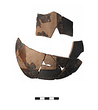
Four non-joining fragments, a and b of top side and side, c and d of top side. Thin brownish glaze on inside. Surface slightly abraded on reserved areas. Reserved band just below shoulder. Est. diam. 0.09; ... Ca. 430 B.C ... Four non-joining fragments, a and b of top side and side, c and d of top side. ... Est. diam. 0.09; max. dim. a) 0.093, b) 0.064, c) 0.047, d) 0.032. R. S. Young, Hesperia 20, 1951, pl. 80:5 (fragments a, b).
|
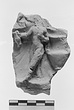
| On the front a raised ground line; on it, a nude young walking left, a pitcher in his right hand and in his left a shallow cup (?). Behind him a large krater.
Flattened behind, broken off all around.
No ... 18 April 1947 |
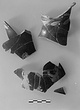
| Eleven pieces comprising two non-joining fragments. To Young's publication of six pieces are now added five more, two of which help to complete to inscription.
Part of the side wall with reserved panel ... 600 B.C ... Line 1: Ανδρογ[---] ho Δ[..]ιες
Line 2: τοι Δι τ΄άναχτι hισ-
Line 3: έδρασεν
Line 1 contains a proper name, Androg ... , followed by a patronymic or an ethnic. ... Also strange is άναχτι instead of ανακτι although this is perhaps an early example of the Attic tendency to aspirate stops: cf. C. D. Buck, The Greek Dialects, Chicago, 1955, pp. 60-61.
... Line 2 breaks off with hισ[---]which suggests a form of ίστημι,although the present tense would be odd.
Line 3 continues boustophedon from line 2 and preserves only one word,έδρασεν. |
|
|