|
|
One handle restored.
Scraped groove in resting surface; concave underside. High, slightly concave stem. Tapering upper body. Rising, flaring spurs.
Lustrous black glaze. Illegible graffito under foot ... Ca. 275 |
Mended from four pieces; slightly burned.
Slightly concave underside with string marks. Wall concave near base.
Reddish yellow fabric (ca. 7.5YR 6/6); unglazed.
Similar: P 18461--P 18463 (Young 1951b, ... 300-250 |
Nothing of sides or bottom. Disk: long-beaked bird and a rearing animal (wolf?) facing each other across filling hole; rim: leaved tendril.
According to R. S. Young the scene on the disk is from one of ... 5th c. A.D. |
Three of the legs restored.
Mane pinched to a sharp, straight ridge; tail applied against left rear leg. Faint traces of glaze show that the horse was glazed over most of its body, with reserved band ... 7th c. B.C. |
Stroke polishing on neck.
Unglazed and handmade.
Small, unpainted votives are found in great quantities at many sanctuary sites. Only about 100 were saved from the dump on Hymettos, although the total ... 8th-7th c. B.C. |
Thin, rough slab of hard, gray limestone. Upper, lower, and left sides roughly smooth, right side broken away; inscribed face smooth, back face rough.
In center of slab, running left to right, the letters ... 7th c. B.C.? |
About half of rim restored.
Flat resting surface; abrupt transition from foot to slightly pointed underside. Convex wall with pronounced offset below rim. Narrow rim slopes down to inside. Thin, dull ... Ca. 300 |
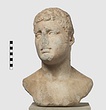
| A large piece missing at the back and left. Nose and mouth battered, ears chipped. Along the break, from the top of the head, is a vertical pinhole with traces of iron stain.
The wear on front and back ... Early Flavian period. |
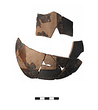
| Eleven pieces comprising two non-joining fragments. To Young's publication of six pieces are now added five more, two of which help to complete to inscription.
Part of the side wall with reserved panel ... 600 B.C. |
|
|