|
|
Parts of wall restored.
Flaring ring foot with rounded contours; beveled resting surface; pointed underside. Deep lower body. Groove under glaze at greatest diameter. Concave, inclined upper body. Slave- ... Ca. 250 ... Young 1951b, no. 9:2, p. 125, pl. 52:c (wrongly captioned no. 1). |
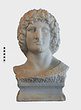
| A youth with flowing locks facing slightly to the proper left. The type is that of 'Eubouleus'.
Unfinished: areas to be drilled left rough.
Seven measuring points: two in hair over temples, one in chin, ... 25 June 1959 |
Mended from four pieces; slightly burned.
Slightly concave underside with string marks. Wall concave near base.
Reddish yellow fabric (ca. 7.5YR 6/6); unglazed.
Similar: P 18461--P 18463 (Young 1951b, ... 300-250 |
Handle and one fourth of body restored; burned.
Raised base, flat underneath. Irregular, ovoid body. Nearly cylindrical neck. Broad groove and ridge below plain rim. Trace of ivy garland in glaze on neck ... 275-250 |
About half of rim restored.
Flat resting surface; abrupt transition from foot to slightly pointed underside. Convex wall with pronounced offset below rim. Narrow rim slopes down to inside. Thin, dull ... Ca. 300 ... Offset of wall as on 791, 792, P 20144 (Young 1951b, no. 12:5, p. 128, pl. 53:c [B 17:5]), P 6967 (D--E 8--9:1). |
Intact.
Slightly concave underside with string marks. Rim slightly offset from floor. Thin glaze, mottled red to brown. Two kappas incised on floor before glazing.
Other glazed saucers of about this ... 325-300 ... Thompson 1940, pp. 134--135, fig. 99:c [G 12:20]), P 19060 and P 19062 (Young 1951b, nos. 4:17, 19, p. 119 [B 18:1]), P 4457 (F 11:2, upper fill). |
Thin, rough slab of hard, gray limestone. Upper, lower, and left sides roughly smooth, right side broken away; inscribed face smooth, back face rough.
In center of slab, running left to right, the letters ... 7th c. B.C.? |
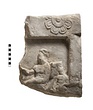
| Part of right side of relief from grave monument with half of one rosette above deep inset panel, and right anta, preserved.
Small figures in relief: seated on klismos is a bearded man with bare, muscular ... Possibly 1st c. B.C. |
One handle, over half of upper body, and part of lower body and foot restored.
Scraped groove in resting surface; concave underside with nipple.
High, slightly tapering stem. Cylindrical upper body ... 275-260 ... Similar but smaller: P 18456 (Young 1951b, no. 13:2, p. 129, pl. 54:a [C 17:2]).
... Braun 1970, no. 78, p. 139, pl. 56:4; Adriani 1952b, grave 20, no. 1, p. 147, pl. LV:3, with coin of Ptolemy II. |
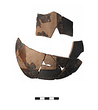
Four non-joining fragments, a and b of top side and side, c and d of top side. Thin brownish glaze on inside. Surface slightly abraded on reserved areas. Reserved band just below shoulder. Est. diam. 0.09; ... Ca. 430 B.C ... Four non-joining fragments, a and b of top side and side, c and d of top side. ... Est. diam. 0.09; max. dim. a) 0.093, b) 0.064, c) 0.047, d) 0.032. R. S. Young, Hesperia 20, 1951, pl. 80:5 (fragments a, b).
|
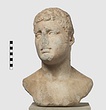
| A large piece missing at the back and left. Nose and mouth battered, ears chipped. Along the break, from the top of the head, is a vertical pinhole with traces of iron stain.
The wear on front and back ... Early Flavian period. |
| Eleven pieces comprising two non-joining fragments. To Young's publication of six pieces are now added five more, two of which help to complete to inscription.
Part of the side wall with reserved panel ... 600 B.C ... Letters incised deeply but not too carefully with a blunt point.
Line 1: Ανδρογ[---] ho Δ[..]ιες
Line 2: τοι Δι τ΄άναχτι hισ-
Line 3: έδρασεν
Line 1 contains a proper name, Androg ... , followed by a patronymic or an ethnic. ... Also strange is άναχτι instead of ανακτι although this is perhaps an early example of the Attic tendency to aspirate stops: cf. C. D. Buck, The Greek Dialects, Chicago, 1955, pp. 60-61.
... To the right of the end of line 1 is a lone four-barred sigma, larger and more deeply cut than the letters of the inscription. |
|
|