|
|
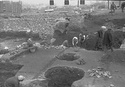
Abandoned digging at 6.25m. due to water level. Tile well could be associated with a bit of late Roman wall to the south, with floor level about one meter above that of pebble floor. Well tiles were not ... 14-22 April 1948 ... Well I |
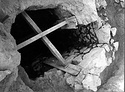
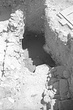
Well I: archaic. On the northwest slope of the Acropolis below the Klepsydra. Diameter ca. 1.10m. Water level ca. -9.50m. Substantial use filling in the lower 0.75m. In the upper debris filling both the ... End of 6th c. B.C. - Early Byzantine ... Well I in ΟΑ |
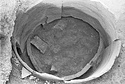
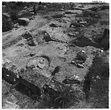
| A tile lined well under Room I of Byzantine House.
A concrete shaft belonging to the mill cut off the top of the well and left in place 3 complete sets of tiles and most of a fourth set. All but the lowest ... 17-18 c. A.D ... A tile lined well under Room I of Byzantine House.
A concrete shaft belonging to the mill cut off the top of the well and left in place 3 complete sets of tiles and most of a fourth set. |
Well at 74/Ι, on the lower north slope of the Areopagus.
Use fill from early 1st to 3rd c. A.D.
Dump fill from 4th c. A.D. Coins
9 April 1938 #2
9 May 1938 #1 Container 20 (lost) p. 1529 ... 1st c. to 3d c. A.D ... Roman Well at 74/I |
| Well at 52/Ι, on the lower northeast slopes of the Areopagus. It was cut down and re-used in the late Roman period, in connection with the water channel. Use fill of 1st to early 2nd c.
Dump fill 5th to ... Early to Late Roman ... Roman Well at 52/I |
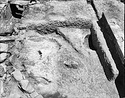
| Located in Middle Stoa, west, south aisle, beneath pressure pipe (cf. A 4900). The siting of the well is remarkable in its proximity to Well I 13:3, also Geometric in date, which was found in 1968 only ... Second half of 8th c B.C ... The siting of the well is remarkable in its proximity to Well I 13:3, also Geometric in date, which was found in 1968 only some 1.70m to the northwest (under the Klepsydra Drain).
|
Well at 62/ΙΑ, 63/ΙΑ, at the northwest foot of the Areopagus. Use filling in the lowest meter of the shaft.
The upper part of the shaft was filled with clay containing only occasional fragments of pottery; ... Ca. 600-540 B.C ... Well at 62/ΙΑ, 63/ΙΑ, at the northwest foot of the Areopagus. ... T 80 from Roman fill above well.
Apparently the well was in use by a household both careful and conservative for something over two generations ... Note that pp. 70 and 76 are in NB. I, ΣΤ not ΣΤ'.
"In notebook references this well has been commonly placed in 62/ΙΑ. |
Homer A. Thompson ... Well at the northwest foot of the Areopagus. Use filling of the Roman period. After the abandonment of the well and the collapse of the well-curb, the upper 2m of the shaft were filled with a dump apparently ... 1st-3rd c. A.D., 5th century ... Well at the northwest foot of the Areopagus. ... After the abandonment of the well and the collapse of the well-curb, the upper 2m of the shaft were filled with a dump apparently dug up from nearby. ... Same deposit with I 16:2. |
Well at 75/ΚΖ (75/ΚΗ, 76/ΚΣΤ-ΚΖ). A dumped filling; an accumulation for the most part of the late 6th and early 5th centuries.
Tiled well; of the lining only a single set of tiles, of unusual make, remained ... Ca. 450-425 B.C. |
A late curbed well. The filling consisted of clay and small stones. The sherds were uniform from top to bottom and appear to be late Byzantine. From measurements in notebooks (pp. 340, 729), S 2855 is ... Late Byzantine |
Near the SW corner of the market square beneath the north part of the Heliaia (?).
No clear distinction in the filling, either of date or of character, could be observed but the presence of a number of ... Ca. 625-570 B.C. |
Coins:
16 April 1934 #2
17 April 1934 #1 ... Late Roman- Ca. A.D. 400 |
Digging terminated at 14.50m. due to falling bedrock. Scanty pottery remains at 10.00m. In the mouth and upper part of the shaft was a heavy dumped filling of much shattered fragments, for the most part ... Last quarter of 5th c. B.C. |
Well east of Geometric Grave. The upper part collapsed into a pit, cut into by Middle Geometric grave I 18:1 and by a Byzantine wall. Some evidence for period of use; little pottery. At the top a few Geometric ... Early Protogeometric ... Well east of Geometric Grave. The upper part collapsed into a pit, cut into by Middle Geometric grave I 18:1 and by a Byzantine wall. ... At the top a few Geometric sherds, perhaps displaced from I 18:3. |
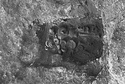
| Laura Gawlinski ... Well in courtyard of Early Building I, adjacent to wall of Room B. Tile lined; upper course in situ, lower two collapsed probably in antiquity. Letters inscribed on rims (eta, phi, omicron, theta). Medium ... First quarter of the 4th c. B.C ... Well in courtyard of Early Building I, adjacent to wall of Room B. ... Well contained three main dumped fills: a slightly later fill perhaps for leveling after filling settled (Layer I and perhaps Layer II), a fill with ceramic and some stones (Layer III and perhaps Layer II), and a fill with large stones, tiles, and collapsed well lining (Layer IV).
Layer I 58.03-57.40m., softer brownish fill
Layer II 57.40-57.16m., sandier fill with streaks of charcoal
Layer III 57.16-56.24m, similar to Layer II, increase of stones and tiles
Layer III/IV 56.24-56.07m., transition between fill of Layer III and Layer IV
Layer IV 56.07-54.94m., fill primarily consisting of large stones, tiles, and collapsed well lining (little soil or ceramic) |
| At the northwest foot of Areopagus. Square stone-curbed well with no clear evidence for a period of use; appears to be a single dump ... Ca. 500 B.C. |
| Well I: PG, ELS. The collapsed well north of the Middle Stoa Terrace. This pit, or shallow well, into which a Turkish storage pit lined with stones was set, produced purely Proto-Geometric pottery and ... Protogeometric ... Well I: PG, ELS. The collapsed well north of the Middle Stoa Terrace. This pit, or shallow well, into which a Turkish storage pit lined with stones was set, produced purely Proto-Geometric pottery and one Mycenaean figurine ... From the disturbed filling overlying mouth of well, P 26312. |
Well beneath 4th c. Klepsydra Drain, within foundations of west end of the Middle Stoa. Diameter 0.90m, cut through bedrock, with handholes on sides. Top 4.50m. dumped fill; 4.50-6.15m. period of use ... Mid-8th c. B.C. |
| Well west of the Eponymous Heroes monument. The shaft was of irregular width (ca. 0.81m where the full circle was first preserved), sunk in soft bedrock clay much of which had collapsed around the top ... Ca. 600-550 B.C. |
Late (Turkish) well at Northeast corner of porch of Metroon ... Turkish |
Nbp. 3104: When dug, the fill of the well divided itself into 3 deposits.
Objects catalogued from the "earth" are: L 4838, P 21602, P 21603, P 21604. Dumped filling of Turkish times. Coins:
17 May 1937 ... Late 6th-7th c. A.D. |
After the abandonment of the well and the collapse of the well-curb, the upper 2.00m. of the shaft were filled with a dump apparently dug up nearby. Material for the most part of the 5th c. B.C. but containing ... 7th c. A.D. |
Coins:
3 June 1932 #1
8 June 1932 #1-#9 ... 5th c. A.D. |
Coins:
8 June 1932 #2-#9
9 June 1932 #1-#14
10 June 1932 #1-#13
11 June 1932 #1-#9
13 June 1932 #1-#3, #6 (dump) ... 1st-3d c. A.D. |
Cistern to N of well in Room 9 of South Stoa I.
The well apparently cut through some cistern or early cavity which the builders of the well filled with whole amphorae and stones. We did not remove all ... 7 July 1967 ... Cistern to North of Well in Room 9 of South Stoa I |
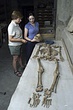
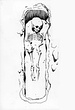
| Eugene Vanderpool ... Rectangular pit, oriented east-west, cut party into filling of Early Protogeometric pit-well (I 18:4), to a preserved depth of about 0.30m. A late Byzantine wall founded below the floor of the grave destroyed ... Middle Geometric I ... Rectangular pit, oriented east-west, cut party into filling of Early Protogeometric pit-well (I 18:4), to a preserved depth of about 0.30m. ... In what survived of the west end of the tomb pit was found the well-preserved lower half of the skeleton, oriented east-west, cranium originally to the east. ... In the process of studying the skeletal material, the fragmentary remains of two further individuals were noted, including the secondary or disturbed remains of an adult inhumation (AA 52b), as well as those of a cremated adult (AA 52c). the position or even presence of these two individuals was not noted in the field, and both are probably intrusive, particularly as the grave was disturbed by later activity.
|
Turkish sherds from this level. No tins of pottery ... August 1951 |
Estimated Grid ... Late 2nd c. A.D. |
Coins:
23 April 1937 #1-#16 d22.80m. (bottom)-22.25m.d ... 2nd. c. B.C. POU |
Pit I at 45/ΙΘ (= Well) (noted also 4th c. pocket in side of this pit).
This is part of the Terracotta Deposit (H 17:4) and the objects listed here are also listed in H 17:4. Containers/lots for this ... Geometric-Protoattic ... Pit I at 45/ΙΘ (= Well) (noted also 4th c. pocket in side of this pit).
|
Nbp. 3104: Container includes a miscellaneous accumulation of Greek and Roman pottery with some fragments of Byzantine brown glaze. No joins were observed between this layer and Layer II ... 16-24 May 1937 |
| Pyre in Horos Terrace Trench, East end, set into Strosis 5.
In room 1 (court), near north wall. Concentration in stratum, no pit discerned; described as a "little nest of pots" within layer V (Lot ΜΣ ... 350-325 B.C. |
Well cut through cistern at 6/ΝΕ (C 9:7).
The stele I 3244 in position in the cistern over the mouth of the well is listed with the cistern deposit C 9:7. Coins:
26 February 1936 #2-#4
27 February 1936 ... A.D. 1st ... Well cut through cistern at 6/ΝΕ (C 9:7).
The stele I 3244 in position in the cistern over the mouth of the well is listed with the cistern deposit C 9:7. |
| David Scahill ... Burial in Geometric well (J 3:8), in Classical Building II, Room I, next to south ashlar wall. "No grave goods!"
ADDENDA: J. Papadopoulos later associated P 34449 and P 34450 to that grave. (Cf. Agora ... Geometric ... Burial in Geometric well (J 3:8), in Classical Building II, Room I, next to south ashlar wall. |
| Homer A. Thompson ... (Grave XXX: EG)
Rectangular cutting with burned bones of a female 40-45 years old, and both burned and unburned pottery fragments.
Rectangular trench, measuring approximately 0.80m long, 0.40m wide, with ... Middle Geometric I |
| Tom Milbank ... An unlined and relatively narrow (ca. 0.82m. in diameter) well cut through hard-pack and bedrock. Although three periods of use can be discerned in the stratigraphy of the well below a depth of ca. 5.47m., ... Middle Geometric I |
A well on the NW slope of the Areopagus; unfinished well-shaft dug to a depth of only 3.05m., and refilled with broken pottery and other debris. The shaft clearly was begun with the intention of digging ... Ca. 520-480 B.C ... A well on the NW slope of the Areopagus; unfinished well-shaft dug to a depth of only 3.05m., and refilled with broken pottery and other debris. The shaft clearly was begun with the intention of digging a well, since footholds were cut in the sides; the reason for the abandonment was not clear; the rock appeared quite suitable for well-sinking. ... Lots ΓΓ 499-501: Top to -1.75m (Fill I), black glaze fragments.
|
Well at 67/ΛΓ on the northeast slope of the Areopagus. Connected with the same cistern system as O 20:2.
Dug as several fills but probably a continuous accumulation Coin
28 May 1938 #1 (?) Illegible N ... 300-250 B.C. |
Well cut through cistern at 40/Θ on Kolonos Agoraios (E 11:1). Two use periods plus an upper dumped fill from which the following objects: B 319, I 3994, SS 5745, T 1235. Coins:
6 April 1936 #18-#21
7 ... First half of 1st c. A.D.
4th-early 5th c. A.D ... Well cut through cistern at 40/Θ on Kolonos Agoraios (E 11:1). Two use periods plus an upper dumped fill from which the following objects: B 319, I 3994, SS 5745, T 1235. |
Well at 69/ΟΒ (Late 5th c.)
Lower fill dated to 420-400 B.C. in Agora XXX.
There were no use filling and the well was apparently not a success as a water-supply: there was no concentration of water-jars ... 420-400 B.C ... Well at 69/ΟΒ (Late 5th c.)
... There were no use filling and the well was apparently not a success as a water-supply: there was no concentration of water-jars at the bottom and no water encountered in digging.
... I can't find out what M 20:3-S is (Cf. |
Well dug through cistern at 64/Γ. Seems to have been stratified; four fills recorded but here treated as one as divisions are rather "arbitrary".
Agora V, p. 126: Constructed in late 1st c.; use filling ... 3rd c. A.D. POU (before 267 A.D.) |
| Well cut into bedrock, associated with late Roman building G in ΕΛ 1.2m in diameter, narrows to 0.5m at bottom. Disturbed by later pits at top. Excavated from 85.77-79.25m (6.52m), but bedrock at 85.91m ... Late 4th/early 5th AD ... Well cut into bedrock, associated with late Roman building G in ΕΛ 1.2m in diameter, narrows to 0.5m at bottom. ... Layers:
I. (85.77-84.94m) mixed rocky fill.
|
Well at 19/ΚΔ, beneath the west colonnade of the Square Market Building in the northeast corner of the Agora. Diameter ca. 1.25m. Water level ca. -3.50m. The construction of the well was rather careless, ... Ca. 580-560 B.C ... Well at 19/ΚΔ, beneath the west colonnade of the Square Market Building in the northeast corner of the Agora. ... In the mouth of the well was a small amount of supplementary fill (425-400 B.C.) ... Baskets I and II found 7 April 1938
Basket IV and mud found 14 April 1938 |
Roman well, stratified.
Finds from the earth (not recorded in a subdivision):
P 7995, P 8036, P 21834, SS 6338, IL 483, IL 486, BI 309, BI 310,
BI 314.
According to the excavator the shaft had been cleaned ... 2nd-4th c. A.D ... Roman well, stratified.
Finds from the earth (not recorded in a subdivision):
P 7995, P 8036, P 21834, SS 6338, IL 483, IL 486, BI 309, BI 310,
BI 314.
... The well might for some reason have been used only sparingly or it might have been equipped with a metal bucket which was used in preference to clay jars on most occasions ... Subdivisions:
.1=Fill I
.2=Fill II
.3=Fill III
.4=Fill IV
.5=Fill V
.6=Fill VI |
Accumulated debris on the west side of the market square.
Related layers added 1999/2000 (JWH), e.g. "Gravelly layer above burning", "Clearing Classical floor", "Lowest level above bedrock", "Below burning", ... First half of 5th c. A.D. |
Roman Group L.
Layer I (cont. 59-64) Pre-Herulian second half of 3rd c. (bottom, 15.95-13.90).
Layer II (cont. 42-58) 4th c.-first quarter of 4th c. (11.90-13.90).
Layer III (cont. 17-41) -4th c. (10.00 ... Second half 3rd c.-early 5th c. A.D. |
Found while excavating Stoa Pit E in 1933. See also I 849 (Ε 329) found in the North Well in Stoa Pit E (Deposit H 9:1). Fragment Ε 496 of this inscription, listed with the finds of H 10:6, is likely from ... 8-10 May 1933
17 May 1935
18-26 May 1937 ... See also I 849 (Ε 329) found in the North Well in Stoa Pit E (Deposit H 9:1). Fragment Ε 496 of this inscription, listed with the finds of H 10:6, is likely from the dump of the North Well. |
| Well cut into bedrock under late Roman building in ΕΛ. 1.2m in diameter with small cutting of unclear function at south edge about 0.2m wide. Walls cut straight down, tapering near bottom to 0.8m. Footholds ... Late Archaic ... Well cut into bedrock under late Roman building in ΕΛ. 1.2m in diameter with small cutting of unclear function at south edge about 0.2m wide. ... Layers:
Hellenistic fill under Roman floors
I.(86.34-85.93m) rubble
II.(85.93-85.58m) dark brown rubble
III.(85.57-85.30m) more stony rubble
IV.(85.30-84.80m) very rocky, almost sterile, increase of clay and sand
V.(84.80-84.03m) less rocks, almost sterile, increase of clay and sand
Late 6th/early 5th B.C dumped fills
VI.(84.03-82.64m) mix of clay and sand deposits, dog skulls
VII.(82.64-81.79m) mostly sand
VIII.(81.79-81.39m) light brownish-grey clay, almost sterile
IX.(80.39-80.99m) mix of grey clay, brown clay and sand, much ceramic
X.(80.99-80.24m) sandy, more ceramic
XI.(80.19-77.74m) sandy, enormous stones (some 100kg+). A "contamination layer" was excavated after layer X because heavy rains refilled the well.
XII.(77.74-75.71m) clay with sand, even more ceramic, ,burned rocks and sherds; pigment and wood
XIII.(75.71-74.84m) crushed bedrock and marl, wood (bucket), large shells, little ceramic, pigment. |
| Brian Martens ... Located in the southern section of Room I, now bound by the scarp of Wall U at the north,, the scarp of Wall L at the east,, and a modern pit at the south. At its now low elevations, excavated in the 2015 ... Third quarter of 5th c. B.C. |
Well shaft cut through a cistern channel which was then packed with three amphorae (P 3123, P 3125, P 4201) of 1st or at latest early 2nd c. A.D. (These three amphorae could be considered with F 15:2) ... 3rd-4th c. A.D ... Well shaft cut through a cistern channel which was then packed with three amphorae (P 3123, P 3125, P 4201) of 1st or at latest early 2nd c. ... Objects SS 2040, SS 2041, SS 2043, P 3143, P 3144, MC 73, I 1454 are included with F 15:2, cistern fill (pp. 81, 573).
... The excavator believed the well had never been tiled and that lower fill was POU. |
Well at U/10-14/4, in Byzantine Room I.
Well is ca. 1.20m in diameter, dug into bedrock. Excavated to depth of roughly -8.00m; sides started collapsing and thus did not dig to full depth. Some stone-lining, ... June 15-16, 17-31 July 1972 ... Well at U/10-14/4, in Byzantine Room I.
Well is ca. 1.20m in diameter, dug into bedrock. ... A much used marble well-head was found collapsed into well midway down period of use fill and a fragment of a ceiling coffer from the Temple of Ares.
|
Debris, Room I of Street Stoa (R/16,20-13/10,15).
The lack of any rooftiles and similar architectural debris suggests that perhaps it was brought in from an adjacent area and dumped in the room. This is ... 6-8 May 1975 ... Debris, Room I of Street Stoa (R/16,20-13/10,15).
... This is further suggested by the fact that the debris rested not on the floor but on bedrock dressed down to ca. 65.80m, well below the level of the threshold block. |
Tiled Well in Square Building Foundations, equipped with evenly spaced hand-holds, with a good supply of water. There was no period of use represented and the dumped fill consisted mostly of chunks of ... Third quarter of 4th c. B.C ... Tiled Well in Square Building Foundations, equipped with evenly spaced hand-holds, with a good supply of water. There was no period of use represented and the dumped fill consisted mostly of chunks of bedrock, with many fragments of pebble mosaic and a few marble chips; the pottery was extremely scanty and very fragmentary. the well had been intentionally filled and carefully covered over a large slab in preparation for the foundations of the Square Building over it ... 31 August 1954 the marble slab (I 6694) was found pp. 4107-4109 |
| Extract from notebook ΠΘ XIX, pp. 3644-3646. Well at 105/ΝΗ (report on sorting of pottery, July 19, 1951 - H.S. Robinson).
"Not a useful well" HSR.
Well dug to 1.50m., vi/9/36; dug from 1.50m. to bottom ... Early Roman; use fillings of 2nd. c. B.C. and 1st. and 4th. c. A.D.; dumped filling of late 4th. c. (HSR)
Fill I: 2nd. c. B.C.
Fill II-V: to second half of 4th. c. A.D.
Fill VI: mixed to Byzantine ... Extract from notebook ΠΘ XIX, pp. 3644-3646. Well at 105/ΝΗ (report on sorting of pottery, July 19, 1951 - H.S. ... "Not a useful well" HSR.
Well dug to 1.50m., vi/9/36; dug from 1.50m. to bottom (22.80m.), iv/9/37 - iv/23/37. ... A.D. respectively, represent "period of use' of the well. For perhaps two centuries thereafter the well must have been out of regular use; cont. 4 (ca. 21.30m.) probably dates from this period and contains predominantly pre-herulian wares: wheel-ridged mugs and pitchers, type XXVII lamp frag. |
A cistern leading to the east of the road leading from the southwest corner of the market square. Filled all at one time, last quarter of 2nd. c. B.C. (nbp. 493).
Included are the Hellenistic finds from ... Late 2nd c. B.C ... Included are the Hellenistic finds from "north cistern arm" and "south cistern arm" as recorded from well 96/I: SS 2040, SS 2041, SS 2043, MC 73, I 1454, P 3143, P 3144. ... Coins:
6 March 1934 #1 (well 96/Ι in north cistern arm)
9 March 1934 #1
10 March 1934 #1-#9, #23-#24 (found in baskets from 94/Θ?)
|
Well C - Passage, belongs with II - Brick Shaft. All dumped fills. No objects catalogued from Well C of section ΟΑ. One object (I 5422) catalogued from modern fill in shaft, one from dump (I 5545). Coins: ... 2nd c. A.D.- Byzantine ... Well C - Passage, belongs with II - Brick Shaft. ... No objects catalogued from Well C of section ΟΑ. One object (I 5422) catalogued from modern fill in shaft, one from dump (I 5545). |
Except for A 2355 and I 3871, the other finds of 'upper fill' are actually from the 'change of fill' recorded on 24 April 1936, nbp. 1500. Coins:
19 March 1936 #1-#4
21 March 1936 #1-#2
24 April 1936 #5-#6 ... 16 March-24 April 1936 |
May be of Hellenistic origin when cistern system went out of use.
For a general note on the cistern see Nb. ΟΕ III, pp. 246 ff.
Objects from B 586 various depths (no subdivision): S 2324-S 2330,
P 34894, ... Late 2nd-early 6th c. A.D. |
Mycenaean Well (S/1,2-13/20,14/1). Underneath the NE Room of the Library of Pantainos, along its S side, as a cutting in bedrock containing reddish fill with bits of green bedrock. The feature is rectangular ... 30 June-23 July 1975 ... Mycenaean Well (S/1,2-13/20,14/1). ... The function of the well is unclear. The depth of the feature , in particular in comparison with wells in the same area, would indicate that the shaft was unlikely to have served as a well, unless the water table in this area changed dramatically between ca. 1500 and ca. 400 B.C.
... (layers I-III), Roman pottery from 66.10-65.00masl ? |
| James H. Oliver ... (E.L. Smithson: Grave IX: PG). Two children's skeletons one on top of the other. Cf. PD 329 for PD 430 for second skeleton, same deposit.
PG grave about 25m. SW of Cistern A at 46/ΜΔ.
[In some records, ... Developed Protogeometric |
Fillings associated with early houses on the lower north slopes of the Areopagus; various levels and dates.
Both houses were built in the 6th century B.C. and destroyed by the Persians; both also have ... 6rd c. B.C.-3rd c. A.D ... Southwest House, Rooms I-VIII, 42-55/ΚΖ-ΜΖ:
The earliest house had a court on the west with a Well (B) and two small rooms at the north. ... See also L 17:3 where objects SS 14318 and T 3576 are listed as part of the well deposit but are actually from the filling over the undug well, i.e. strosis 3, Room IV in Southwest House (nbp. 1393). |
|
|