|
|
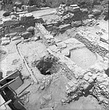
A well behind the Stoa of Zeus. Noted as the finding place of the bronze head of Nike, B 30.
Two Rhodian stamped amphora handles. Fragments of only two bowls ... 260-210 B.C ... Bronze Head Well |
Well L.
Use filling and well-head; abandonment filling chiefly of mud and stones, with a scattering of pottery ... ca. 575-550 B.C.-To early 5th c. B.C ... Well L.
Use filling and well-head; abandonment filling chiefly of mud and stones, with a scattering of pottery. |
Early Roman well with four fills.
fill 1: well sealed 1st. c. A.D.
fill 2: more bones than pots.
fill 3: nothing later than 1st. c. B.C.=POU
fill 4: similar to fill 3, a little earlier? Coins:
7 May 1940 ... Early Roman ... Early Roman well with four fills.
fill 1: well sealed 1st. c. ... Coins:
7 May 1940 #14 from fill around well head
29 July 1946 #1 said to be from well dump
SS 9562 from stone packing to west of well head |
Well in Stoa Terrace opposite Pier 2.
Diameter 1.10m. Well cut with steps on both sides. No water. was probably not much used, although part of a well head was found at 4.50m Estimated Grid ... Into 600-575 B.C ... Well in Stoa Terrace opposite Pier 2.
Diameter 1.10m. Well cut with steps on both sides. No water. was probably not much used, although part of a well head was found at 4.50m |
Well A
Mostly uniform dumped fill. use level probably late. The well head (A 2753) had evidently been broken up and thrown in as soon as the well went out of use. Dumped filling, second quarter of 7th ... 7th century B.C ... Well A
Mostly uniform dumped fill. use level probably late. The well head (A 2753) had evidently been broken up and thrown in as soon as the well went out of use. |
Tiled well, ca. 30m south of the Tholos. Associated with Building D. Hellenistic Group A with Late Roman fill in upper 3.00m. Objects A 245 and P 4597 are from fill on floor around well-head, contemporary ... 325-260 B.C ... Tiled well, ca. 30m south of the Tholos. ... Objects A 245 and P 4597 are from fill on floor around well-head, contemporary with upper fill but not in subdivision .1.
... Coins:
13 March 1933 #1 at well head (#2-#3)
21 March 1933 #1 (dump) (not a coin) |
This is associated with Building A. It had a circular marble well-head with a rectangular well slab beneath. The construction throughout was of well tiles. It produced little to a depth of -8.60m. Between ... 4th c. A.D ... It had a circular marble well-head with a rectangular well slab beneath. The construction throughout was of well tiles. It produced little to a depth of -8.60m. |
| Well in Room 7 of Roman House H, partially covered by caldarium of added bath complex (Room 6). Stone well-head; 0.85m in diameter. Stpped because of danger of collapse. Cut through bedrock, water from ... 6th c. A.D ... Well in Room 7 of Roman House H, partially covered by caldarium of added bath complex (Room 6). Stone well-head; 0.85m in diameter. |
Well at 115/ΜΘ.
Careful stone curbing around the upper walls, the presence of footholds in the sides, an adequate water supply and the fragments of a terracotta well-head in the filling indicate that the ... 600-550 B.C ... Well at 115/ΜΘ.
Careful stone curbing around the upper walls, the presence of footholds in the sides, an adequate water supply and the fragments of a terracotta well-head in the filling indicate that the well served as a water source, but only a few fragments of water jars give any direct evidence of a period of use. |
Well dug through N 18:1 (cistern at 79/ΜΗ) on the lower north slopes of Areopagus; the cistern was the northern chamber of a system; the southern chamber is at 84/ΝΣΤ (N 19:1).
A single dumped deposit ... 3rd-4th c. A.D ... Well dug through N 18:1 (cistern at 79/ΜΗ) on the lower north slopes of Areopagus; the cistern was the northern chamber of a system; the southern chamber is at 84/ΝΣΤ (N 19:1).
A single dumped deposit filled both the well-shaft and the cistern ... It included marbles, a window tile, a millstone, and a well-head as well as pottery and other objects: destruction debris. |
Well 2: archaic. Diameter, top ca. 1.00; bottom ca. 0.90m.
Water level:ca -7.00m In the use filling, along with the plain water pots was a black-figured neck amphora assigned to the Edinburgh painter ... Last quarter of the 6th c. B.C ... Well 2: archaic. Diameter, top ca. 1.00; bottom ca. 0.90m.
... Dumped filling consisting largely of mudbrick, broken rooftiles and other debris, along with a pithos-top well head.
An upper filling was not a dump, but a washed-in filling, containing a scattering of figured fragments. |
North of court F, around well head only. Deposit created by A.W. and first appears in his thesis (Biblio. below).
Cf. nbpp. 2204 and 2234 and lot 350 for court F and p. 2127 for north of court. Coins: ... 1st-2nd c. A.D ... North of court F, around well head only. Deposit created by A.W. and first appears in his thesis (Biblio. below).
|
| Well in West Colonnade of Roman House H. Covered by a large handsome marble well-head, apparently reused. Cut through bedrock. Diameter ca. 1.20m, water at -3.60m.
Two distinct POU fills. One at ca. -4.50m ... June-August 1970 ... Well in West Colonnade of Roman House H. Covered by a large handsome marble well-head, apparently reused. |
Courtyard Well (R/15-13/20).
The well went out of use as a result of the Herulian sack of 267 A.D. in the upper part of the well the well-head itself was found, one of the finest in the Agora collection ... 27 June-15 July 1975 ... Courtyard Well (R/15-13/20).
The well went out of use as a result of the Herulian sack of 267 A.D. in the upper part of the well the well-head itself was found, one of the finest in the Agora collection. ... Area Courtyard Well. Layer: Bottom POU. |
| A well in the industrial area of the Areopagus, about 7.00m. west of the West Bath, to a depth of 14.60m. This well was the direct successor to A 17:1, replacing it when it collapsed. The use filling at ... Second quarter 6th. c ... A well in the industrial area of the Areopagus, about 7.00m. west of the West Bath, to a depth of 14.60m. This well was the direct successor to A 17:1, replacing it when it collapsed. The use filling at the very bottom contained the black figured amphora P 18348 (Hesp. 17 (1948), p. 184, pl. 65, 1) and a well head (P 18853, Hesp. 18 (1949), p. 125, no. 8). |
Well south of the apse of Room 3, Roman House H. Cut through bedrock, diameter ca. 1.15m, stopped at ca. -10.80m because of danger of collapse. Water at very top, up to bottom of parapet between well and ... 2nd-4th c. A.D ... Well south of the apse of Room 3, Roman House H. ... Water at very top, up to bottom of parapet between well and Room 3. Secondary access from well-head outside apse, at a higher level ... A.D. The well apparently went out of use as such with the construction of Roman House H. |
| Initially uncovered with a diameter of c. 1.05m. Its south side extends under the south wall of the Classical structure and so clearly predates it. The highest preserved portion of the well shaft (at the ... 22 July-9 August 1994
26 June 1995
3-7 July 1995 ... The highest preserved portion of the well shaft (at the east) lies at an elevation of 51.03m above sea level. There is no well head, but a small portion of light clay bordering the preserved top of the shaft on the east side might indicate the contemporary ground level. ... Because the south side of the well shaft projects beneath the E-W Classical Wall at J/6,7-2/20, we attempted to leave undug the portion of the well fill that underlies that wall. |
Well at U/10-14/4, in Byzantine Room I.
Well is ca. 1.20m in diameter, dug into bedrock. Excavated to depth of roughly -8.00m; sides started collapsing and thus did not dig to full depth. Some stone-lining, ... June 15-16, 17-31 July 1972 ... Well at U/10-14/4, in Byzantine Room I.
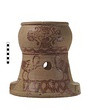
Well is ca. 1.20m in diameter, dug into bedrock. ... A much used marble well-head was found collapsed into well midway down period of use fill and a fragment of a ceiling coffer from the Temple of Ares.
|
| A well on the lower slope of the Hill of the Nymphs, (diam. 1.20m -water level -7m), to 7.90m. The scanty use filling at the bottom contained water jars and pitchers as well as the inventoried objects; ... Second quarter of 6th. c. B.C ... A well on the lower slope of the Hill of the Nymphs, (diam. 1.20m -water level -7m), to 7.90m. The scanty use filling at the bottom contained water jars and pitchers as well as the inventoried objects; above it was about 5.00m. of collapsed bedrock with no pottery whatsoever. The dumped filling, mixed with the broken bedrock above a depth of 2.40m., appears to be of the same date as the use filling, and yielded most of the inventoried objects - black figured and black glazed, as well as coarse ware, lamps, figurines, and loom weights; to be especially noted are a child's commode (P 18010, Hesp. 17 (1948), pp. 154-155), and an inscribed well head (P 18276, Hesp. 18 (1949), p. 125, no. 7). |
Well at 15/ΙΕ = Pocket in side of Turkish Pit at 15/ΙΔ.
Shallow well on the lower slopes of the Acropolis, east of the Panathenaic Way, in the area later occupied by the Archaic Building.
Located 3.5m ... 700-675 B.C. with intrusions ... Well at 15/ΙΕ = Pocket in side of Turkish Pit at 15/ΙΔ.
Shallow well on the lower slopes of the Acropolis, east of the Panathenaic Way, in the area later occupied by the Archaic Building.
... Household: Unglazed; double-yoked handle for large amphora ("cow's head handle"); amphora; utility amphoras; storage amphoras; kados; spouted kados; cooking ware; cooking jug; cooking stand; brazier; cooking ware basin; oinochoe; hydriai; bowl, deep spouted; lekane; large basin; coarse ware basin; pithos; incised coarse ware.
|
| Marcie Handler ... Located in the south section of Room E in the Byzantine Building east of the North-South Road. The uppermost 1.5 meters of well lining was built of well-coursed stones (some reused marble blocks) and tiles ... 12th c. A.D ... The uppermost 1.5 meters of well lining was built of well-coursed stones (some reused marble blocks) and tiles. Below, the well was lined with two courses of terracotta rings with footholds. ... The later phase of the well, a Byzantine well-lining and well-head, was excavated during the 2001 season (BZ XXV p. 4953, Lot BZ 1217) and the Roman catchment basin and well-lining down to the level of the terracotta lining were excavated during the 2002 season (BZ XXVII pp. 5279 & 5285 for the catchment basin; BZ XXVII p. 5293 for the Roman well-lining).
|
| Extract from notebook ΠΘ XIX, pp. 3644-3646. Well at 105/ΝΗ (report on sorting of pottery, July 19, 1951 - H.S. Robinson).
"Not a useful well" HSR.
Well dug to 1.50m., vi/9/36; dug from 1.50m. to bottom ... Early Roman; use fillings of 2nd. c. B.C. and 1st. and 4th. c. A.D.; dumped filling of late 4th. c. (HSR)
Fill I: 2nd. c. B.C.
Fill II-V: to second half of 4th. c. A.D.
Fill VI: mixed to Byzantine ... Extract from notebook ΠΘ XIX, pp. 3644-3646. Well at 105/ΝΗ (report on sorting of pottery, July 19, 1951 - H.S. ... "Not a useful well" HSR.
Well dug to 1.50m., vi/9/36; dug from 1.50m. to bottom (22.80m.), iv/9/37 - iv/23/37. ... A.D. respectively, represent "period of use' of the well. For perhaps two centuries thereafter the well must have been out of regular use; cont. 4 (ca. 21.30m.) probably dates from this period and contains predominantly pre-herulian wares: wheel-ridged mugs and pitchers, type XXVII lamp frag. |
| Grave 19 in notebook. Bones only AA 3.
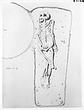
Length 2.15m; width 0.63m; depth 0.52m.
Woman' skeleton with head at north. Cover slabs piled at foot of grave, probably by the diggers of Well J 18:8, who rifled ... Late Geometric ... Woman' skeleton with head at north. Cover slabs piled at foot of grave, probably by the diggers of Well J 18:8, who rifled grave. |
Mycenaean Chamber Tomb W. of Circular Building (at Σ:30/ΛΕ?)
It had been badly disturbed by a fourth-century B.C. pit which cut into the northeast part of the chamber (rectangular, ca. 1.80m by 1.30m) ... Myc. III A 2 ... Only the one lying along the west edge of the chamber was well-preserved, with its head to the south, knees up, and with the pots at its feet. two more pots were found lying between this skeleton and the chamber wall. |
| N.A. Doenges Evelyn Lord Smithson ... "Near or in Grave" (width 0.50m)
Grave to the east of the southeast corner of the great court of the Gymnasium. Shallow and superimposed on Well N 11:5. It is a simple cist oriented north and south, with ... 750-725 B.C ... Shallow and superimposed on Well N 11:5. It is a simple cist oriented north and south, with the head on the north side. |
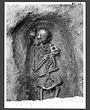
| John Camp ... Protogeometric grave (female inhumation) located about 0.60m northwest of T 15:1. It consisted of a roughly rectangular pit, with the corners slightly rounded, oriented approximately north-south. The pit ... "Submycenaean"/Early Protogeometric ... Within the pit, the well-preserved skeleton of a woman aged about 40-44 years at death was found laid out in a fully extended position on her back, head to the south. The left arm was across the waist, the right reaching up over the chest; the head was rolled over onto its right side, facing east.
|
| Rodney S. Young ... Grave 4 in notebook (E.L. Smithson: Grave XX: PG). Bones discarded. Grave of older child.
JP
Rectangular pit, cut into bedrock to a depth of 0.26m, approximately 0.97m long and 0.36m wide. Tomb oriented ... Late Protogeometric ... Tomb oriented east-west,head of the deceased to the east. a thin strosis of hard-packed redeposited bedrock mixed with much burned earth and many small stones was described as lying above and surrounding the tomb pit. ... The excavator noted that although the bones were "rather small", the teeth were "fairly large and well-developed" suggesting a child of rather "advanced years". |
| Eugene Vanderpool Homer A. Thompson ... Mycenaean Grave to W. of "Court Room" below Stoa Terrace with "Ballot Box" (Grave XXIX).
Unusual type, conforming neither to our pit nor to our cist graves, and consisted of two parts. The outer part was ... Mycenaean III A-B ... The cutting in bedrock was seen to extend well beyond the stones, forming a rectangular cist (1.50 by 2 by 0.90m deep). Along the north side lay a skeleton with head to the northeast, legs slightly flexed at the knees, and hands crossed over the chest.
|
|
|