|
|
Pit along house wall foundations to south = footing trench. Uncertain context, possibly no later than ca. 425 B.C ... 450-400 B.C. |
House K: Brown fill (publ. House U). Filling between terrace wall and house wall at the extreme west end of the Areopagus; a brown gravelly filling of early Roman date found here undisturbed but occurring ... Early Roman |
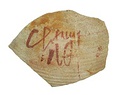
P.H. 1.98m; greatest diameter 1.70; wall thickness 0.20. The walls are of rubble set in clay, and the bottom is flat. Pottery was coarse Byzantine sherds but discarded except for one graffito ... 25 May 1956 |
Ca. 73-81/Drain. Fillings associated with the construction of the Great Drain South, especially the fill thrown in behind the east wall of the drain at the time of its building.
Cf. A 20-21:1 and B 19:7 ... Ca. 425-400 B.C ... Fillings associated with the construction of the Great Drain South, especially the fill thrown in behind the east wall of the drain at the time of its building.
... A 20-21:1 and B 19:7.
Cf. Hesperia 20 (1951), pp. 247, 256. |
Pit in House N, Room 2 (RSY, House C). Filling thrown in behind the west wall of the Great Drain South at the time of the building of the drain and the extension of House C.
Cf. Hesperia 20 (1951), pp ... Ca. 430-410 B.C. |
Well L: PG, ELS. Includes a displaced grave (K 12:2 bis). The pottery appears less consistent than that in the pit at 70/ΜΕ. Depth of well 6.25m. below the top of wall B. PD 2780 ... Protogeometric ... Depth of well 6.25m. below the top of wall B. |
Well (diameter shaft 0.95m) with POU and dumped fillings, separated by about 2.00m. of plain mud apparently fallen from the collapsed sides of the well. The fillings are, however, closely contemporary ... Ca. 425-400 B.C. |
RSY Grave A.
Under the Roman House with three rooms floored with mosaic near the southwest side of the area. The burial consisted of a pot laid on its side over the bedrock, presumably containing a child ... 7 August 1947 |
| Pyre in House C, Room 12 (RSY=Pyre 9) in the industrial area west of the Areopagus.
Notebook refers to House N.
Beside west wall of room 12. Pottery, burnt bone, and cinders in a roughly round pit; disturbed ... Ca. 250 B.C ... Beside west wall of room 12. Pottery, burnt bone, and cinders in a roughly round pit; disturbed by Byzantine pit. ... The pyre predates the fill of the cistern in the room (B 18:13), and it is therefore contemporary with continued activity there. |
| Pyre in House D, Room 4 (RSY=Pyre 4) in the industrial area west of the Areopagus.
Notebook refers to House N.
Pottery belongs late in third quarter of the 4th. c. BC. Pyre burned near beginning of last ... 350-300 B.C. |
| Pyre in House N, room 2, layer 5 (RSY=Pyre 8).
Near northern corner of room 6. Artifacts, bone, burnt logs, and cinders in square pit dug from level of layer 5, through layers 5 and 6; thin clay floor ... 325-300 B.C. |
| Pyre in House N, room 4 (RSY=Pyre 7), in the industrial area west of the Areopagus.
Pottery, mall pieces of calcined bone, log, wood cinders, and charcoal in diamond-shaped pit in floor sequence. The pyre ... Late 4th-early 3rd c. B.C. |
| Mycenaean tomb: Myc. III A:1-2.
SAI
Small rectangular chamber, 2.30m wide by 1.80m deep,, entered from the east through a dromos 1.10m wide which contracted to a doorway 0.92m. wide. the doorway preserved ... 2nd half of 14th c. |
Double Well by Entrance to Square Building (Well B)
Wall A (R 9:2) was Late Geometric or transitional well, into one-half of which a bothros had been sunk in Turkish times (16th c. A.D.)-R 9:3.
This bothros ... ca. 17th century A.D ... Double Well by Entrance to Square Building (Well B)
Wall A (R 9:2) was Late Geometric or transitional well, into one-half of which a bothros had been sunk in Turkish times (16th c. ... This bothros was lined on the side of the Geometric well by a wall made of rough stones and pink cement, supported by three small round wooden beams. |
| Marcie Handler ... Fill within the drain from the basin on the west side of Roman Room B through Wall A.
After we removed the fill within the basin on the west side of Roman Room B (BZ XXVII p. 5325), we began excavating ... Late Roman ... Fill within the drain from the basin on the west side of Roman Room B through Wall A.
After we removed the fill within the basin on the west side of Roman Room B (BZ XXVII p. 5325), we began excavating in the cutting on the east face of a conglomerate block that is part of Wall A. ... The cutting is probably a drain that carried water from the basin through Wall A and onto the North-South Road. |
Mycenaean Tomb under Valerian wall (Burial 12).
It was impossible to fix the limits of the tomb in any direction, since at the north and south it was cut by the wall, an operations could not be extended ... Myc. III B |
Two chambers connected by a tunnel, all filled at the same time, but with slight Hellenistic disturbance. Chamber A, to west at 14/ΛΗ, B to east at 14-15/ΛΒ on grid for section RR.
Cistern system ca. 20.00m ... Ca. 325-275 B.C ... Chamber A, to west at 14/ΛΗ, B to east at 14-15/ΛΒ on grid for section RR.
... B.C. very possibly ca. 277/6 (see Garden article), the southerly side of Kolonos, outside the Precinct Wall, was levelled off and the double cistern were cut down and filled p. 833. |
| Laura Gawlinski ... Well in courtyard of Early Building I, adjacent to wall of Room B. Tile lined; upper course in situ, lower two collapsed probably in antiquity. Letters inscribed on rims (eta, phi, omicron, theta). Medium ... First quarter of the 4th c. B.C ... Well in courtyard of Early Building I, adjacent to wall of Room B. Tile lined; upper course in situ, lower two collapsed probably in antiquity. |
The deposit notebook lists S 1439 here, but the following information on that card indicates that D 18:4 could be considered with D 18:3 and not as a separate deposit.
"Excavation of pit, which partly ... "Excavation of pit, which partly underlies later cross wall, has not been finished. Other mixed fragments, so far removed, stored in B 155, cf. vol. VI, p. 1030-1033. See also XVIII, nb. pp. 3583-3584 and container B 603. T 604 for other fragments possibly of bronze workers molds from street to north of Poros Building. 4th. century context; XV, nb.p. 2866, for mold fragments from southwest room stored in T 732."
|
| Anne McCabe ... Adjacent to the SW face of Byzantine Wall 14. The circular cutting, 0.90m in diameter, appeared at 53.504m under a layer of loose rubble (Lot 481). Wall of the well roughly built, consisting at the top ... 11-19 July 2006
24 June-21 July 2009 |
Investigations within the Stoa of Zeus, the north part, various levels.
Notebook references: Stoa Trench E Layers IV and V, Stoa Pits A, B and C, and Layers I and II of area between back wall and retaining ... 5th c. B.C ... Notebook references: Stoa Trench E Layers IV and V, Stoa Pits A, B and C, and Layers I and II of area between back wall and retaining wall of Stoa. ... Subdivisions: (from the deepest layers to the top):
.1=a) (Pre-)Persian
.2=b) Post-Persian Pre-Stoa
.3=c) Stoa and Stoa Annex filling |
Material from trenches:
a) 1.00-7.00m. from East End of Stoa.
b) 18.40-21.40m. from East End of Stoa.
c) 46.60-48-60m. from East End of Stoa.
d) 51.00-53.00m. from East End of Stoa.
e) 79.00-81.00m. from ... 2nd c. B.C ... Material from trenches:
a) 1.00-7.00m. from East End of Stoa.
b) 18.40-21.40m. from East End of Stoa.
c) 46.60-48-60m. from East End of Stoa.
d) 51.00-53.00m. from East End of Stoa.
e) 79.00-81.00m. from East End of Stoa.
Includes drain trench in front of back wall of Stoa (some disturbed, some undisturbed fill), soft fill above stone drain, fill from within stone drain, channel behind stylobate. |
Ash and Carbon Dump in Corridor directly behind Room C of Brick Building.
This material comprises what appears to have been a household dump associated with the period of use of the Brick Building, but ... To mid-2nd century ... The dump is located in the corridor between the back wall of the Brick Building and the retaining wall behind the building , immediately east of the line of the dividing wall between Rooms B and C [City Grid: Q/18-11/2] |
| David Scahill ... Burial in Geometric well (J 3:8), in Classical Building II, Room I, next to south ashlar wall. "No grave goods!"
ADDENDA: J. Papadopoulos later associated P 34449 and P 34450 to that grave. (Cf. Agora ... Geometric ... Burial in Geometric well (J 3:8), in Classical Building II, Room I, next to south ashlar wall ... AA 362 a, b, c |
Construction fill below floor of Brick Building.
Areas involved:
a) Western portion of Room A: packing below floor.
b) Room B: packing below floor of northern,larger room.
c) Fill over water channel in ... First quarter 2nd century, before its end ... Areas involved:
a) Western portion of Room A: packing below floor.
b) Room B: packing below floor of northern,larger room.
c) Fill over water channel in smaller, southern room B; channel discovered by builders of Brick Building,rebuilt by them and covered over.
d) Foundation trench of earlier building beneath Brick Building, filled and covered by builders of Brick Building.
e) "Apparently from below floor of building" (nb.p. 1282).
... Lot 20 "Ash, Carbon and Slag Fill, against the west face of dividing wall between Rooms A and B" of 1936 excavations including P 19790, SS 5379 and coin ΣΑ-16. It was believed to antedate the construction of the building since the wall of the building seemed to cut it. |
| Eugene Vanderpool ... Mycenaean Chamber Tomb.
Although badly disturbed at various times in antiquity, it was clearly a chamber tomb with the chamber little more than a cubby-hole at the end of a steep dromos, entered at the ... Myc. III A-B |
| Mycenaean Chamber Tomb opposite ΣΑ pier 15. It was discovered about 20m to the west of Pier 15 of the Stoa of Attalos and almost in a line and a few meters south of Tomb XX. although the entire upper part ... Myc. II-IIIA/B |
| Mycenaean Double Grave (Graves A and B).
Grave A was in Layer II. We laid a skull and a few other bones, three vases and a stone bead. We have dug to a maximum of about 0.06m below the top of Layer II ... Myc. IIIA/B ... Mycenaean Double Grave (Graves A and B).
Grave A was in Layer II. ... To the South of Grave A and separated from it by a narrow wall apparently of bedrock, was part of another grave. |
Mycenaean Deposit (Gully) in front of NE Stoa (corrected from P 7:1).
It consisted of a series of irregular pits, some gradually linked up with one another to form what seemed a natural gully. The largest ... Mycenaean IIIA-B |
| Pyre in cut in E-W street, layer 7 (Pyre 14). North edge of Piraeus street, west of the Great Drain Bridge, in the area west of Areopagus.
RSY-Pyre.
Pottery, a little burnt bone, and patches of charcoal ... 250-240 B.C. |
| John Camp ... Protogeometric grave (female inhumation) located about 0.60m northwest of T 15:1. It consisted of a roughly rectangular pit, with the corners slightly rounded, oriented approximately north-south. The pit ... "Submycenaean"/Early Protogeometric |
| Mycenaean Chamber Tomb occupies a considerable part of the western half of section ΕΕ; lies about half way up the north slope of the Areopagus towards its eastern end, just below the highest point of the ... Myc. III A:1 ... Its outer or northern end was blocked by a neatly made dry wall of rough field stones. This wall was 1.40m thick and ran right up to the roof of the passage. ... Group of objects:
a) on the east bench, a little north of its center (BI 511, P 15234-15239)
b) on the floor in the northeast corner of the chamber just to the left of the door (B 704, P 15358-15359)
c) on the floor of the chamber, about 0.40m from the south wall, near its mid-point (B 705, BI 513, BI 514, BI 530
d) on the floor in the northwest part of the chamber, at the foot of the bench about midway between the grave and the north wall of the chamber (J 64, J 65, J 68) |
Built against the south wall of the annex to the Poros Building
west of the Areopagus. At the west the upper layer of marble chips carried against it, the lowest were cut by it.
Part of same system as ... 225-100 B.C ... Built against the south wall of the annex to the Poros Building
west of the Areopagus. ... Part of same system as D 17:3 and D 17:4.
Object B 874 is from the top fill but not related to the upper or lower fills proper; no subdivision. |
Investigations in the Hellenistic Metroon, various levels. Stoa Pits A, B, C, D, E, F, H and I (various layers).
Locations include:
SW corner of Primitive Bouleuterion; from contemporary filling alongside ... 8th-6th c. B.C ... Stoa Pits A, B, C, D, E, F, H and I (various layers).
Locations include:
SW corner of Primitive Bouleuterion; from contemporary filling alongside its south wall.
Footing trench of the Primitive Bouleuterion and from filling accumulated during the period of use of the Primitive Bouleuterion.
|
| An extensive cistern system on the lower north slope of the Areopagus, south chamber with blind tunnel extending further south (south tunnel); north chamber; drawshaft further north, extends to north tunnel ... Ca. 320-240 B.C ... Thus the blind tunnel leading off from the draw-shaft was first shortened 0.50m by a wall of field stones set in clay and carefully plastered on the face toward the shaft. Later, the entire tunnel was blocked off by a similar wall set in the side of shaft. ... Cistern System, 45/Β and 45/ΙΑ (Hell. Group B) (ΣΤ = 45/Β, 45/Ζ, 46/Ζ, cf. |
|
|