|
|
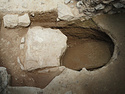
| Marcie Handler ... This deposit is a Mycenaean cist grave with two cover slabs, a type of burial described by Immerwahr in Agora XIII (pp. 103-104). Cist graves appear side by side with chamber tombs in the Mycenaean cemeteries ... LHIIB-LHIIIA:1 ... Two slabs: a worked, flat, roughly rectangular poros limestone slab on the east (which had collapsed in the tomb,, sloping down to the north), and an unworked boulder with a naturally flat top surface and uneven underside on the west (it was still in situ). ... B.C. and an Ostrakon of Xanthippos (ΒΖ 1983), providing a terminus post quem of 484 B.C for the fill that collapsed on top of the slab. The upper fill covering the boulder on the west end of the cutting (Lots ΒΖ 2128 and 2130) dated to ca. 500 B.C., and the fill lying directly on top of the boulder (Lot ΒΖ 2131) dated to the late 8th c. |
Trial trench IV. A thin strip of undisturbed fill excavated on the north side of the upper terrace, just inside the line of the Archaic peribolos wall.
Probably this small patch of clay represents part ... Protoattic ... A thin strip of undisturbed fill excavated on the north side of the upper terrace, just inside the line of the Archaic peribolos wall.
Probably this small patch of clay represents part of the ground surface of the sanctuary in the 7th century, pressed into the high bedrock.
|
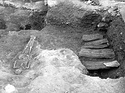
Fillings below the courtyard floor of the Poros Enclosure west of the Areopagus. The lowest layer, over bedrock, is of the archaic period and may have accumulated on the spot before the start of building ... First half of 5th c. B.C ... The lowest layer, over bedrock, is of the archaic period and may have accumulated on the spot before the start of building operations. The upper layers also contain archaic material, but are a dumped filling brought in to level the area at a date not earlier than 460-450. ... Subdivisions:
.1=layer 1, surface
.2=layer 2
.3=layer 3 |
Drain channel system along the line of an ancient north-south road, the channel in part at the surface and in part tunneled and accessible by shafts. Over a considerable part of this channel the hard water ... 2nd-early 3rd c. A.D ... Drain channel system along the line of an ancient north-south road, the channel in part at the surface and in part tunneled and accessible by shafts. Over a considerable part of this channel the hard water deposit at the bottom, belonging to the period of use, is consistently of the second and early third centuries, although coins of Gallienus in the upper part of the filling show that the channel was not abandoned before the time of the Heruli. |
| Grave 7 in notebook. Area disturbed in Roman times; outlines of the shaft had been obliterated.
The northwest end, however, was preserved in a cutting in the rock of the sloping hillside. This cutting, ... 750-700 B.C ... This cutting, 0.59m wide, extended to a total depth of 0.62m below the rock surface. This depth had provided space for two separate burials, one above the other. ... The skeleton of a man lay with the head toward the northwest; an iron knife was found lying under the left upper arm. |
| Rodney S. Young ... Grave 8 in notebook. Bones discarded. Fragments of an iron pin found on the chest and a fragment of a Protogeometric krater base found beside the body were not inventoried.
JP
Unlined roughly rectangular ... LH III/EPG (date uncertain) ... JP
Unlined roughly rectangular pit cut into bedrock, measuring 1.71m long and 0.50m wide. the modern surface of what was known in the early 1930s as Plateia Theseiou sloped down toward the west; the bottom of the tomb at the east end was at a depth of 0.31m from the surface, and only 0.17m at the west end. the tomb was oriented east-west, with the head of the deceased toward the west. the skeleton, in part disturbed, was found on its back, arms by the side of the body. Torso and arms were articulated in situ; of the skull, only two small fragments were found, and there was only one leg bone, apparently not in situ. of the human remains, which were not kept, only the upper arm (L. 0.241) and forearm (L. 0.216) were measured in situ. |
| Marcie Handler ... This pyre was found in the fill under Pyre J 2:23. Unfortunately, no floor surface was found between the two pyres. There were no complete vessels in this pyre. The sherds of the pyre vessels were mixed ... 275-250 B.C ... Unfortunately, no floor surface was found between the two pyres. ... (west slope ware was present, but moldmade bowl fragments were absent), which is very close to the date for the upper pyre, J 2:23 (1st quarter of the 3rd century B.C.). |
|
|