|
|
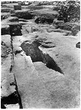
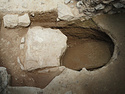
Mycenaean Grave, disturbed, in scarp E of Stoa, a little to the south of the group of tombs clustered around Pier 12. No remains (perhaps a child's grave whose bones had completely disintegrated).
Small ... Myc. IIIA:2-B ... Mycenaean Grave, disturbed, in scarp E of Stoa, a little to the south of the group of tombs clustered around Pier 12. |
Rodney S. Young ... (E.L. Smithson: Grave XXXVI:PG). Early fill over bedrock. No remains.
Two fragmentary unburned vases were found together on bedrock, beneath Roman and Byzantine fill. Disturbed earth over bedrock for several ... Early Protogeometric ... The excavator noted "cinders" among the Early Iron Age pottery in the fill in the immediate vicinity, which may further support the existence in the area of early tombs. |
| Mycenaean Chamber Tomb with niches.
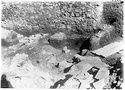
One of the few tombs found in the Agora that has an almost architectural regularity with squares chamber (1.75m wide by 2.10m deep) and axially centered dromos (4m long ... Myc. III A 1:2 ... One of the few tombs found in the Agora that has an almost architectural regularity with squares chamber (1.75m wide by 2.10m deep) and axially centered dromos (4m long by 1.10m wide tapering upward to 0.80m). |
Mycenaean Deposit (Gully) in front of NE Stoa (corrected from P 7:1).
It consisted of a series of irregular pits, some gradually linked up with one another to form what seemed a natural gully. The largest ... Mycenaean IIIA-B ... Because of its proximity to the chamber tombs and because of the exceptional quality of several of the vases, it seems likely that some of the material came from disturbed tombs
Addenda 2025: Pit with Mycenaean pottery cut at the North by NE Stoa. |
| Homer A. Thompson ... PG grave to NW of Stoa Pier 19 (Tomb no. 5 in notebook). In some records as Grave XLII.
It consisted of a rectangular pit, oriented north-south, cut into bedrock. The sides of the pit were lined and the ... Earlier-Developed Protogeometric ... This was one of the better-furnished tombs: grave goods included a metal pin on either shoulder, with the pin-heads toward the south.
|
| Homer A. Thompson ... Cremation burial (trench-and-hole) under S. edge of E-W Street, southern burial. In some records as Grave XLVI.
Neat trench, rectangular as preserved, but may have originally been square, cut partly through ... Early Geometric I ... The floor of the trench was not as heavily burned as that of other related cremation tombs, though there was within it,particularly toward the west, a thick deposit of ash, charcoal, and burned sherds, representing pyre debris. |
| Dorothy Burr Thompson ... Grave 1. Urn cremation (trench-and-hole), adult female 30-40 years old).
Mentioned as Grave XVII in Deposit list.
Consisted of a roughly circular pit, approximately 0.30-0.40m in diameter, cut into ... Late Protogeometric ... See also P 34860-P 34866 catalogued as "sherds overlying tombs
F 16:3 & F 16:4". |
| Dorothy Burr Thompson ... Grave 2. Urn cremation (trench-and-hole). In some records as XXIII.
Variously labeled as grid 7/Δ, 7/Γ and 7/Γ-Δ.
Rectangular pyre trench cut through earth into bedrock, with only the lowest 0.04m surviving ... Transitional Late Protogeometric/Early Geometric I ... See also P 34860-P 34866 catalogued as "sherds overlying tombs
F 16:3 & F 16:4". |
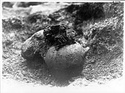
| Marcie Handler ... This deposit is a Mycenaean cist grave with two cover slabs, a type of burial described by Immerwahr in Agora XIII (pp. 103-104). Cist graves appear side by side with chamber tombs in the Mycenaean cemeteries ... LHIIB-LHIIIA:1 ... Cist graves appear side by side with chamber tombs in the Mycenaean cemeteries of the Agora.
|
|
|