|
|
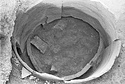
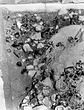
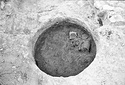
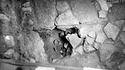
| A tile lined well under Room I of Byzantine House.
A concrete shaft belonging to the mill cut off the top of the well and left in place 3 complete sets of tiles and most of a fourth set. All but the lowest ... 17-18 c. A.D ... Hesperia 83 (2014), p. 200, table 2. |
| Coins:
19 July 1995 #1254
20 July 1995 #1252
21 July 1995 #1268 Three additional finds, A 4916, IL 1909, T 4387, are from outside the well proper and not in the finds list but cf. pp. 7243, 7245 and section ... 4th-12th c. A.D ... Hesperia 83 (2014), p. 200, table 2. |
| Coins:
16 June 1981 #89
17 June 1981 #94-#95, #100 (not a coin).
19 June 1981 #103-#104, #335-#336
23 June 1981 #111-#112 ... 9th-13th c. A.D ... Hesperia 83 (2014), p. 200, table 2. |
Original bottom of pithos was damaged (probably by ground water) and a second, higher bottom consisting of squarish terracotta tiles laid. Fill above second, higher floor was unusually rich in pottery ... Byzantine ... Hesperia 83 (2014), p. 200, table 2. |
Well L: PG, ELS. Includes a displaced grave (K 12:2 bis). The pottery appears less consistent than that in the pit at 70/ΜΕ. Depth of well 6.25m. below the top of wall B. PD 2780 ... Protogeometric ... Hesperia 83 (2014), pp. 222, 200, table 2. |
| Tom Milbank ... An unlined and relatively narrow (ca. 0.82m. in diameter) well cut through hard-pack and bedrock. Although three periods of use can be discerned in the stratigraphy of the well below a depth of ca. 5.47m., ... Middle Geometric I ... Hesperia 83 (2014), p. 218, 200, table 2. |
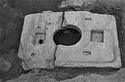
Well in Byzantine Room 9. Excavation of the well terminated at 49.00m. due to cave-in danger. Topped by a stone sill and marble putael, the upper part of well is of Byzantine-period stone masonry; lower ... Byzantine ... Hesperia 83 (2014), p. 246, 200, table 2. |
Well West of N-S Street. Coin
2 August 1982 #704 ... Ca. 115-75 ... Hesperia 83 (2014), p. 200, table 2. |
Well N: Middle Helladic, southwest of Klepsydra.
Diameter, ca. 0.70m. Water level ca. -6.00m ... Middle Helladic ... Hesperia 83 (2014), p. 201, table 2. |
Well X: Late Neolithic. Southwest of Klepsydra.
Diameter, top ca. 0.90m (max), bottom less than 0.70m. No water ... 13-15 June 1937 ... Hesperia 83 (2014), p. 201, table 2. |
Well M: Middle Helladic. West of Klepsydra.
Diameter, top c. 1x0.80m; bottom ca. 0.75m. No water ... Middle Helladic ... Hesperia 83 (2014), p. 201, table 2. |
Well Q: Middle Helladic, West of Klepsydra. Water level -2.00m ... Middle Helladic ... Hesperia 83 (2014), p. 201, table 2. |
Well S: Late Neolithic, West of Klepsydra. Water level ca. -2.80 ... Late Neolithic ... Hesperia 83 (2014), p. 201, table 2. |
Well K: Late Neolithic. Near Klepsydra.
Diameter top ca. 1.00x0.80
at -1.50 ca. 0.75
at -2.25 ca 0.50
Water level ca. -2.00m ... Late Neolithic ... Hesperia 83 (2014), p. 201, table 2. |
Well H: Late Neolithic. West of Klepsydra.
Diameter, top ca. 0.90m; at -4.50m ca 0.75.
Water level ca. -2.00m 1) Some extremity bones of Bos sp.
2) Cardium sp. shells ... Late Neolithic ... Hesperia 83 (2014), p. 201, table 2. |
Well E: Middle Helladic at Acropolis street.
Diameter, upper shaft ca. 0.87m, lower shaft ca. 0.70m ... Middle Helladic ... Hesperia 83 (2014), p. 201, table 2. |
Well 4: Late Neolithic. Diameter ca. 1.15. No water ... Late Neolithic ... Hesperia 83 (2014), p. 201, table 2. |
Well T: Middle Helladic. Close to Paved Building. Diameter ca. 0.75-0.80m.
No apparent water, but a thin layer of sand at the bottom ... Middle Helladic ... Hesperia 83 (2014), p. 201, table 2. |
Well 17: Neolithic ... Neolithic ... Hesperia 83 (2014), p. 201, table 2. |
Well 21: Neolithic ... 17-19 April 1939 ... Hesperia 83 (2014), p. 201, table 2. |
South Tunnel: Bone Factory. Starts at 4-6/Μ and runs south to well. Coin
14 March 1938 #33 Lot ΑΑ 19, does it belong here? ... Second half of 2nd c. A.D ... Hesperia 83 (2014), pp. 201, 242, table 2. |
Well 9: Neolithic
Diameter, 1.00-1.10m. Water level ca. -6.90m ... Neolithic ... Hesperia 83 (2014), pp. 209, 201, table 2. |
| Well cut into bedrock under late Roman building in ΕΛ. 1.2m in diameter with small cutting of unclear function at south edge about 0.2m wide. Walls cut straight down, tapering near bottom to 0.8m. Footholds ... Late Archaic ... Hesperia 83 (2014), p. 201, table 2. |
Deposit of fine table ware and lekythoi, both black-figured and red; the plain wares closely resemble those from the well H 6:5 ... 470-450 B.C ... Deposit of fine table ware and lekythoi, both black-figured and red; the plain wares closely resemble those from the well H 6:5. |
Depth: original at least 3.70m, depth preserved ca. 2.00m.
Diameter: top ca. 0.80x1.15, bottom ca. 0.75m.
Water level ca. -1.50m ... 8-9 March 1939 ... Hesperia 83 (2014), p. 201, table 2. |
Located just north of the stepped retaining wall between the Great Drain and the Poros Monument (Propylon).
Short period of use; dumped filling above, mostly cemetery debris ... Early Protogeometric ... Hesperia 83 (2014), p. 200, table 2. |
| Well I: PG, ELS. The collapsed well north of the Middle Stoa Terrace. This pit, or shallow well, into which a Turkish storage pit lined with stones was set, produced purely Proto-Geometric pottery and ... Protogeometric ... Hesperia 83 (2014), p. 200, table 2. |
| Pit at 74/ΜΑ (1.10x0.58).
Debris filling containing a quantity of animal bones; probably a household refuse pit Animal bones (domestic animals); cow, pig, goat, sheep, hen, dog, and several varieties ... Ca. 525-470 B.C.
480-440 B.C ... Hesperia 83 (2014), p. 200, table 2. |
Deposit of black glazed table ware found with a mass of bones, iron waste and burning. Coins (from above Hellenistic/associated floor):
7 April 1948 #10-#11 ... 375-325 B.C ... Deposit of black glazed table ware found with a mass of bones, iron waste and burning. |
Middle Helladic Gully ... Middle Helladic ... Hesperia 83 (2014), p. 201, table 2. |
| A well in the courtyard (Room 8) of a Byzantine House of Period II. The well was covered by a large squared poros wellhead and a marble puteal (apparently neither inventoried). Within the well shaft, the ... 14 July-9 August 1989
2-13 July 1990 ... Hesperia 83 (2014), pp. 246, 200, table 2. |
| Initially uncovered with a diameter of c. 1.05m. Its south side extends under the south wall of the Classical structure and so clearly predates it. The highest preserved portion of the well shaft (at the ... 22 July-9 August 1994
26 June 1995
3-7 July 1995 ... Hesperia 83 (2014), p. 200, table 2. |
| Disturbed pyre dispersed in fill of Room 5, House D.
Pyre pots in very fragmentary condition were noticed by Barbara Tsakirgis in later analysis of pottery that had been excavated in 1938; no mention of ... 14 June 1938 ... Hesperia 83 (2014), p. 200, table 2. |
| Enclosure within Roman Circular Building. The finds apparently reflect the entire area inside the enclosure. Pottery lot ΒΓ 515 identifies the deposit as layer 10 and coin #895 from layer 11 says "layer ... 12-18 August 1971
9-10 May 1972 ... Hesperia 83 (2014), p. 200, table 2. |
Well at 21/Ε (beneath Library of Pantainos).
The clearing of the well was abandoned because of a cave-in of the rock walls. Heavy dumped filling, the proportion of fine black table ware high ... Ca. 440-425 B.C ... Heavy dumped filling, the proportion of fine black table ware high. |
Well V: Late Neolithic, West of Klepsydra.
Diameter at 2.00 (when first preserved), bottom ca. 0.75m. Water level ca -4.00m ... Late Neolithic ... Hesperia 83 (2014), p. 201, table 2. |
| Dimensions: 1.10m in diameter and 1,36m deep.
It could have been started as a well but then abandoned at a shallow depth (perhaps due to Persian invasion of Athens). BG vessels (including one inscribed ... 500-470 B.C ... Hesperia 83 (2014), p. 200, table 2. |
| Eugene Vanderpool ... Grave. Roughly circular pit with scraps of bone and traces of carbonized material. Four similar empty pits nearby with a little Geometric pottery ... Early Geometric ... Hesperia 83 (2014), p. 200, table 2. |
| Stone-curbed Pit (Sacred Pit) to North of Altar of Ares.
An accumulation of votives dating at least from the middle of the 7th. c. B.C. into the early 5th. c. Finds include those from the immediate area ... 7th-5th c. B.C ... Hesperia 83 (2014), p. 225, 200, table 2. |
Well 2: archaic. Diameter, top ca. 1.00; bottom ca. 0.90m.
Water level:ca -7.00m In the use filling, along with the plain water pots was a black-figured neck amphora assigned to the Edinburgh painter ... Last quarter of the 6th c. B.C ... Hesperia 83 (2014), p. 201, table 2. |
Well 15: Mycenaean. It was situated about 35 meters down the slope northwest of the exit of the Mycenaean Fountain.
Well circular or roughly oval in section.
Diameter max. width to -4.0: ca. 1.50, below ... Late Mycenaean ... Hesperia 83 (2014), pp. 216, 201, table 2. |
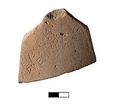
| Laura Gawlinski ... Well in courtyard of Early Building I, adjacent to wall of Room B. Tile lined; upper course in situ, lower two collapsed probably in antiquity. Letters inscribed on rims (eta, phi, omicron, theta). Medium ... First quarter of the 4th c. B.C ... The water table was never reached and there was no period of use fill, indicating that the well was abandoned during digging and never used. |
Well 19: Latest Mycenaean. Near Klepsydra. Diameter mouth 1.25-1.35m., narrowing about a third of the way down and becoming rectangular, 0.90-1.0 to a side. Muddy at m; water collecting rapidly at 8.m ... Late Mycenaean ... Hesperia 83 (2014), pp. 216, 201, table 2. |
A well outside the market square to the southeast, west of the Panathenaic Way; Diameter 1.10m ... 600-550 B.C ... Hesperia 83 (2014), p. 201, table 2. |
Well 6: archaic. Diameter 1.20m
Well on the northwest slope of the Acropolis, below the Klepsydra.
There are three fills, all thrown into the unfinished well at the same time (end of 6th- beginning of ... Last quarter of 6th c. B.C ... Hesperia 83 (2014), p. 201, table 2. |
A small flask-shaped cistern on the lower southeast slope of Kolonos Agoraios. Lined with hydraulic cement and containing a large quantity of glazed table ware and a fair amount of coarse ware; a homogeneous ... 350-325 B.C ... Lined with hydraulic cement and containing a large quantity of glazed table ware and a fair amount of coarse ware; a homogeneous fill with joins at all levels. |
Roman well re-used in Byzantine times. Subdivisions:
.1=0.00-13.80m.
.2=13.80-23.50m.
.3=23.50-25.00m ... Late 1st-early 2nd, 4th-5th, 11th centuries ... Hesperia 83 (2014), p. 200, table 2. |
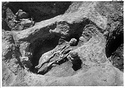
| David Scahill ... Burial in Geometric well (J 3:8), in Classical Building II, Room I, next to south ashlar wall. "No grave goods!"
ADDENDA: J. Papadopoulos later associated P 34449 and P 34450 to that grave. (Cf. Agora ... Geometric ... Hesperia 83 (2014), pp. 218, 200, table 2. |
An unfinished well in the northwest room of the Poros Building, west of the Areopagus. Dumped filling. Chips from marble-working, variety of plain and figured wares ... Ca. 400-385 B.C ... Hesperia 83 (2014), pp. 200, 232, n. 74, table 2. |
| Hole at 57/ΛΣΤ = Pottery Dump at 57/ΛΣΤ. May well have accumulated on the spot where it was found, its fragmentary state being attributable to the later rubble wall laid over it.
Cf. also P 19982 (ΟΟ ... Ca. 400-375 B.C ... Coins:
15 June 1949 #1-#2
Consistent collection of black glazed and figured table-ware, with a few coarse amphoras and a lamp fragment |
| Well cut into bedrock, associated with late Roman building G in ΕΛ 1.2m in diameter, narrows to 0.5m at bottom. Disturbed by later pits at top. Excavated from 85.77-79.25m (6.52m), but bedrock at 85.91m ... Late 4th/early 5th AD ... Six layers of dumped fills and one period of use fill. Water table at ca. 82.55m.
... VI. (82.55-80.75m) water table, grayer fill.
|
| Well in Room 6 of Street Stoa U/2,U/3-13/15.
Associated with the building lying under the Roman Street Stoa. Its fills divided into 5 separate layers, with the bulk of finds belonging to Layer 1, the ... 14 June-21 August 1973 ... Hesperia 83 (2014), pp. 190, 198, 201, 226-231, 238, nn. 2, 66, 82, figs. 7, 8, 9, table 2. |
| This filling is the largest deposit of its time found in the Agora. It may be compared with H 6:5 and with N 7:3.
Dug in soft bedrock to a depth of 11.40m; footholds cut on opposite sides of the shaft ... Ca. 490-450 B.C ... Hesperia 83 (2014), p. 200, table 2. |
| Located at the bifurcation of the Panathenaic Way and West Road.Byzantine fill (9th-10th century) in upper 5.70m. with a series of Classical to Hellenistic accumulations below. Coins:
10 July 1971 #861 ... 14 June-27 July 1971 ... Hesperia 83 (2014), p. 200, table 2. |
| N.A. Doenges Evelyn Lord Smithson ... "Near or in Grave" (width 0.50m)
Grave to the east of the southeast corner of the great court of the Gymnasium. Shallow and superimposed on Well N 11:5. It is a simple cist oriented north and south, with ... 750-725 B.C ... Agora XXXVI, 405 and n. 422, 407, table 2.3, 408 fig. 2.289, 603 n. 89. |
Well to N of Nymphaeum at 115/ΙΣΤ. A good water supply but no evidence for a period of use.
Exceptionally heavy dumped filling, including much fine tableware, many wine- jar fragments and other objects ... Ca. 420-400 B.C ... Hesperia 83 (2014), p. 198, 201, 226-232, 238, 243, nn. 69, 70, 71, 82, fig. 7, table 2. |
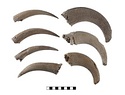
Thra (ΘΡΑ) Well (East of Stoa Room 2). Heavy dumped filling, including figured, black and plain wares, and also a quantity of animal bones, mostly skulls of oxen. On many of these the horns had been sawn ... Ca. 520-480 B.C ... Hesperia 83 (2014), p. 201, table 2. |
Fills from construction and reconstruction of a house. "Brown House" = House A (RSY Hesp. 20) (and pit under Layer 4) in the industrial area west of the Areopagus.
Under the original floor of this house ... Second half of the 5th. c. B.C ... The filling of the floor levels of the house after its plan was changed and it was reconstructed yielded fragments of various coarse amphoras and black glazed table ware; four sherds incised with the letter kappa suggest that this is the initial of the owner of the house of the second period.
|
Well at 45/Θ (Skytha Well) near the north side of the market square. No period of use was distinguished, since it was impossible to clear the well to the bottom. The considerable quantity of dumped filling ... Ca. 460-440 B.C ... Hesperia 83 (2014), p. 200, table 2. |
Tiled well near the SW corner of the market square between the Southwest Fountain House and the Great Drain, three fills noted: lower fill of earth and stones with a few fragments only of coarse pottery ... 4th-2nd c. B.C.
100-70 B.C ... Tiled well near the SW corner of the market square between the Southwest Fountain House and the Great Drain, three fills noted: lower fill of earth and stones with a few fragments only of coarse pottery (none inventoried, containers 66-71); middle filling a heavy deposit primarily of table ware, apparently a gradual accumulation; upper supplementary fill. |
Mycenaean Well (S/1,2-13/20,14/1). Underneath the NE Room of the Library of Pantainos, along its S side, as a cutting in bedrock containing reddish fill with bits of green bedrock. The feature is rectangular ... 30 June-23 July 1975 ... The depth of the feature , in particular in comparison with wells in the same area, would indicate that the shaft was unlikely to have served as a well, unless the water table in this area changed dramatically between ca. 1500 and ca. 400 B.C.
|
|
|