|
|
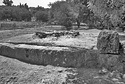
Material from trenches:
a) 1.00-7.00m. from East End of Stoa.
b) 18.40-21.40m. from East End of Stoa.
c) 46.60-48-60m. from East End of Stoa.
d) 51.00-53.00m. from East End of Stoa.
e) 79.00-81.00m. from ... 2nd c. B.C ... Includes drain trench in front of back wall of Stoa (some disturbed, some undisturbed fill), soft fill above stone drain, fill from within stone drain, channel behind stylobate. |
Fillings in a stone-curbed well in the industrial area west of the Areopagus. Diameter (shaft)1.45m. Water level -5.20m. Drain at mouth 0.58m., increasing to a regular 74m. Coin:
24 July 1947 #5 Subdivisions: ... 350-325 B.C./3rd c. B.C ... Fillings in a stone-curbed well in the industrial area west of the Areopagus. ... Water level -5.20m. Drain at mouth 0.58m., increasing to a regular 74m. |
| Not completely excavated due to instability of chamber walls and water. Sherds of all periods - Greek, Roman and Byzantine - were found in it [nbp. 424].
Re-examined in 2010. Photos and notes on NB pages ... 10th c. A.D ... Photos and notes on NB pages listed below.
2010 Final Report
Cistern G 14:3 is plaster lined and built with stone, at least in its upper portion, and contains a series of footholds at the northeast and southwest. Around its mouth is the remains of a square platform of tile, stone and mortar, with a segment of a square ceramic drain running along the northeast. |
| Margaret Crosby ... Grave 1 (Grave XXVI: EG) Urn cremation (trench-and-hole), adult male?
[JP]
Boots or Booties Grave. Near the west branch of the Great Drain, about 100m to the southwest of the Agora horos inscription ... Early Geometric I ... Near the west branch of the Great Drain, about 100m to the southwest of the Agora horos inscription. ... Rough walls of dry stone were built up to east and west of the deep hole containing the ash-urn; these served to support the ends of slab of a bluish-grey limestone placed as a cover to protect the amphora with its ashes. ... In later times a watercourse, perhaps a tributary of the Great Drain, passed over or just to the south of the grave, and silt deposited by the water had filling the amphora to within twelve centimeters of its mouth. |
|
|