|
|
Eugene Vanderpool ... Disturbed burial: Pocket in bedrock (Grave 11: PG). In some records as Grave XI. No remains. No cutting or traces of burning nearby
The coin listed here was found "cleaning bedrock", presumably at the ... Developed to Late Protogeometric ... The vases constitute evidence for early burials on the southeast slopes of the Kolonos Agoraios, although no trace of graves, or of any robbed tomb pits, was preserved nearby. It is equally possible that the vases derive from a destroyed tomb on the southeast side of the hill proper, rather than its slopes. |
| Mycenaean Grave at SE corner of Pier 12 (Burial 9).
There are no traces of dromos, which must have been located at the north and have been cut away by the trench four the south stylobate of the Square ... Myc. III A:1 |
| N.A. Doenges Evelyn Lord Smithson ... "Near or in Grave" (width 0.50m)
Grave to the east of the southeast corner of the great court of the Gymnasium. Shallow and superimposed on Well N 11:5. It is a simple cist oriented north and south, with ... 750-725 B.C ... "Near or in Grave" (width 0.50m)
Grave to the east of the southeast corner of the great court of the Gymnasium. ... It is a simple cist oriented north and south, with the head on the north side. A number of small field-stones along the east may have come from a lining; the pots were found among these. ... Hesperia 22 (1953), p. 39: noted as grave to the east of the southeast corner of the great court of the Gymnasium. |
| John Camp ... Protogeometric Grave about 0.60m to the southeast of T 15:2.
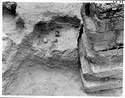
Unlined roughly rectangular-elliptical pit, oriented north-south, neatly cut into bedrock to a depth of 0.70m, with rounded corners. The pit ... Early-Developed Protogeometric ... Protogeometric Grave about 0.60m to the southeast of T 15:2.
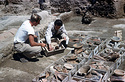
... Within the pit, the skeleton of a woman, aged about 40-44 years at death, within significant osteoarthritis and degenerative joint disease, was placed on the floor of the tomb, on her back, in a fully extended supine position, arms by the side of the body, head to the south. The head had rolled over onto its right side, facing northeast.
|
R. Ross Holloway ... Protogeometric Grave in Koletti Garden. Male inhumation.
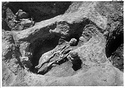
Tomb first encountered and partially damaged by workmen who were digging a cess pit for the restored Koletti House on Polygnotos street. The tomb ... "Submycenaean"/Early Protogeometric ... The tomb was located just southeast of the house, between the paved terrace and the annex to the east. It consisted of an unlined rectangular pit, oriented southeast-northwest, cut into bedrock to a depth of about 0.25m, below the level of the surrounding bedrock, and measuring approximately 1.45m long and averaging 0.60m wide. Within the pit, the skeleton of a man aged 18-21 years at death, and described as somewhat decayed, was laid out on his back in a fully extended position, head to the southeast. the fill of the tomb appeared to consist of sterile redeposited bedrock and it was hastily dug by the workmen prior to the arrival of a trained excavator. the floor of the tomb was encountered at 1.95m below the level of the court in the area of the cess pit, ca. 1.15m below the level of the tiled pavement along the east side of the Kolletti House |
| Mycenaean Tomb to NE of Pier 19 (Burial #1)
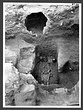
Most of the doorway and the dromos had been cut away by the ancient Stoa builders. The dimensions of the chamber were 2.90m wide by 1.60m deep. Unusual features ... Myc. III A:1 ... Unusual features of the tomb were a small recess in the back or south wall, in which stood the askos, and a rough stone slab which was found on the floor near the center of the east side, but which may once have been a grave marker at ground level.
... Two skeletons, both to the west of the entrance, extended with feet toward the door, seem to represent the latest interments, although the eastern one had been somewhat pushed to the side. In the southeast corner and along the west wall there were swept-up piles of bones and offerings from earlier burials, and in the northwest corner there was a small round pit (0.50m in diameter by 0.20m deep) full of bones. |
| Well at 89-90/ΙΗ-ΙΘ (diameter at top 1.10m), between the southeast corner over the mouth of of the Odeion and the Panathenaic Way. The well lay a thin layer of dug bedrock containing a few Hellenistic ... 650-625 B.C ... Well at 89-90/ΙΗ-ΙΘ (diameter at top 1.10m), between the southeast corner over the mouth of of the Odeion and the Panathenaic Way. ... Carefully dug with a series of eleven steps 0.50m apart on one side of the shaft, ending 1.00m above the bottom. |
| Homer A. Thompson ... Cremation burial (trench-and-hole) under S. edge of E-W Street, southern burial. In some records as Grave XLVI.
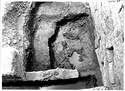
Neat trench, rectangular as preserved, but may have originally been square, cut partly through ... Early Geometric I ... The north side of the trench was destroyed by the a Turkish cess pit. As preserved, the trench measured ca. 1.05x 0.60m, and was presumably oriented east-west, but as the north side was destroyed it is possible that the trench extended toward the north and may, therefore, have had a north-south orientation. Be that as it may, a deep, circular urn-hole was cut into the southeast corner of the pyre trench to a depth of 0.45m below the level of the floor, and measuring 0.35m in diameter.
|
|
|