|
|
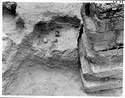
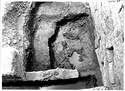
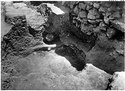
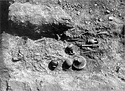
| Mycenaean Grave at SE corner of Pier 12 (Burial 9).
There are no traces of dromos, which must have been located at the north and have been cut away by the trench four the south stylobate of the Square ... Myc. III A:1 ... Chamber Tomb at Southeast Corner of Pier 12 |
Casting pit near SE corner of Poros Building, Room C 3. Combined with D 18:4 ... 1st c. B.C.-1st c. A.D ... Bronze Casting Pit near Southeast Corner of Poros Building |
Well at SE corner of Court of Late Roman Building (Trench C). Estimated Grid ... 12th c. A.D ... Well at Southeast Corner of Court of Late Roman Building |
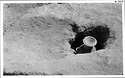
Mycenaean well and grave.
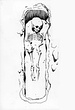
Single burial, that of a middle-aged man, had been made in the mouth of an unproductive well near the southeast corner of the South Square ... Myc. IIIB-C:1 ... Single burial, that of a middle-aged man, had been made in the mouth of an unproductive well near the southeast corner of the South Square. |
Well at the southeast corner, almost on the line of the east-west street. Upper Fill: Late Roman dumped fill.
Lower Fill: Dark Age: ca. 7th c. A.D.
Coin
30 March 1939 #34 ... 7th-Late 6th century ... Well at the southeast corner, almost on the line of the east-west street. |
Cistern at 43/ΙΣΤ, outside the southeast corner of the market square, slightly west of the Panathenaic way. A small neat plaster-lined cistern filled with material evidently all dumped at the same time ... Ca. 375-350 B.C ... Cistern at 43/ΙΣΤ, outside the southeast corner of the market square, slightly west of the Panathenaic way. |
| N.A. Doenges Evelyn Lord Smithson ... "Near or in Grave" (width 0.50m)
Grave to the east of the southeast corner of the great court of the Gymnasium. Shallow and superimposed on Well N 11:5. It is a simple cist oriented north and south, with ... 750-725 B.C ... "Near or in Grave" (width 0.50m)
Grave to the east of the southeast corner of the great court of the Gymnasium. ... Hesperia 22 (1953), p. 39: noted as grave to the east of the southeast corner of the great court of the Gymnasium. |
Well in the southeast corner of the section, at 58/ΝΑ. It must have been originally made in the Roman period to judge from the character of the curbing tiles. It was however cleaned out and reused in ... 10th-Early 11th c. A.D ... Well in the southeast corner of the section, at 58/ΝΑ. |
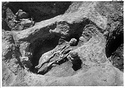
| Mycenaean Chamber Tomb SE of Stoa Pier 12 (Burial 8).
Roughly rectangular, measuring 1.70m by 1.40m, and was cut down to within 0.65m. by the construction of the Square Building. A rectangular cutting ... Early Myc. IIIA |
Lamps all found together at the southeast corner of the excavated area, in a deposit running in part under the dike of earth which has been left against the wall of the street.
Includes 10 lamps in Section ... 17-18 June 1931
15 May 1933 ... Lamps all found together at the southeast corner of the excavated area, in a deposit running in part under the dike of earth which has been left against the wall of the street.
|
Outside the market square, near the southeast corner, on the south edge of the east-west road, where it passes to the south of the Mint.
There is no doubt that the pottery from the well is "stratified" ... Early 1st to 6th c. and of 8th c. A.D ... Outside the market square, near the southeast corner, on the south edge of the east-west road, where it passes to the south of the Mint.
|
| Well at 89-90/ΙΗ-ΙΘ (diameter at top 1.10m), between the southeast corner over the mouth of of the Odeion and the Panathenaic Way. The well lay a thin layer of dug bedrock containing a few Hellenistic ... 650-625 B.C ... Well at 89-90/ΙΗ-ΙΘ (diameter at top 1.10m), between the southeast corner over the mouth of of the Odeion and the Panathenaic Way. |
| Rodney S. Young ... Grave 6 in notebook (E.L. Smithson: Grave XXII: PG). Bones discarded. Urn cremation (trench-and-hole).
JP
Roughly rectangular trench cut through hard earth into bedrock to a depth of about 0.35m, approximately ... Late Protogeometric ... Trench oriented southeast-northwest, with the urn-hole adjoining the southeast corner. |
| Mycenaean Tomb to NE of Pier 19 (Burial #1)
Most of the doorway and the dromos had been cut away by the ancient Stoa builders. The dimensions of the chamber were 2.90m wide by 1.60m deep. Unusual features ... Myc. III A:1 ... In the southeast corner and along the west wall there were swept-up piles of bones and offerings from earlier burials, and in the northwest corner there was a small round pit (0.50m in diameter by 0.20m deep) full of bones. |
| Grave V, under room 18 in House 3, plus burned deposit at 94/IΘ. Identified as sacrificial pyre by SIR on Agoraios Kolonos:
In southeast corner of house 3. 35 artifacts, bone and charred material in pit, ... Ca. 300-275 B.C ... Identified as sacrificial pyre by SIR on Agoraios Kolonos:
In southeast corner of house 3. 35 artifacts, bone and charred material in pit, in floor sequence. |
| Mycenaean tomb: Myc. III A:1-2.
SAI
Small rectangular chamber, 2.30m wide by 1.80m deep,, entered from the east through a dromos 1.10m wide which contracted to a doorway 0.92m. wide. the doorway preserved ... 2nd half of 14th c ... Several earlier interments had been swept aside; some bones were found in the corners of the chamber. others in a small pit (0.55x0.30x0.23 deep)near the southeast corner |
| Homer A. Thompson ... Cremation burial (trench-and-hole) under S. edge of E-W Street, southern burial. In some records as Grave XLVI.
Neat trench, rectangular as preserved, but may have originally been square, cut partly through ... Early Geometric I ... Be that as it may, a deep, circular urn-hole was cut into the southeast corner of the pyre trench to a depth of 0.45m below the level of the floor, and measuring 0.35m in diameter.
|
| James H. Oliver ... (E.L. Smithson: Grave IX: PG). Two children's skeletons one on top of the other. Cf. PD 329 for PD 430 for second skeleton, same deposit.
PG grave about 25m. SW of Cistern A at 46/ΜΔ.
[In some records, ... Developed Protogeometric ... Oriented southeast-northwest, the tomb measured 1.40m long and 0.65m wide at the top, narrowing with depth. The bedrock forming the edges of the tomb pit was stepped in to provide an irregular ledge, running round all four sizes. maximum width of the pit at the bottom was about 0.30m. a partial lining of fieldstones was bedded on the ledges; the uppermost stones were interrupted at the southeast corner by an irregular recessed pocket containing two lekythoi.
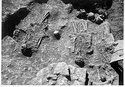
Skeletons fully extended, heads to the southeast. Lower skeleton was described as a "six-year-old girl" with arms bent over the body. |
| Homer A. Thompson ... Cremation burial (trench-and-hole) under S. edge of E-W Street, northern burial. In some records as Grave XLVII.
The western part of the offering trench of the tomb was lost to a Turkish cess pit, and ... Middle Geometric I ... The urn-hole was dug only deep enough to accommodate the cinerary urn to its shoulder; the burning suggests a north-south orientation with the cinerary urn at the south or southeast corner.
According to Angel, the cinerary urn contained the cremated remains of an adult male aged ca. 35 years at death. |
| C.G. Thomas ... Geometric grave. Bones discarded.
Tomb located about 2m west/west-southwest of the EG1 child inhumation, beneath the restored line of a hypothetical wall connecting the western "apse' and the south wall ... Middle Geometric II ... A roughly rectangular trench was cut through earth into bedrock, except at the southeast where it was wholly cut into earth, to a depth of 0.15-0.20m. ... Fragments of mudbrick, found throughout the fill, were most numerous at the east end, where the largest piece marked the southeast corner. The one complete dimension recorded from among the mudbrick pieces from this tomb had a thickness of 0.090m, and was stated to be "standard from PG times down." |
| Dorothy Burr Thompson ... Child's Grave (E.L. Smithson: Grave XXVIII: G).
Cf. Container Lot ΣΤ 165 (fill over geometric grave).
Neat, rectangular, unlined trench, cut into bedrock to a preserved depth of 0.20m,below the level ... Early Geometric I ... The cranium was at a slightly lower level in the tomb than the feet; the upper part of the skull of the deceased was found near the south corner of the tomb, the jaw bone closer to the east corner. ... Slight traces of carbonized matter were noted at the southeast end near the cranium, with small specks of carbon throughout the earth fill,but no substantial traces of burning or any burnt pots. |
| Rodney S. Young ... Grave 20 (E.L. Smithson: Grave X: PG). Bones discarded. Pit tomb, inhumation (on bier or in coffin?), perhaps of a child. Little ash and carbon in the filling, but the grave offerings were unburned.
JP ... Developed Protogeometric ... JP
Deep rectangular pit, 1.72m long and 0.70m wide, cut into bedrock to a depth of 0.83m, oriented east-southeast to west-northwest. the skeleton at the bottom of the pit had mostly disintegrated, except for a shin bone in the eastern half of the tomb. ... It was in this layer that five of the six pots associated with the grave were encountered, toward the SE corner. The se pots, all unburned and clustered together, would have been placed in the area immediately above the feet of the deceased.
c) in the lowest 0.30m, very damp earth with very little ash, much heavy black matter "of a different character", from that in the layer above.
|
|
|