|
|
| Section ΠΠ March-June, 1956 ... A. Boegehold ... The ruins unearthed in section ΠΠ represent six roughly defined periods: 4th century B.C. to Hellenistic, Augustan, pre-Herulian, post-Herulian, Byzantine and Turkish.
The results of the excavation are ... 20 Feb-29 Jun 1956 ... The ruins unearthed in section ΠΠ represent six roughly defined periods: 4th century B.C. to Hellenistic, Augustan, pre-Herulian, post-Herulian, Byzantine and Turkish.
The results of the excavation are presented by period in the report. A note suggesting further excavations in the area is added. |
| Section Ζ 1951 ... Homer A. Thompson ... The remaining pieces of the so-called Byzantine wall were removed, as well as a late Roman wall. Excavations in front of the Civic Offices revealed a hard road surface from the 3rd century A.D. More than ... 21 May-13 Jun 1951 |
| Section ΜΜ
Season of 1939 ... Homer A. Thompson ... Section Μ was to be refilled this year and supplementary explorations took place to resolve some remaining obscurities. The most significant discovery was a road running northwest-southeast, probably the ... 20 Feb-8 Apr 1939 ... Section Μ was to be refilled this year and supplementary explorations took place to resolve some remaining obscurities. ... Originally an alley, it was buried in earth filling and formed into a new wider road in the Augustan period. It was bordered by a Doric colonnade on the north side and by buildings and enclosures on the south side, where also foundations of a monumental stairway giving access to the hilltop were revealed.
|
| Section ΜΜ
Summaries for 1936 ... Homer A. Thompson ... Three main ancient features were excavated within Section ΜΜ: the North Stoa, the South Building and the ancient East-West Street passing between the two buildings. After the destruction of the buildings, ... 10 Feb-25 May 1936 |
| 1961: Season's Report for Section K ... Homer A. Thompson ... A report on the completing of the exploration of the Heliaia, the Southwest Fountain House and the southwest entrance to the Agora, as well as some work of conservation and path-making in the area ... 24 Jul-19 Aug 1961 |
| Sections Ε, Ν, Η 1952 ... Homer A. Thompson ... Mycenaean graves were excavated in section Ε.
Section Ν was disturbed by late pits, bothroi and walls. Excavation was carried out through Roman levels. The area seemed to have been leveled out and raised ... 4 Mar-31 May 1952 ... Mycenaean graves were excavated in section Ε.
Section Ν was disturbed by late pits, bothroi and walls. ... The area seemed to have been leveled out and raised as part of a landscaping project turning the area into a level square. ... A Mycenaen well was found as well as a fine Archaic altar and peribolos. |
| Excavation Summary Section K: 1968 ... S. Grobel ... Excavations in Section Κ were conducted in the Marble Worker's Establishment, a series of rooms grouped around a courtyard. A cistern-well was discovered and excavated, as was a pit and a pyre burial ... 17 Jun-17 Aug 1968 ... Excavations in Section Κ were conducted in the Marble Worker's Establishment, a series of rooms grouped around a courtyard. A cistern-well was discovered and excavated, as was a pit and a pyre burial. ... A retaining wall along the Triangular Temenos, and a Geometric Grave were discovered.
|
| Section ΟΟ 1948 ... Margaret Crosby ... Work in Section ΟΟ was concentrated on the east and west ends of the north side of the section: parts of the ancient east-west street were explored; ca 20 meters of the Great Drain was clearly exposed; ... 8 Mar-26 Apr 1948 ... Work in Section ΟΟ was concentrated on the east and west ends of the north side of the section: parts of the ancient east-west street were explored; ca 20 meters of the Great Drain was clearly exposed; remains of a house (House E) from the 4th century and Hellenistic period, with cistern (Cistern A), water storage tank and a well (Well I) were found; the Roman Bath (Building A and Hypocaust area) was further explored, and a well in the central court (Well II) dug out; a trial cut was dug in a long, narrow poros building with a large open yard and a series of small rooms; and an early Geometric grave was found and excavated. |
| Gleanings from the West Side of the Agora
Spring of 1935, Section ΟΕ ... Homer A. Thompson ... An account, based on archaeological evidence so far discovered, on some of the buildings in the west side of the Agora: Stoa of Zeus Eleutherios and vicinity, Sanctuary of Apollo Patroos, Sanctuary of ... 27 Jan 1934-30 May 1935 |
| Section Ν 1937 ... R.H. Howland ... Report on the excavation in the northern end of Section Ν, which started at Byzantine level and went down to the first classical level. A strip of the Byzantine and Vandal road was the largest area exposed ... 25 Jan-30 Mar 1937 ... Report on the excavation in the northern end of Section Ν, which started at Byzantine level and went down to the first classical level. A strip of the Byzantine and Vandal road was the largest area exposed. A late room with a trough was excavated, and a wall complex related to the Odeion, examined. |
| Section ΝΝ: 1947 ... Rodney S. Young ... Excavation continued in section ΝΝ with the aim of clearing the area for the new museum. Because of the unforeseen depth of filling, the area remained unfinished.
Several features were dug and examined ... 10 Mar-3 Nov 1947 ... Excavation continued in section ΝΝ with the aim of clearing the area for the new museum. ... A second Roman Bath was found. The two baths were separated by a street overlying Drain A.
|
| Section ΟΟ: Preliminary Summary 1947 ... Margaret Crosby, Eugene Vanderpool ... Excavations in Section ΟΟ were taken place in four parts: the modern and Turkish road levels were removed; a part of the Great Drain, and drains connected with it, were examined; high Roman levels of Building ... 17 Mar-14 Aug 1947 ... Excavations in Section ΟΟ were taken place in four parts: the modern and Turkish road levels were removed; a part of the Great Drain, and drains connected with it, were examined; high Roman levels of Building A (Roman Bath) were dug and several rooms, a courtyard and two wells were uncovered; and in the South Central Area a number of houses, some wells and a kiln were uncovered. |
| Section Υ
1937 Excavation Summary ... Rodney S. Young ... Section Υ had suffered from modern leveling operations and in some parts there were no visible antiquities. In the southeast corner were traces of Proto-Geometric grave cuttings. Excavation revealed the ... 1 Oct 1936-24 Apr 1937 ... Excavation revealed the foundations of a large rectangular structure, probably the court of a Byzantine house still beneath modern houses. In one corner of the court was a well and a trough. ... Through the section runs a drain which probably went out of use in time of the Herulian intrusion. |
| Section Ω 1969 ... John McK. Camp II ... Excavations were carried out in the Late Roman complex known as Philosophical School C, and in House D, a private house of the 5th c. B.C. which underlies the north half of the school. A second house of ... 8 Jul-23 Aug 1969 |
| Excavation Summary Section ΟΟ: 1969 ... John McK. Camp II ... Further excavations were conducted in Section ΟΟ, supplementing those done earlier. The large Roman complex, now known as the Southwest Bath, were completely explored. Cuts to the north of the building ... 13 May-6 Jul 1969 ... Further excavations were conducted in Section ΟΟ, supplementing those done earlier. ... Cuts to the north of the building reveal a series of stratified roads. A well was cleared and excavated, and a Hellenistic cistern complex was dug out. |
| Sections Φ, Χ, Ψ, April-June 1957 ... A. L. Boegehold ... Three private dwellings, already known from the preliminary excavation of 1937, formed the major themes of the investigation this year: Southwest House, Polygonal House and Late Roman House and Water Channel ... 10 Mar-12 Aug 1957 ... Most of the excavation was carried out in Section Φ. In the report each building is treated separately, and then a summary point out how they are related to one another. |
| Section ΟΟ: Excavation Summary February, 1950
The Poros Building ... Margaret Crosby ... A report on the excavation of the Poros Building in Section ΟΟ. As a result of the investigation, the plan of the building, as suggested in 1948, was considerably modified. Revealed is a building with ... 21-26 Jun 1950 ... A report on the excavation of the Poros Building in Section ΟΟ. As a result of the investigation, the plan of the building, as suggested in 1948, was considerably modified. Revealed is a building with a large open court, a central corridor and five rooms at the west side and three southern rooms at the east side. |
| Excavation Summary Section Ω: 1970 ... John McK. Camp II ... Excavations were centered around a large late Roman complex know as the Roman House H.
In addition, a late Hellenistic cistern was dug under the northwest corner of the house ... 24 May-22 Aug 1970 |
| Agora Excavations 1948
Fifth and Sixth Weeks: April 5 - April 17 ... Homer A. Thompson ... Report on the 5th and 6th week of the 1948 season in Section Κ. Excavations were carried out from 5-17 April 1948 and focused on the area of the Fountain House and the area west of the Aeropagus. E. Vanderpool ... 5-17 Apr 1948 ... Report on the 5th and 6th week of the 1948 season in Section Κ. Excavations were carried out from 5-17 April 1948 and focused on the area of the Fountain House and the area west of the Aeropagus. ... Vanderpool also contributes with a brief note on a stele found reused as a cover slab on a drain at the northwest corner of the Fountain House. Attached is also a general report on the work carried out through 1948 by the ASCSA in the Ancient Agora. |
| Excavation Summary. Section ΒΔ: 1970 ... Stephen G. Miller ... This is a report of the first year of excavation in Section ΒΔ, a problematic area due to its limitation by the railroad on the south and the Hadrian Street on the north, and to the disturbances made by ... 6 Mar-15 Aug 1970 ... This is a report of the first year of excavation in Section ΒΔ, a problematic area due to its limitation by the railroad on the south and the Hadrian Street on the north, and to the disturbances made by the activities of the inhabitants in the area while digging for wells, pits, holes, foundations, etc. These disturbances had as a result that a significant quantity of earlier material had been destroyed. |
| Excavation Summary Section ΒΔ: 1971 ... Stephen G. Miller ... This season's work in Section ΒΔ was confined to the eastern half of the section. The area was somehow disturbed, partly by a trench dug by Koumanoudes in 1890. Remains of roads, drains and buildings were ... 22 Mar-21 Sep 1971 ... This season's work in Section ΒΔ was confined to the eastern half of the section. The area was somehow disturbed, partly by a trench dug by Koumanoudes in 1890. Remains of roads, drains and buildings were explored, in some places down to the Geometric period.
A large number of deposits were excavated, amongst them a chamber tomb, several pyres, pits, pithoi etc. |
| The Odeum ... Homer A. Thompson ... A rectangular building with poros foundations was excavated in the central part of the eastern area of the excavation. The southwest corner, lying in Section Μ, was excavated in 1934 and the rest of the ... 2 Apr-27 Jun 1935 ... A rectangular building with poros foundations was excavated in the central part of the eastern area of the excavation. ... The building consists of a rectangular auditorium or theater surrounded by a corridor. Excavation revealed a marble orchestra floor, bedrock cuttings for the lower seats of the cavea and the bedrock foundations for a stage. |
| Section Κ 1948 ... Eugene Vanderpool ... The removal of a long narrow dike, formed by the modern Eponymon Street, was completed, and the ancient remains below were exposed for future exploration ... 8 Mar-24 Apr 1948 |
| Section Χ 1937 ... Margaret Crosby ... The area signified as Section Χ lays outside the Agora proper and no signs of any public buildings were found. The area seems to have been used for private houses from the end of the 6th c. B.C. Apart ... 25 Jan-18 May 1937 ... The area signified as Section Χ lays outside the Agora proper and no signs of any public buildings were found. ... No traces of walls of the Hellenistic period had survived but two wells and four cisterns show the existence of private houses in the area during this period.
A house of the Roman period was revealed in the central region of the section. A late Roman well was partly excavated.
|
| Section ΟΟ 1949
Grave Area ... Margaret Crosby ... A report on the excavation in the immediate vicinity of the Early Geometric burial found in 1948 in Section ΟΟ. Two Geometric graves were uncovered, and also walls and drainage systems belonging to the ... 28 Mar-9 Nov 1949 ... A report on the excavation in the immediate vicinity of the Early Geometric burial found in 1948 in Section ΟΟ. Two Geometric graves were uncovered, and also walls and drainage systems belonging to the industrial establishments of the later 6th and 5th B.C. centuries, as well as sporadic remains from later periods, such as a 4th B.C. century pit and a Hellenistic cistern. |
| Section Ω 1938 ... M. Crosby ... Section Ω lies in the east end of the north slope of the Areopagus, well to the southeast of the market square proper. Excavation showed, as expected, that the area was a residential district throughout ... 16 Jan-17 Jun 1938 ... Section Ω lies in the east end of the north slope of the Areopagus, well to the southeast of the market square proper. Excavation showed, as expected, that the area was a residential district throughout antiquity.
... By that time however, there was a street running diagonally up through the section, and remains of buildings, wells, cisterns, etc. from that period and onwards were found. |
| Section X
Miscellaneous Notes Compiled in Summer of 1946 ... Margaret Crosby ... This report is a summary of the excavations taken place in 1937 as well as in 1946.
Some pottery indicate habitation in the area from the Geometric period. Two shallow graves of the 6th and 5th centuries ... 27 May-21 Jun 1946 |
| Report on Excavations in the Athenian Agora 1990 ... T. Leslie Shear, Jr ... This is a report on the archaeological field work conducted in the Athenian Agora during the period from December 1989 to December 1990. The actual excavation period was preceded by preparatory operations ... 4 Jun-3 Aug 1990 ... Three structures, already visible in Section ΒΕ, were revealed which led to a better understanding of these monuments. A well was dug and produced a large amount of pottery.
In Section ΒΗ mostly modern fills were excavated. |
| Section ΠΠ 1947 Season Preliminary Report ... Arthur W. Parsons Margaret Crosby ... The early part of the excavation season in Section ΠΠ was concerned almost exclusively with the removal of the Asteroskopiou Street, a road going back to the 1st or 2nd century A.D.
The work of the remainder ... 28 Apr-11 Aug 1947 ... The early part of the excavation season in Section ΠΠ was concerned almost exclusively with the removal of the Asteroskopiou Street, a road going back to the 1st or 2nd century A.D.
The work of the remainder of the season included excavation of roads and drainage systems, several buildings, five wells of which two were completely dug, and a grave from the early 3rd century B.C. |
| Sections ΝΝ - ΞΞ Excavation Summary 1946 ... Rodney S. Young ... The objective of this year's excavation was to clear the southern part of the section to bedrock. Features earlier investigated (the 6th century cemetery, the Hellenistic-Early Roman terrace and one large ... 31 May-14 Aug 1946 ... The objective of this year's excavation was to clear the southern part of the section to bedrock. Features earlier investigated (the 6th century cemetery, the Hellenistic-Early Roman terrace and one large Roman tank), as well as some discovered this season (a second Roman water tank, a great built shaft, a part of the Great Drain and early house walls), were removed. Four wells were also dug. Only a small area of the section was left for further clearing and investigation. |
| Section ΛΛ 193
Excavation Summary ... Dorothy Burr Thompson ... Excavations in Section ΛΛ revealed that the original contour of Kolonos Agoraios had been much sharper than in modern times. No traces of early graves were found in the area; first sign of habitation is ... 1 Feb-23 Jun 1937 ... Excavations in Section ΛΛ revealed that the original contour of Kolonos Agoraios had been much sharper than in modern times. No traces of early graves were found in the area; first sign of habitation is pottery from the last half of the 5th century B.C. found in metal working pits in connection with a drain and a road. ... In section ΛΛ, a great stair was constructed.
|
| Section Φ Season of 1937 ... Eugene Vanderpool ... In antiquity the area included in Section Φ lay outside the Agora proper and were apparently occupied only by houses and small buildings. The earliest period of which any considerable remains were found ... 25 Jan-17 Jun 1937 ... In antiquity the area included in Section Φ lay outside the Agora proper and were apparently occupied only by houses and small buildings. ... From the Roman period a house was partly cleared. ... A late Roman building covered almost the whole section and was probably part of the great complex of late Roman buildings that covered most of the center of the Agora. |
| Section Υ: 1958 Excavation Report ... Dorothy Burr Thompson ... Two areas at the north foot of the Areopagus were uncovered. The first area did not yield much of interest due to modern disturbances. Excavations of a well, three pits and a water channel produced however ... 3 Mar-3 May 1958 ... Excavations of a well, three pits and a water channel produced however ancients material.
In the second area the only significant ancient remains lay along the southeast side of the northerly part of the section. Some traces of the West Street running north-south with a water-channel underneath, appeared. ... Scanty remains of some houses were excavated: the South House, the North House, and the Southeast Houses (I and II) which was a complex of ten rooms. |
| Section Κ 1953 ... Eugene Vanderpool ... Excavations was carried out in the building fill in the area south of the Middle Stoa, and in the area between the South Stoa and the Fountain House. Work was also done to the porch of the Fountain House ... 23 Feb-30 Jul 1953 |
| Excavation Summary Section ΒΔ: 1972 ... Stephen G. Miller ... With the exception of the removal of certain modern intrusions, the recovery of a few layers of a late Roman road, and the discovery of the westward continuation of the southern foundation of Roman Building ... 22 Mar-20 Jun 1972 ... With the exception of the removal of certain modern intrusions, the recovery of a few layers of a late Roman road, and the discovery of the westward continuation of the southern foundation of Roman Building β, the work in Section ΒΔ during the 1972 season was concentrated on the exploration of the lower levels in the western area of the section. |
| Section Ψ Season of 1938 ... Eugene Vanderpool ... Finds from Section Ψ span from Turkish down to the Neolithic and Geometric times. Several wells and cisterns from various periods were found and explored. The most extensive remains in the section belong ... 24 Jan-18 Jun 1938 ... Finds from Section Ψ span from Turkish down to the Neolithic and Geometric times. ... The most extensive remains in the section belong to a building of the late Roman period. |
| Excavation Summary Section ΟΟ 1968 ... M. Alison Frantz ... The excavation of the Roman Bath east of the Poros Building was resumed in order to clarify aspects on plan and chronology of the building. It was discovered that there had been a bath in the area from ... 17 Jun-31 Jul 1968 |
| Agora Volunteer Report 2017 ... John McK. Camp II ... Excavations took place in three sections, ΒΘ, ΒΖ and ΟΟ, covering a time span from the 14th century B.C. to the 12th century A.D.
In Section ΒΘ work continued in later layers over and in front of the Stoa ... 12 Jun-4 Aug 2017 ... Excavation over the northern channel revealed a cover slab decorated with a large hoplite shield.
In Section ΒΖ North, some walls were dismantled and a lion’s head spout was recovered. ... A casting pit was excavated and produced large fragments of moulds for a bronze statue. |
| Agora Excavations Preliminary Report - Summer 2014 ... John McK. Camp II ... Excavations in 2014 were carried out in three sections: ΒΘ, ΒΓ and ΒΖ.
In Section ΒΘ, overlying the Painted Stoa, the Byzantine houses of the 11th century A.D. were further exposed in the western part ... 9 Jun-1 Aug 2014 ... The eastern half was dug deeper; a pithos discovered at a lower level suggests an earlier phase of the Byzantine settlement. ... Two skeletons were found along with pottery and beads from a necklace.
In Section ΒΓ, the exploration of the Panathenaic Way continued. ... In Classical levels, numerous post-holes of various sizes and depths were dug.
A large number of images of Section ΒΘ were taken with the use of a drone. |
| Summary Report - Agora 2018 ... John McK. Camp II ... Excavations were carried out in Sections ΒΘ, ΒΖ and Ω.
In Section ΒΘ the investigations continued in the area in front of and above the Stoa Poikile. In ΒΘ East, built into a late structure, a large inscribed ... 11 Jun-3 Aug 2018 ... Excavations were carried out in Sections ΒΘ, ΒΖ and Ω.
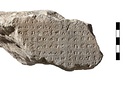
In Section ΒΘ the investigations continued in the area in front of and above the Stoa Poikile. In ΒΘ East, built into a late structure, a large inscribed block was uncovered just south of the Eridanos river. ... As part of clearing and restoration by the ephoreia in Section Ω, excavations took place around a large Roman house of the 4th century A.D., mostly in the area of a mosaic from the 2nd century A.D. |
|
|