|
|
Pit at 18-20/Λ-ΛΓ.
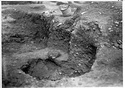
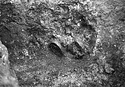
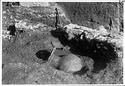
The cistern S 19:3 and the well S 19:8, together with a Roman well, S 19:1, had collapsed to form a large pit S 19:5. The upper part of the pit was dug to a depth of ca. -8m as deposit ... 7-8 April 1938
28 April-26 May 1938 ... S 19:5 ... S 19:5 |
Well S: Late Neolithic, West of Klepsydra. Water level ca. -2.80 ... Late Neolithic ... Late Neolithic Well S in ΟΑ |
Well West of N-S Street. Coin
2 August 1982 #704 ... Ca. 115-75 ... Well West of N-S Street |
Mycenaean Well (S/1,2-13/20,14/1). Underneath the NE Room of the Library of Pantainos, along its S side, as a cutting in bedrock containing reddish fill with bits of green bedrock. The feature is rectangular ... 30 June-23 July 1975 ... Mycenaean Well (S/1,2-13/20,14/1) |
Pit in floor of House S ... Geometric to mid-5th c ... Pit in floor of House S. |
Filling under North-South Road surface, apparently to raise the level of the road as thickness of fill varies depending on height of road. Fill sits on earliest, cobbled road layer. The road surface set ... Mid-6th c. B.C ... Filling under Layer of N-S Road |
The deposit notebook lists S 1439 here, but the following information on that card indicates that D 18:4 could be considered with D 18:3 and not as a separate deposit.
"Excavation of pit, which partly ... Casting pit on line of Poros Building S. wall. |
Cistern at 17-18/ΛΑ (Coroplasts' Dump) outside the market square to the southeast, west of the Panathenaic Way.
Upper and lower fill distinguished during excavation, but material from both appears to ... To ca. 330-320 B.C ... The cistern S 19:3 and the well S 19:8, together with a Roman well S 19:1, had collapsed to form a large pit (S 19:5). The cistern was dug separately, although some of its distinctive fill of terracotta figurines and votive material had fallen into the pit S 19:5. |
Well at 19/ΛΓ.
The cistern S 19:3 and the well S 19:8, together with a Roman well, S 19:1, had collapsed to form a large pit S 19:5.
Top to -8.5m: Byzantine dump to 11-12th c. A.D.
-8.50m to -15.00m: 4th ... Mid 3rd century A.D ... The cistern S 19:3 and the well S 19:8, together with a Roman well, S 19:1, had collapsed to form a large pit S 19:5.
|
Rodney S. Young ... (E.L. Smithson: Grave XXXVI:PG). Early fill over bedrock. No remains.
Two fragmentary unburned vases were found together on bedrock, beneath Roman and Byzantine fill. Disturbed earth over bedrock for several ... Early Protogeometric ... S 19:4 ... S 19:4 |
Valerian Wall, undisturbed contents: Upper stretch.
Not on concordance, not on cardex neither. Asterisk: S 16-17* (no info) ... Asterisk: S 16-17* (no info) |
Cutting in bedrock (Panathenaic Way Cut II, Cutting C1); loose gravelly filling over bedrock including a number of terracotta figurines. Lot ΠΑ 61? P 26458 is probably a slip. One fragment noted as from ... 4th c. B.C ... S 17:3 ... S 17:3 |
Well in Coletti Garden.
Diameter 1m. There were no traces of hand holes in its walls. At 5.2m depth below datum on the S-E side of the shaft, a small underground stream emptied into the well. The stratigraphy ... Ca. 425-400 B.C ... At 5.2m depth below datum on the S-E side of the shaft, a small underground stream emptied into the well. |
Tile-lined Well in Room 2 of Street Stoa (5/8-13/13), ca. 0.64m in diameter. Tiles set in pairs for each circuit, tops carefully lettered for placement, one hand-hole per tile. Actual well earlier (?) ... 21-26 June 1972 ... S 13:1 ... S 13:1 |
Well at 19/Λ.
The bottom of this well contained a considerable quantity of dug bedrock which had fallen in before the well came into use; over this was a fill with oinochoae representing the POU. The presence ... 340-325 B.C ... The presence in this fill of kernoi and a kernos-nold suggests that the users of this well may have been the same people as those responsible for the debris in the nearby coroplasts' dump (S 19:3). |
| Above bedrock in N.W. corner of room S, House of Greek Mosaic. Contents suggest "saucer-pyre" ... Late 4th-early 3rd c. B.C ... Above bedrock in N.W. corner of room S, House of Greek Mosaic. |
Pit in colonnade of south Stoa I, north of S. half of room 4. Estimated Grid ... Pit in colonnade of south Stoa I, north of S. half of room 4. |
Geometric Well on the west side, in the line of the Roman Panathenaic way; 3.70m below paving block of street that overhangs well. It was neatly cut, 1.05m. in diameter, but it was dug only to a depth ... Late Geometric, end of 8th century B.C ... S 20:1 ... S 20:1 |
Deposit in bedrock cuttings, probably from a household. (Panathenaic Way Cut III, E1 and E2).
E1: Mixed 7th-5th c. B.C.
E2: Late Geometric-Early 6th c. B.C. Coins:
19 May 1959 #5-#7 ... 5th c. B.C and earlier ... S 17:1 ... S 17:1 |
| Circular pit and irregular cutting north of it. Diam. of pit ca. 0.80m; Dimension of irregular cutting ca. 1.00x1.20m. The pit was dug into bedrock and filled with red earth which was packed with undisturbed ... Second half of 7th c. B.C ... S 17:2 ... S 17:2 |
Well at 29/ΛΕ, to the SE of the market square, west of the Panathenaic Way.
Circular shaft, caved in at mouth. Diameter 1.20m. Diameter narrows to 0.50m at bottom of shaft, which is slightly concave. No ... Late 8th century B.C ... S 18:1 ... S 18:1 |
Cistern at 6/ΛΓ.
Hellenistic lower fill, with mixed Hellenistic and late Roman fill above, and Byzantine fill in mouth. Coins
1 June 1938 #1-#8
2 June 1938 #1-#6
3 June 1938 #1-#3
4 June 1938 #1-#2
6 June ... 2nd century, with Byzantine disturbance ... S 19:2 ... S 19:2 |
Well at 9/ΛΔ, left unfinished. Coins
27 May 1938 #1 (sand at top) M.C. suggests date as second half of 6th c. (March 1956), p. 1052.
No containers ... 550-500 A.D ... S 19:6 ... S 19:6 |
Well at 18/ΜΓ, on the lower north slope of the Acropolis, under the course of the later Panathenaic Way, west of the Archaic Building.
Diameter 0.97m. Water level 8m.
At the mouth of the well and to a ... Late 8th to 675 B.C ... S 19:7 ... S 19:7 |
Well at 5/ΚΘ. Digging abandoned at -7.20m for fear of collapse.
Upper 50cm, fill in broken in mouth, very late Roman (4th-7th. c. A.D.)
Fill below 50cm to 6.50mL late roman with some earlier material (from ... 4th-7th century A.D ... S 19:9 ... S 19:9 |
A well outside the market square to the southeast, 20m west of the Panathenaic Way; Modern fill in upper 1.65m. with Early Roman dumped fillings below. Coins:
9 May 1939 #37 (dirt pile)
10 May 1939 #53 ... Late 1st c. B.C.-early 1st c. A.D ... S 21:1 ... S 21:1 |
A well outside the market square to the southeast, west of the Panathenaic Way; Diameter 1.10m ... 600-550 B.C ... S 21:2 ... S 21:2 |
Well outside market square to the southeast, west of the Panathenaic Way. Accumulated use filling from first half of 1st c. A.D. to early 3rd c. Top to 14.65m. 4th c. dump; nothing significant catalogued ... POU First half of 1st c.-early 3rd c. A.D ... S 21:3 ... S 21:3 |
Well at 37/Α, on the lower Acropolis slopes, west of the Panathenaic Way ... 600-550 B.C ... S 22:1 ... S 22:1 |
Well at the southeast corner, almost on the line of the east-west street. Upper Fill: Late Roman dumped fill.
Lower Fill: Dark Age: ca. 7th c. A.D.
Coin
30 March 1939 #34 ... 7th-Late 6th century ... S 22:2 ... S 22:2 |
Well at 73/Δ Coins:
24 April 1939 #1 (stuck to sherd in bottom container) A box (4B) and three tins of pottery have been kept (T5-T7). The rest discarded ... Byzantine ... S 23:1 ... S 23:1 |
Well M: Middle Helladic. West of Klepsydra.
Diameter, top c. 1x0.80m; bottom ca. 0.75m. No water ... Middle Helladic ... S 27:1 ... S 27:1 |
Well Q: Middle Helladic, West of Klepsydra. Water level -2.00m ... Middle Helladic ... S 27:2 ... S 27:2 |
Well V: Late Neolithic, West of Klepsydra.
Diameter at 2.00 (when first preserved), bottom ca. 0.75m. Water level ca -4.00m ... Late Neolithic ... S 27:4 ... S 27:4 |
Well K: Late Neolithic. Near Klepsydra.
Diameter top ca. 1.00x0.80
at -1.50 ca. 0.75
at -2.25 ca 0.50
Water level ca. -2.00m ... Late Neolithic ... S 27:5 ... S 27:5 |
Well L: Early Byzantine ... Early Byzantine ... S 27:6 ... S 27:6 |
Well 23: Late Mycenaean (Well D:SM) ... Late Mycenaean ... S 27:7 ... S 27:7 |
Well H: Late Neolithic. West of Klepsydra.
Diameter, top ca. 0.90m; at -4.50m ca 0.75.
Water level ca. -2.00m 1) Some extremity bones of Bos sp.
2) Cardium sp. shells ... Late Neolithic ... S 28:1 ... S 28:1 |
Sculptor's Workshop at 37-40/Β-ΣΤ Coins
20 April 1933 #1-#20
21 April 1933 #37-#41
24 April 1933 #97-#100
1 May 1933 #5-#8
4 May 1933 #2
12 May 1933 #8-#9
15 May 1933 #8
S 343, S 407-S 413, S 390: Fragments ... Ca. 267 A.D ... Coins
20 April 1933 #1-#20
21 April 1933 #37-#41
24 April 1933 #97-#100
1 May 1933 #5-#8
4 May 1933 #2
12 May 1933 #8-#9
15 May 1933 #8
S 343, S 407-S 413, S 390: Fragments of unfinished sculpture-probably to be associated with the Sculptor's Workshop (p. 1482).
|
Rodney S. Young ... Shallow round pit scraped out of bedrock. Grave 18 in notebook. The confusion here is that P 5347 found in the grave was catalogued in B' but the large bowl fragment (P 6482) was catalogued in B (see nb ... 700-650 B.C ... Rodney S. Young |
| Rodney S. Young ... Grave 2 in notebook (E.L. Smithson: Grave XV: PG). Urn cremation (trench-and-hole), adult female.
JP
It consists of a roughly rectangular pit or trench cut into bedrock to a depth of 0.35m., measuring ... Late Protogeometric ... Rodney S. Young |
| Rodney S. Young ... Grave 3 in notebook (E.L. Smithson: Grave XIII: PG). Urn cremation (trench-and-hole), adult female.
JP
Rectangular trench, measuring approximately 1.10x0.45m, but which may have been larger, cut through ... Late Protogeometric ... Rodney S. Young |
| Rodney S. Young ... Grave 4 in notebook (E.L. Smithson: Grave XX: PG). Bones discarded. Grave of older child.
JP
Rectangular pit, cut into bedrock to a depth of 0.26m, approximately 0.97m long and 0.36m wide. Tomb oriented ... Late Protogeometric ... Rodney S. Young |
| Rodney S. Young ... Grave 6 in notebook (E.L. Smithson: Grave XXII: PG). Bones discarded. Urn cremation (trench-and-hole).
JP
Roughly rectangular trench cut through hard earth into bedrock to a depth of about 0.35m, approximately ... Late Protogeometric ... Rodney S. Young |
| Rodney S. Young ... Grave 7 in notebook (E.L. Smithson: Grave XXI: PG). Bones discarded. Disturbed and damaged cremation (originally trench-and-hole), the east end cut away, probably contained the burial urn.
JP
It consisted ... Late Protogeometric ... Rodney S. Young |
| Rodney S. Young ... Grave 8 in notebook. Bones discarded. Fragments of an iron pin found on the chest and a fragment of a Protogeometric krater base found beside the body were not inventoried.
JP
Unlined roughly rectangular ... LH III/EPG (date uncertain) ... Rodney S. Young |
| Rodney S. Young ... Destroyed urn cremation. No remains. Originally assigned as part of Tomb C 9:14 (Grave 7)
JP
"Large fragments of an urn were found in the packing of a Hellenistic water channel which cut through a LPG ... Final Mycenaean/Submycenaean ... Rodney S. Young |
| Rodney S. Young ... Grave 9 (E.L. Smithson: Grave XVIII: PG). Bones discarded.
JP
Roughly circular pit, about 0.59m in diameter, cut into soft bedrock to a depth of 0.42m. Tomb encountered only about 0.12-0.15m below the ... Protogeometric ... Rodney S. Young |
| Rodney S. Young ... Grave 19 (In some records as Grave VIII). No remains, no burned matter or traces of burning.
JP
A small cutting with a single offering. The pit may have been for a simple child/infant inhumation, with ... Early Protogeometric ... Rodney S. Young |
| Rodney S. Young ... Grave 20 (E.L. Smithson: Grave X: PG). Bones discarded. Pit tomb, inhumation (on bier or in coffin?), perhaps of a child. Little ash and carbon in the filling, but the grave offerings were unburned.
JP ... Developed Protogeometric ... Rodney S. Young |
| Rodney S. Young ... Disturbed burial (no remains), probably an infant pot inhumation.
Inhumation grave 17 in notebook. (E.L. Smithson: Grave XIX: PG).
Shallow oval cutting containing a banded amphora on its side, mouth ... LPG ... Rodney S. Young |
| Rodney S. Young ... Grave 18 in notebook.
Adult inhumation; skeletal material; no offerings. Submycenaean?
JP In some records as Grave XIX bis. (see Agora XXXVI, Tomb 31, p. 284) ... LH IIIC/EPG (date uncertain) ... Rodney S. Young |
| Rodney S. Young ... RSY/JP Disturbed Geometric burial over "Sacrificial Pit VI" (Grave B 21:22). Grave IX in notebook. Bones discarded?
Pottery found in the upper filling of a sixth century cremation pit, which had perhaps ... Middle Geometric II/Transitional to Late Geometric ... Rodney S. Young |
Rodney S. Young ... Grave 1 in notebook. Slightly disturbed by the digging of Pit A.
A large oil jar/amphora lay on its side with a flat stone stopping its mouth. The three small vases offered at the burial were found, together ... Ca. 600 B.C ... Rodney S. Young |
| Rodney S. Young ... Grave 4 in notebook. Amphora, no other pots but carbonized remains of food offerings. Over urn two stone slabs, on top, mass of small stones containing Late Geometric sherd ... Late Geometric ... Rodney S. Young |
| Rodney S. Young ... Grave 5 in notebook.
The grave had been somewhat disturbed by the digging of Well B. The hydria lay on its side; in it was found the skeleton of a small child lying on its side with the knees drawn up ... Late 8th-early 7th c. B.C ... Rodney S. Young |
| Rodney S. Young ... Grave 10 in notebook. No remains. Probably grave of a woman.
Only a small portion of the inhumation pit was preserved at the northeast edge of pit A, a large oval cutting of modern date dug for the construction ... Middle Geometric II ... Rodney S. Young |
| Rodney S. Young ... Grave 13 in notebook.
Two skeletons of small children lay in a pithos which had been put on its side; its mouth was stopped by a stone slab.
Most offerings were inside the pithos, but two kantharoi and ... Late Geometric ... Rodney S. Young |
Rodney S. Young ... Grave 15 in notebook.
Skeleton of infant inside the hydria which lay on its side, its mouth stopped by cup; a pitcher stood by the neck of the hydria ... 750-725 B.C ... Rodney S. Young |
Rodney S. Young ... Grave 17 in notebook. No offerings.
Amphora containing skeleton of small child was laid on its side in pit. RSY
Lot Β 304 Fill over Grave 17 ... Early 6th century B.C (?) ... Rodney S. Young |
South Tunnel: Bone Factory. Starts at 4-6/Μ and runs south to well. Coin
14 March 1938 #33 Lot ΑΑ 19, does it belong here? ... Second half of 2nd c. A.D ... S 19-20:1 ... S 19-20:1 |
Exploration of packing below paving blocks of Panathenaic Way.
Uncatalogued material: 66 sherds, 2 objects (50A) and 43 sherds (50B). Coins:
26 April 1960 #1-#2
3 May 1960 #1-#4, #6-#9 Deposit created ... 1st c. A.D ... S-T 20:1 ... S-T 20:1 |
Small pit north of Wall C (appr. 0.50 E-W x 0.35m N-S). Coins:
11 August 1994 #1125-#1127 ... 3rd c. B.C ... Small pit north of Wall C (appr. 0.50 E-W x 0.35m N-S). |
Dug as Tholos Trench V, Room E, burnt filling of plundered wall trench of S wall of court. See also lot Ζ 484 ... Late 6th c. B.C ... Dug as Tholos Trench V, Room E, burnt filling of plundered wall trench of S wall of court. |
Filling of S outer foundation of Square Building.
310-275 B.C., with substantial amount of residual early material. Coins:
25 August 1953 #1-#3 ... 325-300 B.C. (?) ... Filling of S outer foundation of Square Building.
310-275 B.C., with substantial amount of residual early material. |
Scarp S of SE Fountain House (and vicinity)
No info for this deposit No deposit list and S.E. fountain or S.W. fountain?
Asterisk: O-Q 16-17* ... Scarp S of SE Fountain House (and vicinity)
No info for this deposit |
Pyre at N/9-6/1,2, layer 11a.
No formal limits, apparent limits about 0.30-0.40m N-S; 0.50-0.60 E-W (cut into by trench at east) ... Late 575-550 B.C ... No formal limits, apparent limits about 0.30-0.40m N-S; 0.50-0.60 E-W (cut into by trench at east). |
Cistern System #1e: Shaft at 11/ΞΑ.
Agora XXIX: "Well (not cistern shaft, as in Agora XII) ... Communicates with water system through small hole (see C 8:1) probably fortuitously. Single fill, mostly of ... 350-300 B.C ... Coin of 340's/330's-322. |
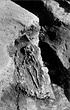
| Shaft oriented N to S (L. 1.30, W. 0.43 at bottom). Fill shot through with cinders and wood ash. Skeleton of a male about 50 years old.
Brann. PD 1065a ... 750-700 B.C ... Shaft oriented N to S (L. 1.30, W. 0.43 at bottom). |
| Susan Rotroff ... Grave 1. Burial of a child perhaps 6 years old, covered by broken amphora. Skeleton lay extended on its back, oriented N-S, with head at south. No grave gifts. PD 2207 ... Final Mycenaean/Submycenaean ... Skeleton lay extended on its back, oriented N-S, with head at south. |
Pocket of pottery to south of grave at 36/ΛΔ; uncertain context. Terracotta figurines resembling those from the Coroplast's Dump (S 19:3) No containers (cf. O 18:2).
T 2468, T 2476, ST 412 from Hellenistic ... 350-320 B.C ... Terracotta figurines resembling those from the Coroplast's Dump (S 19:3) |
| Well in East Colonnade of Roman House H. Diameter 0.80m, lined with field stones set in mortar. used as a cistern as well.
No useful pottery dates. Capital from colonnade A 3866 and part of shaft found ... 29 July 1970 ... Capital from colonnade A 3866 and part of shaft found at 2.50m-3.00m, indicating destruction of house (late 6th, 580's by Slavs). Three marble heads found at -4.65m to -5.25m suggest change from Pagan to Christian in early 6th c. ... Marble heads (S 2354-2356) deliberately discarded before house went out of use. |
| Laura Gawlinski ... Coin hoard of Athenian tetradrachms. Dug into fill under floor (floor level not preserved) on east side of Strategeion near the NE corner of room formed by the eastern poros block wall and an east-west ... Second half of 4th c. B.C ... Dug into two layers of fill, Lots S 295 (ca. 475 B.C) and S 296 (last quarter of 6th c. |
Located in road west of Middle Stoa. It was 4.80m deep. Owing to its shallowness, it was probably kept clean. The southernmost block of the N-S peribolos (?) wall west of the Middle Stoa partly covered ... 200-165 B.C ... The southernmost block of the N-S peribolos (?) wall west of the Middle Stoa partly covered the mouth of the well. |
Containers 15-37. Masses of pots, largely water jars; fragments of Pergamene; Samian B; brittle ware; ER unguentaria.
The following finds on deposit list as bottom fill (.2) are from depths of level .1: ... First half of 1st c. A.D ... The following finds on deposit list as bottom fill (.2) are from depths of level .1: S 1167. |
| Excavation of this pit began in 1995, tentatively identified as a pyre. This proved to be so with continued excavation in 1996. The deposits J 2:8 and J 2:9 were combined to become J 2:9. Miniature vessels ... Ca. 300 B.C ... Dated by S. Rotroff. |
A late curbed well. The filling consisted of clay and small stones. The sherds were uniform from top to bottom and appear to be late Byzantine. From measurements in notebooks (pp. 340, 729), S 2855 is ... Late Byzantine ... From measurements in notebooks (pp. 340, 729), S 2855 is both ΣΤ' 285 and ΣΤ' 684 and is therefore included in this deposit. |
Cistern A for 1935 (there is another Cistern A, for 1936, D-E 8-9:1) Coins:
16 May 1935 #4-#5
17 May 1935 #1-#2
18 May 1935 #1-#2
20 May 1935 #1-#2
22 May 1935 #1
23 May 1935 #2-#6
24 May 1935 #1-#7
25 ... 16-25 May 1935
6 February 1936 ... Also, from rock-cut channel leading south from cistern (27/8/1961) S 589, S 590, SS 4316, IL 254, IL 258, IL 286, T 885, T 901, A 578, P 5947, P 6449 and coins ΠΘ-34, ΠΘ-35. |
| Classical Pyre between floors in Room 2 of Classical Building II.
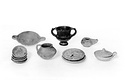
Below floor at 51.66 7masl. Broken pyre pots in fill of ash and carbon, from 51.541-51.513, resting on next floor at 51.513 masl, next ... Ca. 400-390 B.C ... Dated by S. Rotroff. |
| David Scahill ... Beneath toichobate floor level in Room 1 of Classical Building II, against the south ashlar wall, ca. 1.50m. east of the southwest corner of the building. Deposit of broken pyre pots in small pit, 1.00m ... Ca. 325 B.C ... Dated by S. Rotroff. |
First trial east Stoa colonnade, N. of S. wall III, layer 12.
Note quantities of cattle bones, the knuckles sawn off and many worked bits. Evidently a bone implement factory near by. [nbp. 2139] Coins: ... Late 3rd c.-earliest 4th c. A.D ... First trial east Stoa colonnade, N. of S. wall III, layer 12.
|
| Hellenistic Pyre below packed clay floors of Room 2; west of Late Roman wall extension, below tile platform terracotta drain installation, bordered on the north by bedding foundation stones of crosswall ... Ca. 300 B.C ... Dated by S. Rotroff. |
| Pyre in layer 8a in SW corner of Room 7 of Greek House δ.
Oval pyre; 0.60 (n-s)x 0.35 (e-w).
The pyre was covered by the surface of layer 8 and extended slightly into layer 9 below it. Small bone fragments, ... 325-300 B.C ... Oval pyre; 0.60 (n-s)x 0.35 (e-w).
The pyre was covered by the surface of layer 8 and extended slightly into layer 9 below it. |
| Pyre against north face of polygonal wall, Room 2, Classical Building II. No floor preserved above, but the pyre is below floor level 51.820masl, preserved just to the east and above patchy floor with ... Ca. 275-260 B.C ... Dated by S. Rotroff. |
| Sacrificial Pyre II, Classical Building II.
Found right beneath the stuccoed channel built for sluicing in the 1st c. A.D., and must have been partly disturbed when the channel was constructed. It may ... Ca. 250 B.C ... Dated by S. Rotroff.
AS 1719.1 in Study Collections-Case No. 99C-2 box V. |
May be of Hellenistic origin when cistern system went out of use.
For a general note on the cistern see Nb. ΟΕ III, pp. 246 ff.
Objects from B 586 various depths (no subdivision): S 2324-S 2330,
P 34894, ... Late 2nd-early 6th c. A.D ... Objects from B 586 various depths (no subdivision): S 2324-S 2330,
P 34894, P 34898.
|
Pit in Tholos Trench V (below Layer e).
In plan it would seem to have been oval, though its east end is c/../ by the south wall of the North Archaic Home. Its N-S width is 1.25m, its E-W length is 1.40m ... 7th-early 6th c. B.C ... / by the south wall of the North Archaic Home. Its N-S width is 1.25m, its E-W length is 1.40m. |
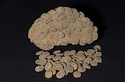
| A closely compacted group of 431 bronze coins found at ca. 52.50m., against the east brick wall. No sign of a container. Others dribbled down against the channel wall in a restricted area to as deep as ... Late Roman ... Their date suggests a later deposition: the latest coins dating to the reign of Leo I, come into the 470's. |
| Disturbed pyre dispersed in fill of Room 5, House D.
Pyre pots in very fragmentary condition were noticed by Barbara Tsakirgis in later analysis of pottery that had been excavated in 1938; no mention of ... 14 June 1938 ... Another group of pyre pots excavated in 1969 immediately to the east is probably part of the same disturbed group(s). It is likely that more than one pyre is involved: the two rilled-rim plates do not match and there are three lekanis lids (rarely does a pyre contain more than two lekanides). If originally associated with this house, the pyre (s) could be related to the 4th c. |
Cistern at 53/ΝΕ, bottle-shaped, stucco-lined, in the east aisle of the peristyle of Roman House H (courtyard of Greek House G, just west of andron).
Lower diameter 2.73m.
Homogenous fill all apparently ... Into early 2nd century B.C ... Pottery similar to H.A.T.'s Group C/ D. No long petal-Megarian bowls from within cistern. |
Baskets 1-21 (containers 1-20). The following objects, although listed in deposit notebook as being from level .1, are from depths within the .2 range:
MC 318, MC 433-MC 437, T 1309, T 1394, T 1396, IL ... 110 to early 1st c. A.D ... The following objects, although listed in deposit notebook as being from level .1, are from depths within the .2 range:
MC 318, MC 433-MC 437, T 1309, T 1394, T 1396, IL 517, IL 548, IL 549, IL 1076, S 864, S 865, A 711, A 712, P 8939-P 8941, P 9033, P 9034, P 9514, P 9515, P 9540, P 9541, P 9814, P 11813-P 11815, P 11817, P 11824-P 11826, P 11832, P 11842, P 11843, P 11857, P 11867, P 11868, P 11876, P 11884, P 11886, P 11888, P 11889, P 11891, P 11893, P 11895, P 11898, P 11910, P 11911, P 20511-P 20513 |
N-S Cut on 20m. line (area of Road, area of Stoa, area N of Stoa)
various levels and dates over the three areas.
Investigations to the northwest of the market square in the area of the road that bordered ... Protogeometric to Late Roman ... N-S Cut on 20m. line (area of Road, area of Stoa, area N of Stoa)
various levels and dates over the three areas.
... Plundered trench of early N-S wall: geometric to 4th c. |
Well at 69/ΟΒ (Late 5th c.)
Lower fill dated to 420-400 B.C. in Agora XXX.
There were no use filling and the well was apparently not a success as a water-supply: there was no concentration of water-jars ... 420-400 B.C ... I can't find out what M 20:3-S is (Cf. P 9347) as published in Agora XII (SD) |
Filling of early N-S road and related fills, in the area of the Geometric Cemetery south of the Tholos; various levels including plundered foundation trench.
For late, disturbed or uncertain levels over ... 7th-6th c. B.C ... Filling of early N-S road and related fills, in the area of the Geometric Cemetery south of the Tholos; various levels including plundered foundation trench.
|
Investigations to the south of the Metroon, in the passageway between the Metroon and the Tholos; accumulated layers, from the Geometric and earlier periods to the 3rd and 2nd centuries B.C.
Cf. Hesperia ... Geometric to second c. B.C ... Not included in this deposit are disturbed areas west of Propylon and footing trench of south face of Metroon but cf. S 1869t, S 1870,
I 6686, I 6687, P 24285, BI 741. |
Lamps all found together at the southeast corner of the excavated area, in a deposit running in part under the dike of earth which has been left against the wall of the street.
Includes 10 lamps in Section ... 17-18 June 1931
15 May 1933 ... Includes 10 lamps in Section Η' from the burnt layer, ca. 0.60m. above bedding for S foundation of Stoa of Zeus at 19/ΝΕ, see nbp. 568. |
| A well at the northeast corner of Classical Building, behind back wall. Dumped fill appears to have occurred as a single event as there are joining sherds throughout.
POU date ca. first half 5th c. B.C.; ... 5th c. B.C ... Two lesbian amphoras, ca. 430's B.C. Pottery includes much black glaze plus good examples of black figure and red figure, several lekythoi. |
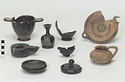
| Marcie Handler ... It was situated in the NW corner of Room 3 in the Classical Commercial Building, just S of Wall 11, the cross-wall that divides Room 3 from Room 4 to the north. The pyre pots were found surrounded by ... Late 4th c. B.C ... It was situated in the NW corner of Room 3 in the Classical Commercial Building, just S of Wall 11, the cross-wall that divides Room 3 from Room 4 to the north. |
Lower fill:
See Deposit G-I 11-12, where the finds are again listed.
Dug as Tholos Trench A, Layer VI, no finds.
Dug as Tholos Trench C, Layer IV+Va, A 756, A 757, P 10507.
Dug as Tholos Trench N, Layer ... 6th c. B.C ... See Deposit G-H 10-11, where the finds are again listed.
Cut S. of Metroon, Layer XII, (Section Β), P 5878, L 1866.
|
| Bronze-casting pit and furnace against S apse of Church (106/ΛΕ). Late Roman sherds of the 4th and the 6th c. A.D. were found with fragments of moulds from bronze casting. The west end was destroyed by ... 5th-6th c. A.D ... Bronze-casting pit and furnace against S apse of Church (106/ΛΕ). |
|
|