|
|
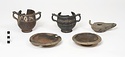
| Pyre in layer "9d" in SW corner of Room 6 of Greek House δ. Ashes and fragments of small bones ... Ca. 225 B.C. |
| Disturbed pyre dispersed in fill of Room 5, House D.
Pyre pots in very fragmentary condition were noticed by Barbara Tsakirgis in later analysis of pottery that had been excavated in 1938; no mention of ... 14 June 1938 |
House N, Room 4, Pit through layers 5-6. Debris filling, mixed context. Estimated Grid ... Late 4th. c. B.C. into early 3rd c. B.C ... House N, Room 4, Pit through layers 5-6. |
| Pyre in House N, room 2, layer 5 (RSY=Pyre 8).
Near northern corner of room 6. Artifacts, bone, burnt logs, and cinders in square pit dug from level of layer 5, through layers 5 and 6; thin clay floor ... 325-300 B.C ... Pyre in House N, room 2, layer 5 (RSY=Pyre 8).
Near northern corner of room 6. Artifacts, bone, burnt logs, and cinders in square pit dug from level of layer 5, through layers 5 and 6; thin clay floor laid over it. Young identified layer 6 as the latest house floor and concluded that this pyre was buried after the abandonment of the house. |
Pit at 79-83/ΜΒ-ΜΖ (or 81/ΜΣΤ=pit under floor of Room 11 in Roman Bldg. 2, 82/ΜΓ, 83/ΜΕ=well at 83/ΜΗ). Purpose of pit obscure. Evidently filled in Hellenistic times and disturbed in Roman times. Coins: ... 275-200 B.C. with later disturbance ... Pit at 79-83/ΜΒ-ΜΖ (or 81/ΜΣΤ=pit under floor of Room 11 in Roman Bldg. 2, 82/ΜΓ, 83/ΜΕ=well at 83/ΜΗ). ... Coins:
26 February 1937 #1-#2
27 February 1937 #2-#3
1 March 1937 #1
3 March 1937 #1
6 March 1937 #1-#3
9 March 1937 #1-#4
29 March 1937 #4
3 April 1937 #4-#6
5 April 1937 #3-#4
6 April 1937 #4-#8
7 May 1937 #1(well dump) |
House C, Room 5, small hoard. Deposit created by A.W. and first appears in his thesis (Biblio. below).
"Another small hoard or purse of Herulian date", A.Walker (1980), p. 127. Coins:
23 June 1947 #7-#13 ... Ca. 267 A.D. |
Early Roman pit at P/7-6/4,6
layer Ia in Room 7 of Greek House δ. Black earth fill with much carbon.
Plaster, nails, glass, bones (also bones from deposit P 6:4).
Coin
5 June 1971 #395 ... Early Roman ... Early Roman pit at P/7-6/4,6
layer Ia in Room 7 of Greek House δ ... Plaster, nails, glass, bones (also bones from deposit P 6:4).
Coin
5 June 1971 #395 |
| Pyre in House N, room 4 (RSY=Pyre 7), in the industrial area west of the Areopagus.
Pottery, mall pieces of calcined bone, log, wood cinders, and charcoal in diamond-shaped pit in floor sequence. The pyre ... Late 4th-early 3rd c. B.C ... Pyre in House N, room 4 (RSY=Pyre 7), in the industrial area west of the Areopagus.
... The pyre came to light just below the surface of layer 4, with the pit going down into layer 5, the floor associated with phase 3 of the house. Layer 4 ran over the foundation of the wall between rooms 5 and 6; a layer of decayed mudbrick covered layer 4. |
Plaster dump at Q/2,5-6/7,9.
Layer 5 in "Wall Painted Room" of Roman House ε. Layer resting on bedrock and covered partially by good strosis (55.26m.). Fill was red with mudbricks, tiles, much plaster ... Late 1st-early 2nd c. A.D ... Plaster dump at Q/2,5-6/7,9.
Layer 5 in "Wall Painted Room" of Roman House ε. |
| Well in Room 6 of Street Stoa U/2,U/3-13/15.
Associated with the building lying under the Roman Street Stoa. Its fills divided into 5 separate layers, with the bulk of finds belonging to Layer 1, the ... 14 June-21 August 1973 ... Well in Room 6 of Street Stoa U/2,U/3-13/15.
... Its fills divided into 5 separate layers, with the bulk of finds belonging to Layer 1, the so-called Upper Dump fill. ... Layer 4. 49.93m-48.13m (boxes 78-80) was a fill of almost solid cut bedrock which produced 5 boxes of pottery and no catalogued objects. |
Pit in House T, Room 3 (through layer 6), in the industrial area west of Areopagus. Very likely pit may have been respectable archaic context, but nothing to go on beyond the two catalogued pieces (LT ... Ca. 500-480 B.C ... Pit in House T, Room 3 (through layer 6), in the industrial area west of Areopagus. ... No container for this pit, and also apparently none for layer 6? Layer 5 us described as "5th-4th c. |
Filling in the footing trench of the late Roman Fortification.
Includes Layer 1 and Layer 2 of Library Colonnade opposite Room 2. "Note: both these layers are fill thrown into V.W. footing trench." (nb.p ... End 3rd. c. A.D ... Includes Layer 1 and Layer 2 of Library Colonnade opposite Room 2. "Note: both these layers are fill thrown into V.W. footing trench." ... Coins:
23 March 1933 #16-#19
24 March 1933 #4-#5(below layer of bricks 1.00m. east of
Ven. wall 24/ΙΗ)
26 April 1933 #1-#5
1 May 1933 #5-#8 (yellow fill against Venetian wall 36/ΙΑ)
27 May 1939 #6-#7
13 June 1939 #3 |
Cistern at 65/ΚΗ (and Channel). Cistern in the northwest room of the annex to the Poros Building west of the Areopagus. Part of the same system as D 17:4 and D 17:5, the chambers connected by long tunnels ... 300-250 B.C ... Cistern in the northwest room of the annex to the Poros Building west of the Areopagus. Part of the same system as D 17:4 and D 17:5, the chambers connected by long tunnels. ... Coins:
22 June 1950 #4
23 June 1950 #1-#3, #5-#6
24 June 1950 #1 |
| Pyre in House T, Room 1, Layer 5-6 (RSY=Pyre 3) in the industrial area west of the Areopagus.
First quarter 4th. c. B.C.
Artifacts, bone, and cinders in pit in floor sequence. The pyre was found in digging ... 400-375 B.C.(?) ... Pyre in House T, Room 1, Layer 5-6 (RSY=Pyre 3) in the industrial area west of the Areopagus.
|
Fillings associated with early houses on the lower north slopes of the Areopagus; various levels and dates.
Both houses were built in the 6th century B.C. and destroyed by the Persians; both also have ... 6rd c. B.C.-3rd c. A.D ... Coins:
18 March 1958 #1
8 April 1958 #1-#2
9-10 April 1958 #1-#3
10 April 1958 #1-#2
21 April 1958 #1
22 April 1958 #1-#6
24 April 1958 #1-#7
25 April 1958 #1-#5
26 April 1958 #1-#17
3 May 1958 #1-#4
5 May 1958 #1
6 May 1958 #1-#2
7 May 1958 #1-#3
12 May 1958 #1-#3
13 May 1958 #1 ... See also L 17:3 where objects SS 14318 and T 3576 are listed as part of the well deposit but are actually from the filling over the undug well, i.e. strosis 3, Room IV in Southwest House (nbp. 1393). |
|
|