|
|
| Section ΜΜ
Season of 1939 ... Homer A. Thompson ... Section Μ was to be refilled this year and supplementary explorations took place to resolve some remaining obscurities. The most significant discovery was a road running northwest-southeast, probably the ... 20 Feb-8 Apr 1939 ... The most significant discovery was a road running northwest-southeast, probably the principal road in antiquity between the region of the Agora and that of the Sacred and the Dipylon Gates. ... New evidence for the history of the lesser roadway between the main road and the foot of Kolonos was also brought to light. Originally an alley, it was buried in earth filling and formed into a new wider road in the Augustan period. |
| Preliminary Report on the 2003 Excavation Season ... John McK. Camp II ... Excavations in 2003 were carried out largely in the northwest corner of the Agora known as Section BZ. The area was divided into two parts: the north-south road and areas to the west, and east of the road ... 13 Jun-25 Jul 2003 ... The area was divided into two parts: the north-south road and areas to the west, and east of the road.
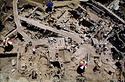
... West of the road, remains of a bath built in the 3rd century A.D. were excavated. East of the road, further evidence of occupation in the area were discovered, as well as of activity by coroplasts.
|
| Agora Excavation Summary 1966 ... Gerald Lalonde ... Excavation was carried out beneath the modern road south of the Theseion and the Southwest Fountain House. The purpose was to investigate the coarse of the roadway and its adjacent monuments at successive ... 4 Jul-2 Sep 1966 ... Excavation was carried out beneath the modern road south of the Theseion and the Southwest Fountain House. |
| Section ΜΜ
Summaries for 1936 ... Homer A. Thompson ... Three main ancient features were excavated within Section ΜΜ: the North Stoa, the South Building and the ancient East-West Street passing between the two buildings. After the destruction of the buildings, ... 10 Feb-25 May 1936 ... After the destruction of the buildings, and after the road had ceased to be used, the area was still inhabited. |
| Section Ν 1937 ... R.H. Howland ... Report on the excavation in the northern end of Section Ν, which started at Byzantine level and went down to the first classical level. A strip of the Byzantine and Vandal road was the largest area exposed ... 25 Jan-30 Mar 1937 ... A strip of the Byzantine and Vandal road was the largest area exposed. |
| Sections Rho and Eta 1937 ... James H. Oliver ... Byzantine settlements in Sections Η and Ρ were removed and the foundations of the Temple of Ares exposed.
The most noticeable feature was the road serving as the main thoroughfare in the neighborhood from ... 24 Feb 1937 ... The most noticeable feature was the road serving as the main thoroughfare in the neighborhood from the earliest Byzantine times until present days. A vast amount of road filling was removed as well as a series of rooms. |
| Section ΠΠ 1947 Season Preliminary Report ... Arthur W. Parsons Margaret Crosby ... The early part of the excavation season in Section ΠΠ was concerned almost exclusively with the removal of the Asteroskopiou Street, a road going back to the 1st or 2nd century A.D.
The work of the remainder ... 28 Apr-11 Aug 1947 ... The early part of the excavation season in Section ΠΠ was concerned almost exclusively with the removal of the Asteroskopiou Street, a road going back to the 1st or 2nd century A.D.
|
| Section ΟΟ: Preliminary Summary 1947 ... Margaret Crosby, Eugene Vanderpool ... Excavations in Section ΟΟ were taken place in four parts: the modern and Turkish road levels were removed; a part of the Great Drain, and drains connected with it, were examined; high Roman levels of Building ... 17 Mar-14 Aug 1947 ... Excavations in Section ΟΟ were taken place in four parts: the modern and Turkish road levels were removed; a part of the Great Drain, and drains connected with it, were examined; high Roman levels of Building A (Roman Bath) were dug and several rooms, a courtyard and two wells were uncovered; and in the South Central Area a number of houses, some wells and a kiln were uncovered. |
| Section ΠΠ 1948 ... Mabel Lang ... The western and northern parts of Section ΠΠ were brought down to Roman level. Revealed were Roman houses (North House and South House), drains and roads (East-West Road with two drains underneath it, ... 16 Mar-29 Apr 1948 ... Revealed were Roman houses (North House and South House), drains and roads (East-West Road with two drains underneath it, and the Great Drain Bridge). |
| Agora Excavations 1995 Preliminary Report ... John McK. Camp II ... Excavations continued in the areas of the Panathenaic Way, west of the Stoa Poikile, and in and around the Classical commercial building north of the Stoa Poikile.
In the Panathenaic way the exploration ... 12 Jun-4 Aug 1995 ... It became clear that the composition of the road fills changed drastically over time. In the second half of the 5th century B.C. the road surfaces were carefully prepared, perhaps to then serve as a race track.
|
| Preliminary Report on the 2006 Excavation Season ... John McK. Camp II ... This summer the 75th anniversary of the beginning of the excavations and the 50th anniversary of the reconstruction of the Stoa of Attalos were celebrated.
Excavation were concentrated on two areas: northwest ... 13 Jun-4 Aug 2006 ... In Section ΒΖ excavation continued in the north-south road and in the buildings to the east and west of it. ... Within the road itself, more of the hydraulic installations were cleared, including a second lead pipe and the drain along the side of the road. East of the road, earlier walls came to light, indicating that the Classical commercial building continued. |
| Section Ζ 1951 ... Homer A. Thompson ... The remaining pieces of the so-called Byzantine wall were removed, as well as a late Roman wall. Excavations in front of the Civic Offices revealed a hard road surface from the 3rd century A.D. More than ... 21 May-13 Jun 1951 ... Excavations in front of the Civic Offices revealed a hard road surface from the 3rd century A.D. |
| Excavation Summary Section ΒΔ: 1972 ... Stephen G. Miller ... With the exception of the removal of certain modern intrusions, the recovery of a few layers of a late Roman road, and the discovery of the westward continuation of the southern foundation of Roman Building ... 22 Mar-20 Jun 1972 ... With the exception of the removal of certain modern intrusions, the recovery of a few layers of a late Roman road, and the discovery of the westward continuation of the southern foundation of Roman Building β, the work in Section ΒΔ during the 1972 season was concentrated on the exploration of the lower levels in the western area of the section. |
| Section Υ
1937 Excavation Summary ... Rodney S. Young ... Section Υ had suffered from modern leveling operations and in some parts there were no visible antiquities. In the southeast corner were traces of Proto-Geometric grave cuttings. Excavation revealed the ... 1 Oct 1936-24 Apr 1937 ... At the north end the drain was cut in an ancient road fill and probably the ancient street originally ran over the drain for the whole length of its course. Beside the road, parts of two ancient retaining walls are preserved. |
| Agora Excavations Preliminary Report - Summer 2014 ... John McK. Camp II ... Excavations in 2014 were carried out in three sections: ΒΘ, ΒΓ and ΒΖ.
In Section ΒΘ, overlying the Painted Stoa, the Byzantine houses of the 11th century A.D. were further exposed in the western part ... 9 Jun-1 Aug 2014 ... Several road surfaces of Hellenistic date were encountered. No traces of wheel ruts were found which suggest that this road was closed to wheeled traffic. |
| Preliminary Report on the 2007 Excavation Season ... John McK. Camp II ... Excavation continued this year in the sections ΒΖ, ΒΗ and Γ.
In Section ΒΖ South, two areas were investigated: the north-south road and the areas west of the road. In the road, hard-packed gravel surfaces ... 13 Jun-3 Aug 2007 ... In Section ΒΖ South, two areas were investigated: the north-south road and the areas west of the road. In the road, hard-packed gravel surfaces were taken out, and the later water supply lines, one of terracotta and two of lead, were fully exposed. |
| Excavation Summary Section K: 1968 ... S. Grobel ... Excavations in Section Κ were conducted in the Marble Worker's Establishment, a series of rooms grouped around a courtyard. A cistern-well was discovered and excavated, as was a pit and a pyre burial ... 17 Jun-17 Aug 1968 ... Much of Section ΣΤ, excavated in 1932 and then filled-in, were reopened to explore the road and drainage system in the southwest Agora. |
| Preliminary Report on the 1998 Excavation Season ... John McK. Camp II ... Most work this year was concentrated to a new area at the extreme northwest, where a modern building had been demolished. Fill from modern to Byzantine times were excavated. The principal feature uncovered ... 8 Jun-31 Jul 1998 ... The principal feature uncovered was the north-south road which runs through the area.
|
| Preliminary Report on the 1999 Excavation Season ... John McK. Camp II ... Most of the work this season was concentrated in the northern half of Section ΒΖ where the Byzantine levels were further explored. Street walls along both sides of the north-south road were revealed and ... 7 Jun-30 Jul 1999 ... Street walls along both sides of the north-south road were revealed and part of three houses were uncovered. |
| Preliminary Report on the 2011 Excavation Season ... John McK. Camp II ... Excavations were carried out in three sections, two of them overlying the Painted Stoa (ΒΗ and ΒΘ) and one in the Panathenaic Way (ΒΓ).
In Section ΒΓ, excavations were concentrated on the Panathenaic Way ... 13 Jun-5 Aug 2011 ... A second trench in the road was opened to reexamine the hypothesis that the road itself had been used as a race track.
|
|
|