|
|
Stand; open above and below. Spreading concave profile with moulded rim and base; the rim flat on top. Well made of heavy light-red household ware, red to buff surfacing. On the underside a few splashes ... Context ca. 425-400 B.C ... The glaze splashes might suggest that this stand was made not for domestic use but possibly for a pottery works, to hold large vases during some stage of their manufacture or decoration. |
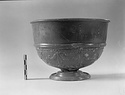
| Mended from several fragments; about half of body missing. Moulded foot; short stem; shallow convex body; high straight rim with out-turned lip. In relief on body: boukrania with pendent ribbons, garlands ... 20 July 1946 |
Mended with small missing pieces restored in plaster and painted. Lip offset on inside; foot offset on underside. Glaze slightly abraded on handles. H. 0.074; diam. of rim 0.18; W. with handles 0.238; ... Ca. 510-500 B.C ... H. 0.074; diam. of rim 0.18; W. with handles 0.238; diam. of tondo 0.088; diam. of foot 0.074. Pottery and Glass (November 1954), p. 349 (illustrated); H. ... Beazley accepted the attribution but with some hesitation (see especially The Berlin Painter [Melbourne 1964], pp. 1, 12, 13); yet he included the cup among the painter's works in both ARV2 (1963) and Paralip. (1971). |
|
|