|
|
Fillings immediately antedating the building of the Stoa.
Cf. Hesperia 6 (1937), p. 20 and the debris of a pottery works behind the Stoa (H 7:1) ... Hesperia 6 (1937), p. 20 and the debris of a pottery works behind the Stoa (H 7:1). |
Filling behind retaining wall of Stoa of Zeus. The remains of unfired clay adhering to the interior of various pieces make it probable that the material in this filling is a mass of debris from the floor ... Ca. 435-425 B.C ... The remains of unfired clay adhering to the interior of various pieces make it probable that the material in this filling is a mass of debris from the floor of a pottery-works destroyed by subsequent building. |
Stand; open above and below. Spreading concave profile with moulded rim and base; the rim flat on top. Well made of heavy light-red household ware, red to buff surfacing. On the underside a few splashes ... Context ca. 425-400 B.C ... The glaze splashes might suggest that this stand was made not for domestic use but possibly for a pottery works, to hold large vases during some stage of their manufacture or decoration. |
| Pre-Heliaia Houses. Steps on North Side. Outer Foundation of Heliaia. Outer Foundation of Heliaia; South Side. Outer Foundation of Heliaia; Southeast Corner. Outer Foundation of Heliaia; West Side. Outer ... Κ-18 3402, 3403 ... Pottery Works ... Pottery Works; Kiln ... Pottery Works; Clay Pits |
Amyx, Darrell A. Lawrence, Patricia ... American School of Classical Studies at Athens ... In the first section of this book, Amyx catalogues and discusses more than 200 fragments of Archaic Corinthian pottery with figure decoration, selected from those previously unpublished or inadequately ... 1975 ... In the first section of this book, Amyx catalogues and discusses more than 200 fragments of Archaic Corinthian pottery with figure decoration, selected from those previously unpublished or inadequately published. The authors have also given attention to vase-painters of the Protocorinthian and Corinthian periods who were previously known chiefly from works exported in antiquity, and have succeeded in establishing the importance of the Corinth Museum as a center for the study of the Corinthian Style. |
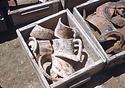
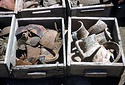
| Seventh century well to east of Odeion: Protoattic pottery as found (close-up of boxes). Deposit O 12:1 ... Horizontal (normal) ... 1952 |
| Seventh century well to east of Odeion: Protoattic pottery as found (close-up of boxes). Deposit O 12:1 ... Horizontal (normal) ... 1952 |
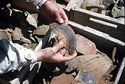
| Seventh century well to east of Odeion: Pottery before washing (Andreas making joins, close-up). Deposit O 12:1 ... 1952 |
|
|
.jpg.icon.jpg)