|
|
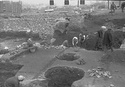
| Well I: PG, ELS. The collapsed well north of the Middle Stoa Terrace. This pit, or shallow well, into which a Turkish storage pit lined with stones was set, produced purely Proto-Geometric pottery and ... Protogeometric ... This pit, or shallow well, into which a Turkish storage pit lined with stones was set, produced purely Proto-Geometric pottery and one Mycenaean figurine. |
Well 19: Latest Mycenaean. Near Klepsydra. Diameter mouth 1.25-1.35m., narrowing about a third of the way down and becoming rectangular, 0.90-1.0 to a side. Muddy at m; water collecting rapidly at 8.m ... Late Mycenaean ... Three strata in filling; no pottery joins between them. ... Above, two dumped strata of domestic debris, storage pithoi, architectural fragments, quantities of stones from walls (in upper), grindstones; commonest and latest pottery post-fountain.
... Sorted for storage E.L.S. (1952) |
A small square well at 37/ΚΑ (about 0.60x0.70m), on the north slope of the Areopagus. Curbed with rough stones.
Filling of a small shallow well which contained nothing from the POU and since no water was ... Ca. 350-320 B.C ... Filling of a small shallow well which contained nothing from the POU and since no water was encountered, may have served only as a storage or rubbish pit.
... Great variety of coarse and fine pottery, lamps, amphoras with stamps, and many figurines, of which the most remarkable is the terracotta hedgehog. |
With cistern at 17/ΟΕ-ΟΣΤ (P 10:2), two chambers connected by a passage.
18/Π went out of use first and was closed off from 17/ΟΕ-ΟΣΤ; filled up at one time with material dating between 350 and 300 B.C ... 325-285 B.C ... With cistern at 17/ΟΕ-ΟΣΤ (P 10:2), two chambers connected by a passage.
18/Π went out of use first and was closed off from 17/ΟΕ-ΟΣΤ; filled up at one time with material dating between 350 and 300 B.C. with a miscellaneous collection of tiles, coarse pottery and other household objects, with a few good black-glazed pieces and two dateable coins.
17/ΟΕ-ΟΣΤ continued in use until ca. 250 B.C. when it was filled up at one time with an apparently contemporary group of discarded household pottery. ... Tins 442-447 withdrawn from storage to mend up as group from this cistern, November 1948. |
Washed-in filling at the base of the Acropolis cliffs, some 7m. east of the Klepsydra; the fill was characterized by teh fragments of a series of red-figured oinochoai of special shape, of the late 5th ... Late 3rd c. B.C ... The filling which had been undisturbed since antiquity, was in places as much as 0.80m deep and produced a great quantity of pottery. Much of the pottery was coarse, fragments of rooftiles, storage jars and so on; but it included fragments of at least eight very curious oinochoes.
... Although the character of the pottery precluded the possibility that this was a sanctuary dump, it seemed probable at first that the pit was in part artificial, and that the pottery had been deliberately deposited there. |
Well ΑΒ located on the lower terrace to the north of the sanctuary(diameter 1.10m). Foot-holes were cut into the shaft at intervals of ca. 0.40m. The fill consisted mostly of small stones, dug bedrock, ... Second quarter of the 6th century B.C ... Among the pottery, there was about 40% of earlier sherds from the 8th and 7th centuries B.C. and of Corinthian-ware (9.7%).
... Coarse ware and plain ware : SOS amphora; storage jar; lekane; coarse ware.
|
|
|