|
|
| Pyre against north face of polygonal wall, Room 2, Classical Building II. No floor preserved above, but the pyre is below floor level 51.820masl, preserved just to the east and above patchy floor with ... Ca. 275-260 B.C ... Pyre against north face of polygonal wall, Room 2, Classical Building II. |
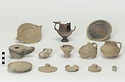
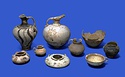
| David Scahill ... Below packed clay floors in Room 2 of Classical Building II; bordered on east and south sides by polygonal cross wall and back wall extension for Classical Building. Late Roman wall and drain installation ... LHIII A:1 ... Below packed clay floors in Room 2 of Classical Building II; bordered on east and south sides by polygonal cross wall and back wall extension for Classical Building. ... Upper part of tomb cut away by leveling for floors of Classical Building. Loose fill of stones and earth with large number of Geometric sherds ranging from Protogeometric to late Geometric in date, from top of cutting extending down into layer of tomb contents. |
Brian Martens ... This deep stratum (ca. 030m) is delayed Persian destruction cleanup deposited in the 470s B.C. it contains about one generation's worth of pottery, almost exclusively dating between about 500-470 B.C ... 29 June-19 July 2017
12–15 July 2022 ... The stratum abutted E-W polygonal Wall 8 and was laid down for Post-Persian renovations of the building. The dump of pottery raised the floor level of the building; atop J 1:18 was a layer of crushed bedrock and a renewed floor surface.
|
Well 12: Archaic.
It lies on a rocky ledge about thirty meters north of the Klepsydra, just east of the Panathenaic street. In spite of its depth, it produced little pottery and its contents were of slight ... 6th c. B.C.? ... In the well were not merely the usual quantities of domestic wares, pithoi, tubs and the like, of broken up terracotta rooftiles and crude brick; there was also a number of building stones: three large blocks of poros from some archaic structure, and many small carefully dressed blocks of Acropolis limestone from a polygonal wall or walls. |
|
|