|
|
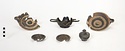
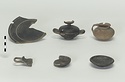
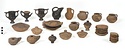
Greek Deposit at 42/ΙΖ Lot Ι 164a: fish plates, rouletting etc ... 4th c. B.C. and possibly into 3rd c. B.C ... Lot Ι 164a: fish plates, rouletting etc. |
| Crevice in Rock (Grave?) at 70/ΝΣΤ (below modern surface accumulation).
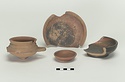
Identified as a sacrificial pyre, with characteristic banded plates and saucers, by SIR ... 4th c. B.C./300-250 B.C ... Identified as a sacrificial pyre, with characteristic banded plates and saucers, by SIR. |
Fill in abandoned cistern, lower terrace adjacent yo the Eleusinion on the north.
Uncatalogued material: 189 sherds, 4 objects. Many kernoi fragments.
Objects : loom weights; lamp.
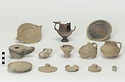
Early ware : Gray Minyan; ... Mid. 4th c. B.C ... Archaic-Classical : black figure; black glaze; amphora; cup; krater; oinochoe; skyphos; cup-kantharos; bolsal; stemmed dishes; echinos bowls; fish plates; plates; lekanis; pyxis; thurible; miniature kothon; unglazed; plemochoai.
|
The absence of certain shapes (no kantharoi or cup-kantharoi) may be due to the nature of the establishment from which the material came. Also, absence of rouletting save for one example. The lack of these ... Ca. 390-375 B.C ... Coins:
Cf. 17 May 1933 #1-#10
18 May 1933 #1-#2
20 May 1933 #1
23 May 1933 #1
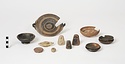
Bolsals; plates; many "coarsely glazed' plates; small "coarsely glazed" saucers; black-glazed bowls; fish-plate; "animal askoi"; red figured bell-krater fragment; small black-glazed bowl fragments; one piece of rouletting; lamps. |
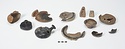
| Pyre against north face of polygonal wall, Room 2, Classical Building II. No floor preserved above, but the pyre is below floor level 51.820masl, preserved just to the east and above patchy floor with ... Ca. 275-260 B.C ... Includes 2 chytra, small saucer and rilled rim plates. |
After the abandonment of the well and the collapse of the well-curb, the upper 2.00m. of the shaft were filled with a dump apparently dug up nearby. Material for the most part of the 5th c. B.C. but containing ... 7th c. A.D ... B.C. but containing a little that is later and also three plates apparently from a sacrificial pyre of the early 4th c. |
| Cistern at 77/Μ on lower north slopes of the Areopagus. Bottom diameter of 2m connected by tunnel to cistern M-N 18:1.
Only stamped amphora handle dates slightly after 240. Latest coin dates about 200 ... 3rd c. B.C.-196/190 B.C ... Bowls and plates share stamps with vessels from N 21:4, E 14:1, F 17:4, G 14:2. |
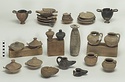
| Laura Gawlinski ... Fill excavated south and west of Early Building Ii, Room E latrine, with a high concentration of votive material, such as pyre saucers, miniature loom weights, and ribbon handled plates. Some traces of ... 400-350 B.C ... Fill excavated south and west of Early Building Ii, Room E latrine, with a high concentration of votive material, such as pyre saucers, miniature loom weights, and ribbon handled plates. Some traces of ash, but not spread throughout entire fill. |
| Pocket, identified as sacrificial pyre by SIR. Possibly disturbed. Outside south wall of building. Concentration of pottery in a small pocket below a "Hellenistic" fill. There is no mention of bone or ... First quarter 4th c. B.C ... A miniature black glazed lekanis (P 1465) and a small one-handler accompany the saucers and plates and the miniature chytra (P 1470). |
| Sacrificial Pyre = Pit in floor (identified as pyre by SIR); with the characteristic small plates and saucers. "Saucer Grave" at 12/ΚΑ.
Dimensions: 2m (length)x 0.70 (width).
North of north wall of building ... First half 4th c. B.C ... Sacrificial Pyre = Pit in floor (identified as pyre by SIR); with the characteristic small plates and saucers. |
| Grave V, under room 18 in House 3, plus burned deposit at 94/IΘ. Identified as sacrificial pyre by SIR on Agoraios Kolonos:
In southeast corner of house 3. 35 artifacts, bone and charred material in pit, ... Ca. 300-275 B.C ... Typical saucers, banded plates, miniature cooking pots, two unusual lamps and a pair of Corinthian type skyphoi. |
| Disturbed pyre dispersed in fill of Room 5, House D.
Pyre pots in very fragmentary condition were noticed by Barbara Tsakirgis in later analysis of pottery that had been excavated in 1938; no mention of ... 14 June 1938 ... It is likely that more than one pyre is involved: the two rilled-rim plates do not match and there are three lekanis lids (rarely does a pyre contain more than two lekanides). |
| Pyre in House N, room 4 (RSY=Pyre 7), in the industrial area west of the Areopagus.
Pottery, mall pieces of calcined bone, log, wood cinders, and charcoal in diamond-shaped pit in floor sequence. The pyre ... Late 4th-early 3rd c. B.C ... This is one of the largest pyres (more than one pyre lekanis, four chytridia, four ribbon-handled plates, all of them made up of two pairs). |
|
|