|
|
Clearing bedrock on line of early (Archaic) peribolos wall, east of entrance on the south side, west end. Uncatalogued material: 50 sherds, 83 fragments. of plemochoai.
Classical Ware : lekythos; plemochoai ... Early 2nd c. B.C ... Agora XXXI, pp. 149-150, 224; plan 2 and plan 3. |
Firm fill over bedrock on east edge of section, north of the early (Archaic) peribolos wall. Uncatalogued material: 10 sherds, 30 fragments of plemochoai. Deposit created by Margie Miles, 4 inventoried ... 3rd quarter 4th c. B.C ... Agora XXXI, pp. 150, 224; plan 3. |
House C, Room 4 (Pottery dump of stamnos wall and fill below floor). Coins:
1 July 1947 #13
2 July 1947 #1
Coins from House IV:
14 May 1947 #1-#2
19 May 1947 #6-#7
20 May 1947 #32 ... First half 3rd c. B.C ... Hesperia 20 (1951), pp. 136 (plan), 183, 277 where House C=House P. |
| RSY Grave 51.
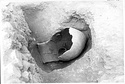
The grave lay on the slope of the Areopagus in Roman house O, just east of the line where the hillside is scarped for the foundation of the west wall of the house.
Cutting:the pit cut in ... Archaic period/6th or 7th c ... Hesperia 20 (1951), p. 109, pl. 48 c, d (Grave 51), plan pl. 33. |
| Investigations in the area of Archaic Temple Added by E.V June 1963 ΕΛ 324-331. In the annual report for 1959 both the building of the temple itself, and the red limestone addition are dated in the early ... First half of 6th c. B.C. - early 5th c. B.C ... Agora Guide, pp. 92-93, p. 89, fig. 19 (plan). |
Mycenaean burial, disturbed (Piers 12-13 east). Plan unclear.
Bones discarded.
It was found in the trench for the east stylobate of the Square Building. It was so badly disturbed by the Classical builders ... Myc. IIIA:2 ... Mycenaean burial, disturbed (Piers 12-13 east). Plan unclear.
Bones discarded.
... It was so badly disturbed by the Classical builders that it is impossible to tell anything about the plan, whether it was a small chamber tomb or a pit grave. |
Rodney Young ... Grave. RSY Grave 50. Outside archaic cemetery on the lower slopes of the Hill of the Nymphs, cremation burial. Roughly square pit (0.80x1.00m). This pit contained a heavy deposit of cinders and ash; its ... Beginning of the last quarter of the 6th century ... Hesperia 20 (1951), p. 108-109, pl. 47 d, 48 b (Grave 50), plan, pl. 33. |
Archaic house with Distyle Porch (= Building J) in southeast of section: packing beneath floors (Layers a and b of Tholos Trench S.Layer b=Beneath original floor dated to ca. 500 B.C.
Layer a=Between original ... 6th-early 5th c. B.C ... Hesperia Suppl. 4 (1940), pp. 34-38; p. 41 (plan). |
| Eugene Vanderpool ... Grave. Bones discarded.
Burial lies over dromos of Mycenaean chamber tomb N 21-22:1. The roots of a tree had upturned the bones, but the head probably lay at the northeast ... Middle Geometric II ... Hesperia 9 (1940), p. 292 (noted), fig. 34 and marked on plan p. 279, fig. 15. |
Pit in Tholos Trench V (below Layer e).
In plan it would seem to have been oval, though its east end is c/../ by the south wall of the North Archaic Home. Its N-S width is 1.25m, its E-W length is 1.40m ... 7th-early 6th c. B.C ... Pit in Tholos Trench V (below Layer e).
In plan it would seem to have been oval, though its east end is c/../ by the south wall of the North Archaic Home. |
| Mycenaean Double Grave (Graves A and B).
Grave A was in Layer II. We laid a skull and a few other bones, three vases and a stone bead. We have dug to a maximum of about 0.06m below the top of Layer II ... Myc. IIIA/B ... The skeletal material (AA 177) ... does not agree with the evidence of the plan and the excavator’s description since AA 177 consisted of bones of a M. about 40 to the north, and a F.(?) to the south, whereas the plan clearly shows three skulls, apparently all children. |
Square Peristyle (Square Building) Constructions fill + other (square peristyle area); fragmentary and with some earlier material but in the main, where undisturbed, a homogenous deposit. Coins:
26 May ... Βefore 300 B.C ... Agora Guide, pp. 76-78, fig. 15 (plan). |
Rodney S. Young ... (E.L. Smithson: Grave XXXVI:PG). Early fill over bedrock. No remains.
Two fragmentary unburned vases were found together on bedrock, beneath Roman and Byzantine fill. Disturbed earth over bedrock for several ... Early Protogeometric ... No photographs were taken, nor was any plan prepared of the deposit in situ (JP). |
| An area about 10m2. on the lower northwest slopes of the Areopagus, southeast of the archaic fountain house. A dumped fill to the end of the 3rd quarter of the 7th c. B.C., containing many votives, overlying ... 7th c. - 625 B.C ... See TCD Plan pp. 399-400 and list with TCD boxes numbers (and the lots they correspond to).
|
Filling between tongue walls to north of main apse in Late Roman complex, equals "Coroplasts' Dump" overlying Odeion south side.
Containers Ο 17-Ο 20 are from "debris of burnt building" [i.e. Odeion ... 267-ca. 350 A.D ... These finds include only those from "Late Roman fill between tongue walls" (the "brownish earth" indicated on nbp. 252 plan),and not from "debris of burnt building" which should fall under Destruction Debris of Odeion deposit L-M 9-12. |
| Debris filling in a bronze casting pit and workshop, characterized by mold fragments but including also a few plain vases and fragments of wine jars. Third quarter of 4th. c. BC.
The pit was cut into the ... Ca. 350-325 B.C ... The ground plan is that of a slightly lop-sided keyhole. |
Well at 62/ΙΑ, 63/ΙΑ, at the northwest foot of the Areopagus. Use filling in the lowest meter of the shaft.
The upper part of the shaft was filled with clay containing only occasional fragments of pottery; ... Ca. 600-540 B.C ... "In notebook references this well has been commonly placed in 62/ΙΑ. The plan shows it actually in 63-64/ΙΑ." |
Fills from construction and reconstruction of a house. "Brown House" = House A (RSY Hesp. 20) (and pit under Layer 4) in the industrial area west of the Areopagus.
Under the original floor of this house ... Second half of the 5th. c. B.C ... The filling of the floor levels of the house after its plan was changed and it was reconstructed yielded fragments of various coarse amphoras and black glazed table ware; four sherds incised with the letter kappa suggest that this is the initial of the owner of the house of the second period.
|
| Mycenaean Chamber Tomb.
Only the bottom 0.10 to 0.20m of the chamber was preserved along with the partial skeletal remains of two or three occupants. The plan revealed a square chamber (1.80m by 1.80m), ... Myc. III A 1:2 (14th c.) ... Only the bottom 0.10 to 0.20m of the chamber was preserved along with the partial skeletal remains of two or three occupants. The plan revealed a square chamber (1.80m by 1.80m), entered by a sloping dromos (0.90m wide and preserved to a length of 2.5m) from the northeast.
|
Cistern at 60/ΙΕ; bell-shaped cistern with a channel 1.65m high and 4.60m long, leading to a dead end against bedrock. This channel runs north with a slight curve to the east and looks as though it was ... Second half of 3rd c. B.C.-Early 2nd c. B.C ... After starting both channels, the builders for some reason gave up the plan, leaving them unconnected. |
| In room A. Concentration of artifacts and burning in stratum, no pit discerned. The pyre lay below a Late Hellenistic fill with a smooth earth surface. It is described as a black patch of earth with sherds, ... 350-250 B.C ... Strosis II, on which the pyre rested, covered the walls of Room A, demonstrating that the pyre postdates a change of plan or abandonment of this part of the building, other parts of which survived to the Late Hellenistic period. |
| Pyre(?) in House N, S.W. Room. (=House C, Room 10)
In room 10. Vessels from an earlier pyre were found dispersed in the makeup of the latest "floor" in the room, with tile fragments trodden into its surface ... First quarter of the 4th c. B.C ... This layer and the one below it run over the wall between rooms 9 and 10,so either they postdate the destruction of the house or indicate yet another change in its plan. In either case, the trodden surface suggests that the area continued to be used.
|
Cistern at 9/Β (10/Β on plan), at the NW foot of the Areopagus, some 200m to the west of the Coroplast's Dump. It had evidently belonged to one of the small houses in that thickly populated residential ... Second half 4th c. B.C ... Cistern at 9/Β (10/Β on plan), at the NW foot of the Areopagus, some 200m to the west of the Coroplast's Dump. |
Investigations to the south of the Metroon, in the passageway between the Metroon and the Tholos; accumulated layers, from the Geometric and earlier periods to the 3rd and 2nd centuries B.C.
Cf. Hesperia ... Geometric to second c. B.C ... Hesperia 6 (1937), p. 131, fig. 71, for a section of the layers, and notebook p. 1169 for a sketch plan of the area delineated by this deposit.
|
| Mycenaean Chamber Tomb under north side of Temple of Ares, towards its west end.(1951).
The tomb had a hasty and unfinished appearance oddly at variance with its long history and the quality of the pottery ... 1st: Myc IIB-IIA:1-2, 2nd: Myc. IIIC:1 (1450-1200 B.C.) ... It formed an irregular triangle in plan, with the apex to the north: 2.00m wide by 2.85m long. |
| Mycenaean Small Chamber tomb.
The cist measures 1,90m E to W, 0.75-0.90m N to S, max. depth -1.30m. Nothing was found in it; cleaned in modern times and used as a cesspool. Some of the SW part of it had ... Myc. IIIA, early 14th c ... The cutting is not straight either in vertical or horizontal section, which shows that the chamber was circular in plan and probably roughly semi-circular in section. |
|
|