|
|
Anne McCabe ... Pithos D, adjacent to Pithos A at the NE, is built of stone and broken tile, beehive-shaped, unlined, with no floor. The wall of Pithos D appears to have been cut by the construction of the mortar wall ... 4-6 July 2007
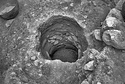
31 July 2007 ... Pithos D, adjacent to Pithos A at the NE, is built of stone and broken tile, beehive-shaped, unlined, with no floor. The wall of Pithos D appears to have been cut by the construction of the mortar wall of Pithos A, and both vessels were damaged by the modern basement. ... The damaged upper courses of the wall of Pithos D were dismantled from 53.911m. |
Pithos in NW corner (room) of Poros Building. Marble chips ... Mid-4th c.? |
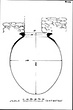
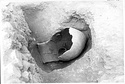
| Grave 2 in notebook. Child of about two (or 10?) months, body placed in plain pithos, which rested on its side at the bottom of a pit; the mouth closed with a stone slab.
The burial forms a group with ... 750-725 B.C ... months, body placed in plain pithos, which rested on its side at the bottom of a pit; the mouth closed with a stone slab.
The burial forms a group with two other graves (D 16:2, D 16:4) set in angle formed by intersecting roads. |
| "Room D" is the triangular area at L/15,16-2/10,12, NW of Wall 1, in E corner of basement of No.3. Hastings Street, bounded by the NE and SE walls of basement).
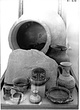
Bell-shaped vessel built of horizontally-laid ... 10th-11th c. A.D ... Pithos or Bothros in Byzantine "Room D". |
| Pithos ay the bottom of the north slope of the Areopagus with single fill; Part of Hellenistic Group D.
One stamped amphora handle dates slightly after 146. Latest coin dates in first two decades of 2nd ... 160-130 B.C ... Pithos ay the bottom of the north slope of the Areopagus with single fill; Part of Hellenistic Group D.
|
| RSY Grave 51.
The grave lay on the slope of the Areopagus in Roman house O, just east of the line where the hillside is scarped for the foundation of the west wall of the house.
Cutting:the pit cut in ... Archaic period/6th or 7th c. |
|
|