|
|
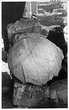
Part of left breast and chest remain.
Possibly to be associated with S 551 (Ο 564): head of Aphrodite.
Cf. Pausanias, I, 8, 4.
Fine work.
Pentelic marble.
ADDENDA Can not belong to S 551, because she ... 30 July 1946 ... Possibly to be associated with S 551 (Ο 564): head of Aphrodite.
Cf. Pausanias, I, 8, 4.
Fine work.
|
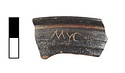
| Rim fragment. Scraped line with traces of miltos below lip.
Incised on rim: MYC ().
Metallic black glaze. Attic.
Apparently rare Attic name. Perhaps refering to 5th c. MUS, famous metal worker who made ... 11 July 1949 ... MUS, famous metal worker who made Parthenon shield and several silver cups mentioned by Athenaeus and Pausanias. |
| A flake, apparently from the shoulder of a very large draped figure.
The surface towards the top was rough-finished with a single point; lower down, smoothed with a chisel. Towards one side a puntillo ... August 1947 ... Possibly to be associated with the colossal toes found near the N.W. corner of the Odeion, S 1220 (ΩΔ 229), and so possibly with the "Dionysos worth seeing" of Pausanias.
Pentelic marble. |
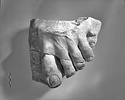
| Parts of left foot of a colossal figure.
a) First three toes of foot. Edge of plinth to proper right appears to be original. Very precise work; surface extremely fresh. Traces of red (?) on toenail.
b) ... a) (ΩΔ 229) 15 June 1946
b) (Ι 1640) July 1959 ... Foot of Dionysos? Cf. Pausanias I, 14, 1.
Pentelic marble. |
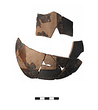
| Eleven pieces comprising two non-joining fragments. To Young's publication of six pieces are now added five more, two of which help to complete to inscription.
Part of the side wall with reserved panel ... 600 B.C ... Hemberg shows that Apollo receives the title Anax in Homer and Classical literature far more often than any other deity, and since, like Zeus, Apollo was worshipped on Mount Hymettos (Pausanias, I, 32,2), it is possible that the inscription is a dedication to both deities.
|
|
|