|
|
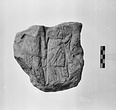
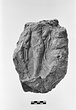
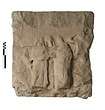
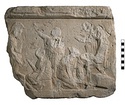
| Right side of nymph relief with back preserved; top, bottom and sides broken.
Two nymphs, heads missing, dressed in chiton and himation, hold hands and dance left. Rocky cave border at right.
Pentelic ... 9 August 1977 ... Relief Fragment with Nymphs |
Inscribed fragment.
Back, rough picked, preserved.
Top, bottom and sides broken.
Inscribed on a shallow band below a battered ovolo moulding.
Two lines of the inscription preserved.
Pentelic marble. Brough ... 18 January 1937 ... Brough in from behind the hill of the Nymphs, southwest of the Agora. |
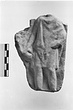
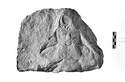
| Broken all around, curved surfaces.
Male figure with short chiton and chlamys leads by the hand a female figure. Drapery preserved at right is chiton and himation - Hermes Psychopompas (?). Resembles pose ... 4th c. B.C ... Resembles pose of Hermes and Nymphs.
Pentelic marble. |
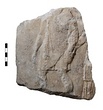
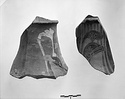
| Broken top, bottom and left sides. Surface weathered.
Frontal figure, broken off below neck and above ankles, wears a short chiton and chlamys. At the left a rocky projection.
Perhaps a relief of Hermes ... 12 July 1978 ... Perhaps a relief of Hermes and the Nymphs.
Pentelic marble. |
| Broken on all sides. Back preserved; rough-picked.
Legs of nude male striding left with drapery falling in front; archaistic.
Perhaps representing row dance of Hermes and the Nymphs.
Hollow cutting on ... 9 August 1977 ... Perhaps representing row dance of Hermes and the Nymphs.
Hollow cutting on back surface from reuse.
|
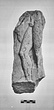
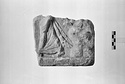
| From a thin plaque; rough-picked back; figures roughly cut in low relief.
Preserved are parts of two draped standing female figures, hand in hand to left. At right a rocky projection.
Hymettian marble ... 24 October 1938 ... ADDENDA The figures represent two nymphs, cf. Fenbel (1930), Die Attischen Nymphenreliefs. |
Handle missing; chips from side.
Watch-shaped body, small discus, top rayed. Long nozzle, triangular at end. Rudimentary unpierced knob at right. Vertical strap-handle.
Signed: "ΑΙΝΕΙΟΥ"; letters in relief, ... 5 February 1940 ... Found by some boys somewhere in the region of the Pnyx and the Hill of the Nymphs. |
| Top and left side preserved, back and front worn by traffic.
Top of stele was rounded. A horned Pan facing front, about to put his syrinx to his lips.
Summary but spirited work.
Pentelic marble.
(This ... 14 May 1936 ... (This fragment may well come from the Byzantine foundation and may ultimately derive from the sanctuary of the nymphs that adjoined the Sanctuary of Bendis in the Peiraeus.)
|
| About half of neck reserved. Break for lower handle attachment at lower left. Part of helmet and high white crest right, preserved. At left, just to right of black panel under handle and just above break, ... 7 May 1947 ... Context published as "Valley between the Areopagus and the Hill of the Nymphs, context of the Roman period." |
| Small archaistic relief. Fragment from lower right corner, broken at top and left. Back rough-dressed; sides toothed fine. At the right is a large object roughly blocked out: rocky landscape (?). To the ... 18 December 1936 ... ADDENDA Published as a votive relief of Pan and three Nymphs. |
| Broken at right. Top, bottom and left sides irregularly preserved. Back originally rough-picked but smoothed from reuse. Original relief ground chipped away on edges, particularly at top.
Preserved are ... 25 August 1977 ... The male figure is slightly larger than the females - perhaps he is Apollo and the women Muses or Nymphs. The surface is very battered.
|
| Broken at left and bottom. Back worn down. Surface badly chipped, especially heads of figures.
At left sits Athena, somewhat elevated, resting her chin on her left hand. Left elbow supported by left knee, ... 21 June 1972 ... Possibly nymphs of Mt. Penteli quarrying stone.
|
| Inscribed fragments of votive or funerary reliefs.
Cave of Pan relief.
Fragment Ω 1525, broken all around. Part of top and bottom surfaces preserved. Bottom border of a stele with part of the tenon preserved ... 330-320 B.C. (?) ... Below Nymphs, Pan lying on his left side, supporting himself on a wineskin, furry goat legs, bearded, with smile still visible.
|
|
|