|
|
| Not completely excavated due to instability of chamber walls and water. Sherds of all periods - Greek, Roman and Byzantine - were found in it [nbp. 424].
Re-examined in 2010. Photos and notes on NB pages ... 10th c. A.D ... Cistern: Northern chamber |
Well dug through N 18:1 (cistern at 79/ΜΗ) on the lower north slopes of Areopagus; the cistern was the northern chamber of a system; the southern chamber is at 84/ΝΣΤ (N 19:1).
A single dumped deposit ... 3rd-4th c. A.D ... Well dug through N 18:1 (cistern at 79/ΜΗ) on the lower north slopes of Areopagus; the cistern was the northern chamber of a system; the southern chamber is at 84/ΝΣΤ (N 19:1).
|
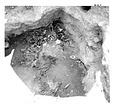
| Stephen G. Miller ... Irregular circular tomb (Diam. 2.20-2.60) with blocked dromos to northwest. Top of tomb lost in Archaic grading of area, center disturbed by Byzantine pit, overbuilt by northern-eastern walls of Room 3 ... LH III |
| Brian Martens ... Mycenaean Chamber Tomb J 1:11, located in the area north of Wall K, was partially excavated during the 2014 season. At this point the full western extent of the chamber has not been located because of ... LHIIIA ... At this point the full western extent of the chamber has not been located because of a dividing baulk and a possible second chamber or passage appears to open at the northeast. ... Two articulated skeleton, both adult females (one with fetus in utero), were found along the northern and southern walls of the chamber, respectively. ... Only a small portion of the northern edge, cutting into the rocky red virgin fill, could be revealed; the remainder is presently concealed under the scarp of still-standing Wall P. the stomion and its intact blocking wall were found behind a thin layer of fill centered at the western side of the chamber. |
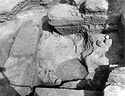
| David Scahill ... Behind northeast corner of Classical Building; east wall C. Below Hellenistic levels and early Classical pit. Chamber cut through bedrock, depth ca. 0.90m., diameter ca. 2m., roughly square in shape, angling ... LH III A:1 ... Below Hellenistic levels and early Classical pit. Chamber cut through bedrock, depth ca. 0.90m., diameter ca. 2m., roughly square in shape, angling inward toward top. ... Two distinct clay layers at floor; fine orange layer in northern half, dark brown layer in southern half. |
Dromos of a Mycenaean Tomb at N end of Stoa Terrace (Burial 3). No remains. Perhaps to be associated with dromos of a Mycenaean chamber tomb (?) observed in this area (XIV, p. 2707).
Tomb found when workmen ... Myc. III A ... Perhaps to be associated with dromos of a Mycenaean chamber tomb (?) observed in this area (XIV, p. 2707).
Tomb found when workmen were clearing the bottom stratum of the foundations of the Stoa colonnade at its northern end. A soft spot in the earth revealed a cutting about 0.95m wide running from west to east and sloping downward toward the east, apparently the dromos of a chamber tomb, with its chamber under the stylobate foundations of the Stoa. The cutting was filled with greenish earth and contained only two sherds. The chamber and its burials could not be excavated, if indeed they had been spared by the Stoa builders. |
| Mycenaean Grave to W of Pier 12 (Burial 11).
The northern part of the tomb had been cut away by the foundation trench for the south stylobate of the Square Building that preceded the Stoa, and the dromos, ... Myc. IIB-IIIA:1 ... Mycenaean Grave to W of Pier 12 (Burial 11).
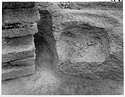
The northern part of the tomb had been cut away by the foundation trench for the south stylobate of the Square Building that preceded the Stoa, and the dromos, if one existed, must have been lost in this operation. The chamber was small with an original east-west dimension of 1.60m and a preserved north-south dimension of 1.20m, the walls preserved to a maximum height of 0.90m. ... Although it might be argued from the single internment and the absence of any preserved dromos that this was a pit grave, the location of the body along the edge of the cutting would seem rather to indicate a small chamber tomb that has been cut away at the north. |
| An extensive cistern system on the lower north slope of the Areopagus, south chamber with blind tunnel extending further south (south tunnel); north chamber; drawshaft further north, extends to north tunnel ... Ca. 320-240 B.C ... An extensive cistern system on the lower north slope of the Areopagus, south chamber with blind tunnel extending further south (south tunnel); north chamber; drawshaft further north, extends to north tunnel. ... About the same time,the southern chamber was dispensed with and the mouth of the passage leading to the north chamber was carefully walled, the one plastered face of the wall looking toward the northern chamber. ... In the meantime , the passageway connecting the two chambers was sacrificed and its remaining mouth closed by a wall looking into the northern chamber.
The network of underground reservoirs intended to supply the private houses of classical times which must have stood there to the south of the public market-square. |
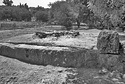
| Mycenaean Chamber Tomb occupies a considerable part of the western half of section ΕΕ; lies about half way up the north slope of the Areopagus towards its eastern end, just below the highest point of the ... Myc. III A:1 ... Mycenaean Chamber Tomb occupies a considerable part of the western half of section ΕΕ; lies about half way up the north slope of the Areopagus towards its eastern end, just below the highest point of the hill. ... It was originally several meters longer but its northern end was cut off by a late Roman retaining wall. ... Its outer or northern end was blocked by a neatly made dry wall of rough field stones. |
Evidence of stratification into five layers, although joins between the layers. Layer VI added when the construction of the Roman building above required it. No subdivisions assigned.
Flask-shaped cistern ... Early 3rd-late 2nd c. B.C ... Flask-shaped cistern chamber located on the northern slopes of Agoraios between the NW corner of the Hellenistic Building and the Temple of Aphrodite Ourania. |
|
|