|
|
Great Drain north end, filling under tiles (55-58).
Only the finds from 55-58/* are recorded here (as found in the notebooks) although the deposit notebook shows additional finds from the entire sand fill ... 3rd-2nd c. B.C ... Great Drain north end, filling under tiles (55-58).
|
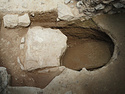
Pit in bedrock (disturbed child's grave?). No bones or ashes. No lots.
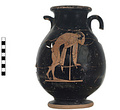
No coins listed. P 14520 was certainly from the north end, doubtless a grave offering; few sherds (first half of 5th century) came ... Late 6th - early 5th c. B.C ... P 14520 was certainly from the north end, doubtless a grave offering; few sherds (first half of 5th century) came from the north end as well. |
Great Drain sand fill under Roman bath including small area at north end under tiles that was excavated separately.
See also A-B 19-20:1 for additional Great Drain sand fill at ca. 70-113/* Subdivisions: ... 30 July-11 August 1947 ... Great Drain sand fill under Roman bath including small area at north end under tiles that was excavated separately.
... Subdivisions:
.1=55-58/*, sand fill north end, under tiles.
.2=sand fill south end continuing to north.
55-58/* |
Geometric Well at ca. 21/Κ beneath the west colonnade of the Square Peristyle, west of the north end of the Stoa of Attalos ... Late 8th century B.C ... Geometric Well at ca. 21/Κ beneath the west colonnade of the Square Peristyle, west of the north end of the Stoa of Attalos. |
Well at 8/ΙΑ-ΙΒ, beneath the north colonnade of the Square Peristyle, just west of the north end of the Stoa of Attalos. Quite uniform fill. Diameter 1.15m. No P.O.U. Coins:
4 April 1938 #39 ... 650-600 B.C.
5th c. B.C ... Well at 8/ΙΑ-ΙΒ, beneath the north colonnade of the Square Peristyle, just west of the north end of the Stoa of Attalos. |
Archaic Well at 10/ΚΒ, directly west of the north end of the Stoa of Attalos.
Well, not cleared. a small amount of pottery gathered from the top of the shaft ... 600-550 B.C ... Archaic Well at 10/ΚΒ, directly west of the north end of the Stoa of Attalos.
|
Coins:
30 July 1947 #3-#11
31 July 1947 #4-#19
1 August 1947 #1-#9
4 August 1947 #1-#20
5 August 1947 #3-#20
6 August 1947 #1-#38
7 August 1947 #1-#21
8 August 1947 #1-#41
9 August 1947 #3-#6
57-59/*
66-67/* ... 28-31 July 1947
6-9 August 1947 ... Sand fill, south end continuing to north |
Well Y, in area North of the West end of the Yellow Poros Foundation. The shaft had cut through the wall of an earlier well and the cavity had been packed with stones by the diggers of the new well. In ... Earth 5th c. B.C ... Well Y North of the West End of the Yellow Poros Foundation |
Located beneath line of Poros Gutter, from a square settling basin cut in bedrock at the north end of Trench II, South of Theseion, 1.30m below the modern road surface. The basin is lined with rough-picked ... Last quarter of 5th c. B.C.-early 4th c. B.C ... Located beneath line of Poros Gutter, from a square settling basin cut in bedrock at the north end of Trench II, South of Theseion, 1.30m below the modern road surface. |
Well of Christian Lamp; west of Stoa terrace wall near north end. Pottery spread out June 1952. A big amphora was made up (ΣΑ 1780), but nothing else went together. Fill appeared o be all of one period ... Late 5th-early 6th century A.D ... Well of Christian Lamp; west of Stoa terrace wall near north end. |
| Marcie Handler ... The Pyre was revealed in a layer of 4th c. fill in the north end of Room 6, just south of Wall 8. Room 6 is defined by the street wall (Wall A) on the west, Wall 7 on the east, Wall 9 on the south (preserved ... 4th c. B.C ... The Pyre was revealed in a layer of 4th c. fill in the north end of Room 6, just south of Wall 8. Room 6 is defined by the street wall (Wall A) on the west, Wall 7 on the east, Wall 9 on the south (preserved only as a stub on the east side of the area), and possibly Wall 8 or Wall 6 on the north.
2.5 meters SW of the pyre, a patch of floor surface at J/10-1/20 at 52.188 masl. was found. ... This pyre is the northernmost pyre found in Section ΒΖ North, and its location suggests that the Classical Commercial Building continues this far north. |
| Homer A. Thompson ... PG grave north of Stoa Pier 19 (Grave 6). In some records as Grave XLIII.
Unlined rectangular pit cut into a shallow depression in bedrock that was formed by the collapse of the roof of Mycenaean Chamber ... Developed Protogeometric ... PG grave north of Stoa Pier 19 (Grave 6). ... Unlined rectangular pit cut into a shallow depression in bedrock that was formed by the collapse of the roof of Mycenaean Chamber Tomb Q 8:8. The north end of the tomb had been sheared away for the construction of the Stoa. ... The tomb was oriented south-southwest to north-northeast.
On the floor of the pit, " a few bones and the skull" of the deceased were encountered, the cranium evidently at the south end of the grave. |
| Laura Gawlinski ... Bronze foundry north of bridge on Piraeus street, east of Great Drain.
Keyhole-shaped bronze casting pit, cut into bedrock.
2016: Continuation of the excavation of a rectangular pit with foundry debris, ... Late 6th-early 5th c. B.C.
(Late Archaic/ Early Classical) ... Bronze foundry north of bridge on Piraeus street, east of Great Drain.
... Pit is 2.58m long (N-S), at least 1.35m wide; 0.66m at narrow north end; 1.36m deep. ... Oriented north-south: 2.58m long; 1.35m at widest point; 0.66m at narrow north end; 1.36m deep. |
| Marcie Handler ... The remnants of a disturbed pyre in a layer of dumped Hellenistic fill. The fill was found in the area on top of and east of the eastern wall of the Classical Commercial Building at its north end. Fragmentary ... Ca. 225 B.C ... The fill was found in the area on top of and east of the eastern wall of the Classical Commercial Building at its north end. Fragmentary pyre pots were mixed into the fill, which dated to the period after 225 BC. ... the pyre pottery may very well have come from a pyre buried under a floor in the building just to the west of here. |
| Susan I. Rotroff ... Grave 2. Adult female inhumation. Grave extending under the south retaining wall of the Temenos of the Royal Stoa. It is oriented ne-sw, with head at sw. Grave built of slabs of schist, with packing of ... Final Mycenaean/Submycenaean ... Grave built of slabs of schist, with packing of small stones around north end. Floor was bedrock.
The grave diggers cut into an earlier grave immediately to the north; this grave was found empty. |
| Mycenaean Chamber Tomb SE of Stoa Pier 12 (Burial 8).
Roughly rectangular, measuring 1.70m by 1.40m, and was cut down to within 0.65m. by the construction of the Square Building. A rectangular cutting ... Early Myc. IIIA ... Across the north end lay the single skeleton of a child with head to east, lying on its back with knees doubled up. |
| Pyre in Horos Terrace Trench, East end, set into Strosis 5.
In room 1 (court), near north wall. Concentration in stratum, no pit discerned; described as a "little nest of pots" within layer V (Lot ΜΣ ... 350-325 B.C ... Pyre in Horos Terrace Trench, East end, set into Strosis 5.
In room 1 (court), near north wall. Concentration in stratum, no pit discerned; described as a "little nest of pots" within layer V (Lot ΜΣ 115), which overlay the hard strosis 5, the uppermost preserved floor of the house. |
| Pocket with burning at 60/ΚΗ. "Is this perhaps a disturbed pyre burial." [Nbp. 2928].
Identified as pyre by SIR.
Near north end of corridor, beside its west wall. Concentration of artifacts, tiny scraps ... 4th c. B.C ... Identified as pyre by SIR.
Near north end of corridor, beside its west wall. |
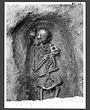
Eugene Vanderpool Homer A. Thompson ... Mycenaean burial (no offerings) in NW corner of Stoa Terrace (original north end).
" It consisted merely of an adult skeleton lying in an extended position with head to east and the left leg slightly flexed ... Mycenaean or Protogeometric ... Mycenaean burial (no offerings) in NW corner of Stoa Terrace (original north end).
" It consisted merely of an adult skeleton lying in an extended position with head to east and the left leg slightly flexed at the knee. |
Pit in Tholos Trench V (below Layer e).
In plan it would seem to have been oval, though its east end is c/../ by the south wall of the North Archaic Home. Its N-S width is 1.25m, its E-W length is 1.40m ... 7th-early 6th c. B.C ... In plan it would seem to have been oval, though its east end is c/../ by the south wall of the North Archaic Home. |
| Eugene Vanderpool ... Mycenaean Grave under Stoa Terrace, at original north end of Stoa; and PG vases on patches of stones over this burial, and to NE (formerly P 8:7). Cf. Q 8:13. No remains. In some records as Grave XLV ... 1 December 1953 ... Mycenaean Grave under Stoa Terrace, at original north end of Stoa; and PG vases on patches of stones over this burial, and to NE (formerly P 8:7). |
Evidence of stratification into five layers, although joins between the layers. Layer VI added when the construction of the Roman building above required it. No subdivisions assigned.
Flask-shaped cistern ... Early 3rd-late 2nd c. B.C ... Water was received at the north end of this and entered the cistern through a passage which was apparently dammed at the place it entered the cistern with a low block to provide for settling of sediment.
|
| Eugene Vanderpool ... Mycenaean Chamber Tomb.
Although badly disturbed at various times in antiquity, it was clearly a chamber tomb with the chamber little more than a cubby-hole at the end of a steep dromos, entered at the ... Myc. III A-B ... Although badly disturbed at various times in antiquity, it was clearly a chamber tomb with the chamber little more than a cubby-hole at the end of a steep dromos, entered at the north by two steps, and with the stone blocking-wall preserved for a few courses. |
| Mycenaean Chamber Tomb occupies a considerable part of the western half of section ΕΕ; lies about half way up the north slope of the Areopagus towards its eastern end, just below the highest point of the ... Myc. III A:1 ... Mycenaean Chamber Tomb occupies a considerable part of the western half of section ΕΕ; lies about half way up the north slope of the Areopagus towards its eastern end, just below the highest point of the hill. ... The only disturbances in this fill were three pits of the Turkish period near the north end.
The door or entrance passage is narrower than the dromos (width ca. 1.20m and narrows very slightly to about 1.10m at the top; maximum height 2.40m). ... Its roof has entirely caved in, except for a small bit projecting at the north end of the west side; probably was not flat but slightly concave (all along the north side it seems that it rises from the sides toward the center).
|
| Mycenaean Chamber Tomb under north side of Temple of Ares, towards its west end.(1951).
The tomb had a hasty and unfinished appearance oddly at variance with its long history and the quality of the pottery ... 1st: Myc IIB-IIA:1-2, 2nd: Myc. IIIC:1 (1450-1200 B.C.) ... Mycenaean Chamber Tomb under north side of Temple of Ares, towards its west end.(1951).
... The original dromos ran from west to east and entered the chamber toward the south end of the long west wall. ... It formed an irregular triangle in plan, with the apex to the north: 2.00m wide by 2.85m long. |
Cistern-system west of the Stoa of Zeus. Two chambers connected by a tunnel, each with two fills. Lower fill in south chamber contemporary with upper fill in north chamber, at the end of the 4th c. B.C ... Ca. 375-160 B.C ... Lower fill in south chamber contemporary with upper fill in north chamber, at the end of the 4th c. |
Soft Trench behind Stoa Stylobate, opposite Piers 21 and 22, along W face of Shop front wall. Herulian destruction debris at the north end of the Stoa of Attalos. Coins:
20 February 1954 #1-#2
22 February ... Late 3rd c. A.D ... Herulian destruction debris at the north end of the Stoa of Attalos. |
| Deposit of terracottas, molds and pottery in a shallow pit sloping downward from north to south. This deposit was located beneath a layer of fill under a Late Roman plaster floor (Lots ΒΕ 2093-2095). The ... 1st c. A.D ... Deposit of terracottas, molds and pottery in a shallow pit sloping downward from north to south. This deposit was located beneath a layer of fill under a Late Roman plaster floor (Lots ΒΕ 2093-2095). The deposit was cut at its south end by the Byzantine/Late Roman disturbance excavated in Lots ΒΕ 2087-2088, which explains the presence of terracottas in those contexts. |
| John Travlos ... (Grave XXXII: EG) Urn cremation (trench-and-hole). Published as cremation burial of a warrior.
The tomb was probably originally oriented north-south, with the urn-hole at the south end. The north side ... Transitional Early Geometric II-Middle Geometric I ... The tomb was probably originally oriented north-south, with the urn-hole at the south end. The north side of the urn-hole, most of the neck and rim of the cinerary urn, and the entire pyre trench had been cut away by a Turkish pit that was cleared in 1938.
|
| Bronze-casting pit and furnace against S apse of Church (106/ΛΕ). Late Roman sherds of the 4th and the 6th c. A.D. were found with fragments of moulds from bronze casting. The west end was destroyed by ... 5th-6th c. A.D ... The west end was destroyed by the church builders. There is a tile floor set on bedrock and two brick piers of the south wall stand to a height of 1.12 m.; one scrap of the north wall establishes a width of 1.05m. |
Cistern at 60/ΙΕ; bell-shaped cistern with a channel 1.65m high and 4.60m long, leading to a dead end against bedrock. This channel runs north with a slight curve to the east and looks as though it was ... Second half of 3rd c. B.C.-Early 2nd c. B.C ... Cistern at 60/ΙΕ; bell-shaped cistern with a channel 1.65m high and 4.60m long, leading to a dead end against bedrock. This channel runs north with a slight curve to the east and looks as though it was intended to meet a channel which started west from the cistern at 53/ΚΓ. |
| Homer A. Thompson ... PG grave to NW of Pier 19 (Grave 4).
It consisted of a rectangular pit, oriented north-south, cut into bedrock. Only the lowest part of the tomb pit was preserved; the upper part was cut away in the Classical ... Earlier-Developed Protogeometric ... It consisted of a rectangular pit, oriented north-south, cut into bedrock. ... The very northern end of the original pit tomb may have been cut by the foundations for the Stoa of Attalos. |
| An extensive cistern system on the lower north slope of the Areopagus, south chamber with blind tunnel extending further south (south tunnel); north chamber; drawshaft further north, extends to north tunnel ... Ca. 320-240 B.C ... An extensive cistern system on the lower north slope of the Areopagus, south chamber with blind tunnel extending further south (south tunnel); north chamber; drawshaft further north, extends to north tunnel. With exception of north tunnel (which contains nothing later than 300), all parts seem to have been filled at the same time.
... The cisterns and chains of cisterns must have been filled up at various times between the end of the 4th B.C. and the 1st c. |
Cistern-chamber on the northwest side of Kolonos Agoraios, 10 to 12m west of the end of the Hellenistic Building. Dimensions at bottom 2.50m x 2.75m.
The west chamber of a cistern system composed of two ... Use filling early 1st-2nd c. B.C ... Cistern-chamber on the northwest side of Kolonos Agoraios, 10 to 12m west of the end of the Hellenistic Building. ... The west chamber of a cistern system composed of two chambers connected by a passage (91/Ν); the east chamber at 91/Ν (E 5:1) retained little or no traces of its original period of use. North of the Hephaisteion. |
| John Camp ... Protogeometric grave (female inhumation) located about 0.60m northwest of T 15:1. It consisted of a roughly rectangular pit, with the corners slightly rounded, oriented approximately north-south. The pit ... "Submycenaean"/Early Protogeometric ... It consisted of a roughly rectangular pit, with the corners slightly rounded, oriented approximately north-south. The pit was cut to a depth of at least 0.45m at the south end and 0.25m at the north on account of the sloping bedrock. |
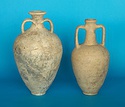
| Marcie Handler ... A deposit of six amphorae and one micaceous water jar was excavated between 20 June and 6 July 2005 in the area north of Wall K. The neck and one handle of one of the amphorae (BZ 1213) had been poking ... Ca. 1st c. A.D ... A deposit of six amphorae and one micaceous water jar was excavated between 20 June and 6 July 2005 in the area north of Wall K. The neck and one handle of one of the amphorae (BZ 1213) had been poking out of the surrounding fill since the end of the 2001 season. |
| C.G. Thomas ... Geometric grave. Bones discarded.
Tomb located about 2m west/west-southwest of the EG1 child inhumation, beneath the restored line of a hypothetical wall connecting the western "apse' and the south wall ... Middle Geometric II ... Oriented more or less to the points of the compass, the trench measured about 0.80m (east-west) by about 0.70m (north-south). The filling consisted of hard earth, most of it burned and struck through with charcoal, which was especially thick on the floor of the trench, where some pieces were as much as 0.05m across. Cremated human bone was scattered throughout the filling, with the heaviest concentration at the east end. Fragments of mudbrick, found throughout the fill, were most numerous at the east end, where the largest piece marked the southeast corner. ... Remnants of a stone packing over the trench survived on the west side and for a short distance along the north.
Sherds, burned and unburned, were scattered throughout the fill. |
| Brian Martens ... Mycenaean Chamber Tomb J 1:11, located in the area north of Wall K, was partially excavated during the 2014 season. At this point the full western extent of the chamber has not been located because of ... LHIIIA ... Mycenaean Chamber Tomb J 1:11, located in the area north of Wall K, was partially excavated during the 2014 season. ... At season-end, the chamber measures about 3x2.25 m. ... Just to the north, we excavated additional glass-paste beads, presumably part of a second strand.
|
| Brian Martens ... It was partially excavated during the 2012 and 2013 seasons. The tomb, located at the center of Room III in the NE area of section ΒΖ, was found under fill surrounding perpendicular mid-to late 6th c ... LHIIIA ... A strip of fill at the north side of the cutting, just below the scarp of Wall L remained unexcavated at the end of the season (J/17,18-1/10,11; 51.290-51.376 masl.)
2018:
We removed a final strip of fill in the chamber below the scarp under Wall K (J/17,19-1/10,11). ... A more complete analysis of these findings appears in the 2018 end-of-season report. |
| Marcie Handler ... This deposit is a Mycenaean cist grave with two cover slabs, a type of burial described by Immerwahr in Agora XIII (pp. 103-104). Cist graves appear side by side with chamber tombs in the Mycenaean cemeteries ... LHIIB-LHIIIA:1 ... Two slabs: a worked, flat, roughly rectangular poros limestone slab on the east (which had collapsed in the tomb,, sloping down to the north), and an unworked boulder with a naturally flat top surface and uneven underside on the west (it was still in situ). ... The upper fill covering the boulder on the west end of the cutting (Lots ΒΖ 2128 and 2130) dated to ca. 500 B.C., and the fill lying directly on top of the boulder (Lot ΒΖ 2131) dated to the late 8th c. |
| Initially uncovered with a diameter of c. 1.05m. Its south side extends under the south wall of the Classical structure and so clearly predates it. The highest preserved portion of the well shaft (at the ... 22 July-9 August 1994
26 June 1995
3-7 July 1995 ... The well is cut through a compact stratum of fill at the top of its the north side; elsewhere it is cut into the gray bedrock. ... Towards the end of season, the lower portion of that undug fill began to collapse into the shaft. |
|
|