|
|
Fragment of late Roman lamp, as type XXVIII, with two or more nozzles.
Incised leaf pattern on rim, impressed circles at nozzles. Flat bottom with two grooves around edge, and scattered dotted circles ... 29 March 1952 ... Fragment of late Roman lamp, as type XXVIII, with two or more nozzles.
... ADDENDA Traces of signature underneath (?) ... Late Roman fill over South Stoa. |
The neck and rim complete, with stumps of both handles of an early Rom jar similar to SS 10717 (ΠΠ 742); the rim somewhat more undercut.
Two stamps on rim.
Cf. SS 9608, SS 10717. North-south Street; Roman ... 10 May 1949 ... The neck and rim complete, with stumps of both handles of an early Rom jar similar to SS 10717 (ΠΠ 742); the rim somewhat more undercut.
... North-south Street; Roman packing beside Drain A at east. |
Complete save for small hole in bottom.
Plain discus; wavy lines on rim, with impressed dots at inner edge of handle and nozzle.
Solid handle, with two grooves above and below.
On the reverse, a double ... 7 March 1933 |
On rim, herringbone.
On discus, seated lion, facing right. Slightly restored with plaster.
Handle solid, small; double grooved above, single below.
On bottom, double almond-shaped groove, with three circles ... 25 April 1932 |
| Inscribed fragments.
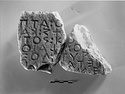
Fragment ΘΘ 105 a), inscribed face only preserved.
Six lines of the inscription preserved; boustrophedon.
Fragment ΘΘ 105 b), inscribed face only preserved.
Seven to eight lines ... a-c) (ΘΘ 105 a-c) 16, 16, 17 April 1937
d) (ΘΘ 138) 20 april 1937
e) (ΘΘ 155) 23 April 1937
f) (ΘΘ 206) 12 May 1937
g) (ΑΑ 64) 9 February 1938
h) (ΙΙ 223) 26 February 1938
i) (ΑΑ 244) 6 April 1938
j) (ΙΙ ... Joins at bottom of fragment d).
... Joins at top of fragment b).
... a-c) (ΘΘ 105 a-c), found at surface on the line of the late Roman Fortification, at the southwest of the Eleusinion.
d) (ΘΘ 138), found in late context on the line of the late Roman Fortification, at the southwest of the Eleusinion.
e) (ΘΘ 155), found in a late wall, at the south of the Eleusinion.
f) (ΘΘ 206), found in modern context, at the south of the Eleusinion.
g) (ΑΑ 64), found in modern context, west of the Eleusinion.
h) (ΙΙ 223), found in modern wall, south of the church of Hypapanti.
i) (ΑΑ 244), found in modern context, west of the late Roman Fortification.
j) (ΙΙ 448), found on east wall of the church of Hipapanti.
|
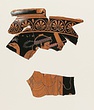
| Projecting rim, flat and reserved on top. Inside, alternating glazed and reserved bands, glazed broader and more streaked toward the middle of the pot than at the top where the surface has been polished ... 22 February -7 April 1935, 22 May 1937 ... Inside, alternating glazed and reserved bands, glazed broader and more streaked toward the middle of the pot than at the top where the surface has been polished and the glaze is shiny and thick.
a) Mended from five fragments, preserves part of the rim, of the palmette band below it, and of two figures in the zone beneath: the wreathed head and a bit of the back of Apollo, right, with his lyre. ... At the right edge of the fragment, part of his name(?) ... B' building fills, B- fill to north. and layer II of 38/ΣΤ. Fragment j) from late Roman disturbance in classical floor to south of the Propylon. |
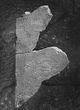
| Fragment Θ 26 a), from right side of inscribed block; fine picked on one side, rough picked on the back.
Fragment Κ 115 b), back and left side preserved. Fifteen lines of the inscription preserved.
Fragment ... 127/6 B.C ... Fragment Π 116 d), inscribed face only preserved. At left is part of a wreath, and at right the lower part of a rosette.
... Some of the main fragments were used in the filling of the south tower of the gate in the late Roman Fortification (Q 13); other main fragments came from modern house walls in this neighborhood, no doubt extracted from the Fortification; and a few were found in modern constructions 100m. and more to the north and west of the tower. ... The stele appears to have stood originally in front of the terrace of the Stoa of Attalos, about opposite Pier 5 from the south, and to have been broken up after the Herulian invasion for use as building material in the late Roman Fortification. |
|
|