|
|
http://agathe.gr/guide/odeion_of_agrippa.html Odeion of Agrippa Late in the 1st century B.C. the Athenians were given money for a new marketplace by Caesar and Augustus, and the northern half of the old Agora square was filled with two new structures, ... Entry to the Odeion was either from the upper level of the Middle Stoa on the south or through a modest porch at ground level on the north (Fig. 53). ... The structure was rebuilt as a lecture hall, with the seating capacity reduced to about 500, and a far more elaborate facade was built at the north, using massive pillars carved in the form of giants (snaky tales) and tritons (fishy tails) (Fig. 54). ... Drawing of the Late Roman reuse of the Odeion of Agrippa as part of a large palace-like complex, early 5th century A.C. |
Broneer, Oscar ... American School of Classical Studies at Athens ... After a discussion of the fragmentary evidence for several buildings of the Greek period which were swept to construct it, the South Stoa at Corinth is treated in detail. Careful description of all the ... 1954 ... After a discussion of the fragmentary evidence for several buildings of the Greek period which were swept to construct it, the South Stoa at Corinth is treated in detail. Careful description of all the remains, both those in situ and reused blocks, forms the basis of the reconstruction of this extensive two-story building of the third quarter of the 4th century B.C. which stretched the full length of the south side of the Corinthian Agora and, more than any other single building, established the size and shape of the center of the Hellenistic and Roman city. One of the largest secular buildings in Greece, the South Stoa appears to have been planned as a kind of hotel to accommodate visitors at a time when Corinth served as the capital of a briefly united Greek world. |
| Panorama view toward east of the street leading to the Roman Agora. The Gate of Athena in the background ... Craig Mauzy ... Image made of 2014.11.0007-2014.11.0013.
For more views and raw files, see Public / Photography / Unworked / Projects / 2104.11 Roman Street. east Horizontal (normal) ... 13 Aug 2014 |
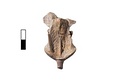
Fragment of late Roman lamp, as type XXVIII, with two or more nozzles.
Incised leaf pattern on rim, impressed circles at nozzles. Flat bottom with two grooves around edge, and scattered dotted circles ... 29 March 1952 ... Fragment of late Roman lamp, as type XXVIII, with two or more nozzles.
... ADDENDA Traces of signature underneath (?) ... Late Roman fill over South Stoa. |
The neck and rim complete, with stumps of both handles of an early Rom jar similar to SS 10717 (ΠΠ 742); the rim somewhat more undercut.
Two stamps on rim.
Cf. SS 9608, SS 10717. North-south Street; Roman ... 10 May 1949 ... The neck and rim complete, with stumps of both handles of an early Rom jar similar to SS 10717 (ΠΠ 742); the rim somewhat more undercut.
... North-south Street; Roman packing beside Drain A at east. |
Complete save for small hole in bottom.
Plain discus; wavy lines on rim, with impressed dots at inner edge of handle and nozzle.
Solid handle, with two grooves above and below.
On the reverse, a double ... 7 March 1933 |
| Byzantine Houses. Great Drain. Roman Levels of Southwest Side of Bath. East End of Bath. Area North of Street, House E. Geometric Grave 1. More of Roman at South. Northwest Room of Poros Building. Southeast ... ΟΟ-1 3, 4 Lot ΟΟ 1 Lot ΟΟ 263 Lot ΟΟ 264 Lot ΟΟ 936 ... Jul 1950 ... Roman Levels of Southwest Side of Bath ... More of Roman at South ... General Destruction amid Roman Work at North |
| Area west of the Holy Apostles and north of the Southeast Fountain House: General view from the roof of the Church of the Holy Apostles. At left, the Southeast Fountain House and the early house foundation ... southwest 5825 Horizontal (normal) ... 22 Aug 1955 |
| Area west of the Holy Apostles and north of the Southeast Fountain House: General view from the roof of the Church of the Holy Apostles. At left, the Southeast Fountain House and the early house foundation ... AMS southwest 5825 ... 22 Aug 1955 |
On rim, herringbone.
On discus, seated lion, facing right. Slightly restored with plaster.
Handle solid, small; double grooved above, single below.
On bottom, double almond-shaped groove, with three circles ... 25 April 1932 |
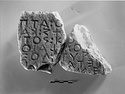
| Inscribed fragments.
Fragment ΘΘ 105 a), inscribed face only preserved.
Six lines of the inscription preserved; boustrophedon.
Fragment ΘΘ 105 b), inscribed face only preserved.
Seven to eight lines ... a-c) (ΘΘ 105 a-c) 16, 16, 17 April 1937
d) (ΘΘ 138) 20 april 1937
e) (ΘΘ 155) 23 April 1937
f) (ΘΘ 206) 12 May 1937
g) (ΑΑ 64) 9 February 1938
h) (ΙΙ 223) 26 February 1938
i) (ΑΑ 244) 6 April 1938
j) (ΙΙ ... Joins at bottom of fragment d).
... Joins at top of fragment b).
... a-c) (ΘΘ 105 a-c), found at surface on the line of the late Roman Fortification, at the southwest of the Eleusinion.
d) (ΘΘ 138), found in late context on the line of the late Roman Fortification, at the southwest of the Eleusinion.
e) (ΘΘ 155), found in a late wall, at the south of the Eleusinion.
f) (ΘΘ 206), found in modern context, at the south of the Eleusinion.
g) (ΑΑ 64), found in modern context, west of the Eleusinion.
h) (ΙΙ 223), found in modern wall, south of the church of Hypapanti.
i) (ΑΑ 244), found in modern context, west of the late Roman Fortification.
j) (ΙΙ 448), found on east wall of the church of Hipapanti.
|
| Well cut into bedrock under late Roman building in ΕΛ. 1.2m in diameter with small cutting of unclear function at south edge about 0.2m wide. Walls cut straight down, tapering near bottom to 0.8m. Footholds ... Late Archaic ... Well cut into bedrock under late Roman building in ΕΛ. 1.2m in diameter with small cutting of unclear function at south edge about 0.2m wide. ... Footholds about 30cm apart down the north and south sides. Does not seem to have tapped into a water source, no distinct period of use. ... Layers:
Hellenistic fill under Roman floors
I.(86.34-85.93m) rubble
II.(85.93-85.58m) dark brown rubble
III.(85.57-85.30m) more stony rubble
IV.(85.30-84.80m) very rocky, almost sterile, increase of clay and sand
V.(84.80-84.03m) less rocks, almost sterile, increase of clay and sand
Late 6th/early 5th B.C dumped fills
VI.(84.03-82.64m) mix of clay and sand deposits, dog skulls
VII.(82.64-81.79m) mostly sand
VIII.(81.79-81.39m) light brownish-grey clay, almost sterile
IX.(80.39-80.99m) mix of grey clay, brown clay and sand, much ceramic
X.(80.99-80.24m) sandy, more ceramic
XI.(80.19-77.74m) sandy, enormous stones (some 100kg+). |
| David Scahill ... Below packed clay floors in Room 2 of Classical Building II; bordered on east and south sides by polygonal cross wall and back wall extension for Classical Building. Late Roman wall and drain installation ... LHIII A:1 ... Below packed clay floors in Room 2 of Classical Building II; bordered on east and south sides by polygonal cross wall and back wall extension for Classical Building. ... Upper part of tomb cut away by leveling for floors of Classical Building. ... At floor of tomb, concentration of bone fragments and pots, mostly broken in situ, concentrated against the north side of the tomb, with some bone fragments across the middle, and on the south side with more pots. |
| Preliminary Report on the 2007 Excavation Season ... John McK. Camp II ... Excavation continued this year in the sections ΒΖ, ΒΗ and Γ.
In Section ΒΖ South, two areas were investigated: the north-south road and the areas west of the road. In the road, hard-packed gravel surfaces ... 13 Jun-3 Aug 2007 ... In Section ΒΖ South, two areas were investigated: the north-south road and the areas west of the road. ... More of the deep street drain and another subsidiary channel entering it from the west, were cleared. ... More of the back wall of the presumed Stoa Poikile was found. |
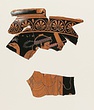
| Projecting rim, flat and reserved on top. Inside, alternating glazed and reserved bands, glazed broader and more streaked toward the middle of the pot than at the top where the surface has been polished ... 22 February -7 April 1935, 22 May 1937 ... Inside, alternating glazed and reserved bands, glazed broader and more streaked toward the middle of the pot than at the top where the surface has been polished and the glaze is shiny and thick.
a) Mended from five fragments, preserves part of the rim, of the palmette band below it, and of two figures in the zone beneath: the wreathed head and a bit of the back of Apollo, right, with his lyre. ... At the right edge of the fragment, part of his name(?) ... B' building fills, B- fill to north. and layer II of 38/ΣΤ. Fragment j) from late Roman disturbance in classical floor to south of the Propylon. |
| Fragment Θ 26 a), from right side of inscribed block; fine picked on one side, rough picked on the back.
Fragment Κ 115 b), back and left side preserved. Fifteen lines of the inscription preserved.
Fragment ... 127/6 B.C ... Fragment Π 116 d), inscribed face only preserved. At left is part of a wreath, and at right the lower part of a rosette.
... Some of the main fragments were used in the filling of the south tower of the gate in the late Roman Fortification (Q 13); other main fragments came from modern house walls in this neighborhood, no doubt extracted from the Fortification; and a few were found in modern constructions 100m. and more to the north and west of the tower. ... The stele appears to have stood originally in front of the terrace of the Stoa of Attalos, about opposite Pier 5 from the south, and to have been broken up after the Herulian invasion for use as building material in the late Roman Fortification. |
| James Artz Pirisino Daniele Kylindreas Miltiades ... Excavation in Room 3 of ΒΘ West revealed 5 ceramic vessels in a row against the eastern face of Wall 12. 3 complete vessels (ΒΘ 122, 124, and 125) were catalogued, along with the base of a plain glazed ... 9th-11th c. A.D ... Excavation in Room 3 was restricted to a small area south of and adjacent to Wall 23. ... The floor was left in situ at the end of the season.
2017 Addendum:
In 2017, we resumed excavation of Room 3, concentrating our efforts on the high baulk at the northeastern part of the room.
... We also uncovered fragments of a Byzantine vessel at an elevation of 53.590m, which were later removed entirely (ΒΘ 302).
|
http://agathe.gr/publications/monographs.html Monographs Excavations in the civic and cultural center of classical Athens began in 1931 and have continued almost without interruption to the present day. The first Athenian Agora volumes presenting ... All monographs are published by the American School of Classical Studies at Athens. ... These range in date from the last century of the Roman Republic to the declining years of the Republic of Venice. ... Since lamps from Athens do appear at other sites, the presentation of a well-dated sample of these finds provides useful reference material for scholars working at other sites. |
| F.W. Imhoof-Blumer and P. Gardner, Ancient Coins Illustrating Lost Masterpieces of Greek Art: A Numismatic Commentary on Pausanias, new enlarged ed., with introduction, commentary, and notes by A.N. Oikonomides, ... Agora 26 xiv ... Ancient Coins of the Greco-Roman World: The Nickle Numismatic Papers, W. ... Price, Coins from Some Deposits in the South Stoa at Corinth, Hesperia 36, 1967, pp. 348-388 ... Ripollès, Roman Provincial Coinage I, From the Death of Caesar to the Death of Vitellius, London/Paris 1992 |
|
|
.jpg.icon.jpg)
.png.icon.jpg)