|
|
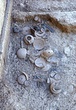
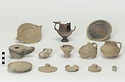
| David Scahill ... Beneath toichobate floor level in Room 1 of Classical Building II, against the south ashlar wall, ca. 1.50m. east of the southwest corner of the building. Deposit of broken pyre pots in small pit, 1.00m ... Ca. 325 B.C ... Excavations | 2001 | Trenches | Scahill | Classical Building II | Room 1 | Beneath Toichobate Floor Level | Pyre J 3:7 |
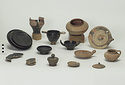
| Pyre against north face of polygonal wall, Room 2, Classical Building II. No floor preserved above, but the pyre is below floor level 51.820masl, preserved just to the east and above patchy floor with ... Ca. 275-260 B.C ... Pyre against north face of polygonal wall, Room 2, Classical Building II. No floor preserved above, but the pyre is below floor level 51.820masl, preserved just to the east and above patchy floor with plaster at ca. 51.70 |
Well at 67/ΛΓ on the northeast slope of the Areopagus. Connected with the same cistern system as O 20:2.
Dug as several fills but probably a continuous accumulation Coin
28 May 1938 #1 (?) Illegible N ... 300-250 B.C ... II. -11.00m to -14.30m. Drinking cups advanced over those in level I, but absence of mold-made bowls suggests material no later than ca. 225. |
| Sacrificial Pyre I, Classical Building II.
The pyre was set through the original floor level of the northern room of the Classical Building and apparently is the remainder of a ritual conducted when the ... Ca. 375-350 B.C ... Sacrificial Pyre I, Classical Building II.
The pyre was set through the original floor level of the northern room of the Classical Building and apparently is the remainder of a ritual conducted when the old floor was raised. |
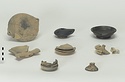
| In room A. Concentration of artifacts and burning in stratum, no pit discerned. The pyre lay below a Late Hellenistic fill with a smooth earth surface. It is described as a black patch of earth with sherds, ... 350-250 B.C ... It is described as a black patch of earth with sherds, resting on a rough and uneven surface topping a fill that dates largely in the 4th c., to at least 325, with seven Hellenistic sherds perhaps intrusive from the level above. The fragmentary state of some of the pottery in the pyre suggests some disturbance.
Strosis II, on which the pyre rested, covered the walls of Room A, demonstrating that the pyre postdates a change of plan or abandonment of this part of the building, other parts of which survived to the Late Hellenistic period. |
Well at 19/ΚΔ, beneath the west colonnade of the Square Market Building in the northeast corner of the Agora. Diameter ca. 1.25m. Water level ca. -3.50m. The construction of the well was rather careless, ... Ca. 580-560 B.C ... Diameter ca. 1.25m. Water level ca. -3.50m. The construction of the well was rather careless, perhaps caused by the soft crumbly nature of the bedrock
No distinction in date or character could be observed in the filling, from just below the top to the bottom. ... Baskets I and II found 7 April 1938
Basket IV and mud found 14 April 1938 |
| Extract from notebook ΠΘ XIX, pp. 3644-3646. Well at 105/ΝΗ (report on sorting of pottery, July 19, 1951 - H.S. Robinson).
"Not a useful well" HSR.
Well dug to 1.50m., vi/9/36; dug from 1.50m. to bottom ... Early Roman; use fillings of 2nd. c. B.C. and 1st. and 4th. c. A.D.; dumped filling of late 4th. c. (HSR)
Fill I: 2nd. c. B.C.
Fill II-V: to second half of 4th. c. A.D.
Fill VI: mixed to Byzantine ... No sherds from this level were stored (p. 2735) but some were probably put in with basket 9, the final container from the well fill; cont. 9 could not be located when the pottery was sorted in 1951. ... One coin (iv/9/37 #1) of Constantine II (323-361 A.D.) suggests a late 4th cent. date for this destruction fill. ... Subdivisions: (PAF/data mgmt)
.1= Fill I = 22.80 (bottom)-22.25m.
.2= Fill II = 22.25-21.30m.
.3= Fills III, IV, V = 21.30-1.50m.
.4= Fill VI = 1.50m to top, including Dump |
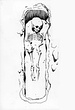
| James H. Oliver ... (E.L. Smithson: Grave IX: PG). Two children's skeletons one on top of the other. Cf. PD 329 for PD 430 for second skeleton, same deposit.
PG grave about 25m. SW of Cistern A at 46/ΜΔ.
[In some records, ... Developed Protogeometric |
|
|