|
|
Fragment of edge missing; otherwise intact. Small flat-topped lid with downturned edge.
Scratched on the top:
Black glaze on outside, inside reserved. Late Roman tomb at 53-54/ΛΕ-ΛΣΤ. Found with T 1421 ... 10 April 1937 ... Late Roman tomb at 53-54/ΛΕ-ΛΣΤ. |
Cracked but practically complete.
A wide mouthed jar with flaring lip and globular body. Bottom concave.
Greenish glass, blackened at surface, but apparently solid enough. Late Roman tomb on lower north ... 26 April 1937 ... Late Roman tomb on lower north slope of Areopagus. |
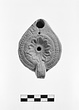
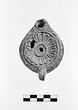
| Intact.
On discus, rosette with pointed petals. On rim, herringbone; handle, unpierced, three grooves above and below. On reverse, double heart-shaped groove.
Unglazed.
Type XXVIII of Corinth collection ... 9 April 1937 ... Soft greyish-brown earth with bones; i.e. late Roman tomb. |
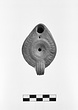
| Intact.
On discus, rays (?), faint. On rim, herringbone, faint. Handle unpierced; three grooves above and below. On reverse, two heart-shaped grooves.
Glaze dull purplish-red.
Type XXVIII of Corinth collection ... 10 April 1937 ... Late Roman tomb, with T 1421 (Φ 260) ff. |
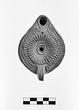
| Intact save minor fractures.
Discus plain; rim plain. Handle unpierced, three grooves above, two below.
On reverse, five concentric grooves.
Dull purplish-red glaze.
Type XXVIII of Corinth collection ... 26 April 1937 ... Late Roman tomb. Lying upside down at west edge of tomb, slightly south of center on top of wall black of Roman house, with a little earth under it. |
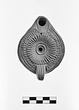
| Intact save minor fractures.
On discus, rays. On rim, herringbone. Handle unpierced, three grooves above, two below.
On reverse, three concentric grooves.
Thin reddish clay.
Type XXVIII of Corinth collection ... 26 April 1937 ... Late Roman tomb. Lying upside down close to west edge of tomb near center. Just north of wall black of Roman house, on strosis level with its top (strosis on which bones lie). |
| Intact save fragment of discus.
On discus, rosette. On rim, groove; handle, unpierced; three grooves above, two below. On reverse, two concentric grooves.
Glaze, thin, dull, red to black.
Type XXVIII ... 9 April 1937 ... Soft greyish-brown earth with bones; i.e. late Roman tomb. |
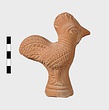
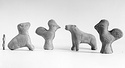
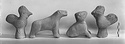
| Rattle in shape of cock on high roundish base.
Pellets inside.
Mold made as T 1421-1422 (lengthwise in two pieces). Small vent hole under tail. Details elaborately gouged. No trace of color.
Pinkish buff ... 9 April 1937 ... Soft greyish brown earth with bones.
Late Roman tomb at 53-54/ΛΕ-ΛΣΤ. |
| Rattle in shape of dog seated on its haunches.
Pellets, if any, do not rattle.
Vent hole in bottom. Mold made like T 1421 (lengthwise in two pieces). One half of the mold duller than the other. Two halves ... 9 April 1937 ... Soft greyish brown earth with bones.
Late Roman tomb at 53-54/ΛΕ-ΛΣΤ. |
| Rattle in shape of cock on high roundish base.
Pellets inside.
Similar to T 1423; halves less carefully joined. Mold made as T 1421-1423 (lengthwise in two pieces). Small vent hole under tail. Details ... 9 April 1937 ... Soft greyish brown earth with bones.
Late Roman tomb at 53-54/ΛΕ-ΛΣΤ. |
Lower right part missing.
Figure with high headdress, holding a square tablet in lap.
Features must have been largely done with paint for the modelling is confined to a general outline of the face and ... 24 April 1937 ... Clay fired hard, brownish in color.
Late Roman ... Bone pit, south end, just below upper fill.
Late Roman tomb at 53/ΛΕ-ΛΣΤ. |
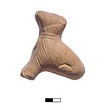
| Intact rattle in shape of bear walking.
Inside, several small pellets. The two hind legs are joined together; the left foreleg is added separately by hand.
Details gouged. Mold made lengthwise in two pieces ... 9 April 1937 ... Found with P 9801, L 2916-2918.
Late Roman tomb at 53-54/ΛΕ-ΛΣΤ. |
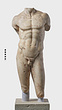
| Head missing. Stubs of arms preserved. Right leg broken below knee; left leg above knee.
Torso of a standing youth, about half life-size, the weight on the right leg. The upper left arm is set back a little; ... 19 March 1948 ... Built face up into the wall of Tomb U, west of the Church of Elias and Charalambos, ca. 127 m. Probably originally built into the NS late Roman wall, which was cut by the tomb builders. Cement found clinging to front of statue, same as that of the late Roman wall, whereas tomb walls are built without cement. |
Two-handled Cup.
Foot missing; bottom and half of body restored.
Groove at greatest diameter. Rim convex to outside, with groove below lip. Narrow strap handles with one groove; small rotelles at arch ... Context of 100-75 ... Apparently a late Hellenistic and early Roman shape. ... Cf. also Bruneau 1970, no. 61.10, p. 478, figs. 110, 111, from a tomb of the second half of the 1st century at Argos; Délos XXVII, D 28--D 30, p. 242, fig. 124, pl. 41; OlBer VI, p. 49, fig. 31:a (early Imperial, from Olympia). |
|
|