|
|
Pocket of late Geometric pottery in bedrock behind Stoa Shop V; apparently a household deposit ... 750-700 B.C ... Pocket of late Geometric pottery in bedrock behind Stoa Shop V; apparently a household deposit. |
Burial disturbed. Located in Middle Stoa, north aisle, "upper trench", piers 3 and 4. Two individuals: small child (ca. 5 yrs. old) and adult female.
In its disturbed state the burial was found (at elevation ... First half of 7th c. B.C. |
Disturbed pit with a skull. Pottery discarded. Late context; more likely Turkish than Geometric.
See Hesperia 14 (1945), p. 303 for skull description ... 4 May 1936 ... Disturbed pit with a skull. Pottery discarded. Late context; more likely Turkish than Geometric.
|
Geometric Well under Rubble Wall of Predecessor.
Classical pit above a Geometric well with a small amount of pottery from the late 6th to the middle of the 4th c. B.C. Estimated Grid ... Late 8th century B.C ... Geometric Well under Rubble Wall of Predecessor.
Classical pit above a Geometric well with a small amount of pottery from the late 6th to the middle of the 4th c. |
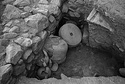
Geometric Well on the west side, in the line of the Roman Panathenaic way; 3.70m below paving block of street that overhangs well. It was neatly cut, 1.05m. in diameter, but it was dug only to a depth ... Late Geometric, end of 8th century B.C. |
| Burned Deposit. A thick deposit of ash, cinders and pottery fragments extending alongside wall of cemetery. Character of pottery like the pyre of F 12:2 ... Late Geometric |
RSY Grave A.
Under the Roman House with three rooms floored with mosaic near the southwest side of the area. The burial consisted of a pot laid on its side over the bedrock, presumably containing a child ... 7 August 1947 ... The grave had been disturbed in early times by the building of a wall (6th or 5th century B.C.) which in part overlay it; only the part of the pot immediately over the stereo was preserved. it was an amphora with banded body and conventional ornaments on the reserved neck, probably late 8th century ... Pottery nondescript geometric, a little proto-geometric, discarded. |
| Rodney S. Young ... RSY/JP Disturbed Geometric burial over "Sacrificial Pit VI" (Grave B 21:22). Grave IX in notebook. Bones discarded?
Pottery found in the upper filling of a sixth century cremation pit, which had perhaps ... Middle Geometric II/Transitional to Late Geometric |
| Grave 20 in notebook. Objects recorded in nb. from Grave 21 (earlier and disturbed by Grave 20) are included here. A pyre [using pieces of pots from Grave 21] was probably burned beside grave 20 and some ... Late Geometric |
Double Well by Entrance to Square Building (Well B)
Wall A (R 9:2) was Late Geometric or transitional well, into one-half of which a bothros had been sunk in Turkish times (16th c. A.D.)-R 9:3.
This bothros ... ca. 17th century A.D ... Double Well by Entrance to Square Building (Well B)
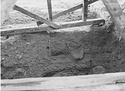
Wall A (R 9:2) was Late Geometric or transitional well, into one-half of which a bothros had been sunk in Turkish times (16th c. ... This bothros was lined on the side of the Geometric well by a wall made of rough stones and pink cement, supported by three small round wooden beams. In dark brown fill, it contained many household utensils (spoons, a wooden bowl fragment, a saucepan and an iron knife), quantities of pottery and a fragment of marble capital Balance of pottery discarded. |
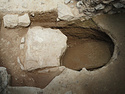
| David Scahill ... Behind northeast corner of Classical Building; east wall C. Below Hellenistic levels and early Classical pit. Chamber cut through bedrock, depth ca. 0.90m., diameter ca. 2m., roughly square in shape, angling ... LH III A:1 ... Loose fill of stones and earth filling tomb with large number of geometric sherds ranging early to late Geometric. Fallen bedrock in northeast corner with geometric pot imbedded in the top. ... Pottery appears to be LH III A:1 with some possibly earlier. |
| Marcie Handler ... This deposit is a Mycenaean cist grave with two cover slabs, a type of burial described by Immerwahr in Agora XIII (pp. 103-104). Cist graves appear side by side with chamber tombs in the Mycenaean cemeteries ... LHIIB-LHIIIA:1 ... The fill on top of poros slab (Lot ΒΖ 2135) included pottery dating mostly to the late 8th c. ... The upper fill covering the boulder on the west end of the cutting (Lots ΒΖ 2128 and 2130) dated to ca. 500 B.C., and the fill lying directly on top of the boulder (Lot ΒΖ 2131) dated to the late 8th c. B.C., indicating that the tomb was covered over in the late Geometric period. |
| Rubbish Dump in mouth of abandoned well in Tholos Trench F, Kitchen. Filled with ash, charcoal, broken pottery, roof tiles.
Also from Trench L.
13 March 2014 by Ann Steiner
The deposit has four components ... Ca. 425-400 B.C ... Filled with ash, charcoal, broken pottery, roof tiles.
... Component 2: The second segment, moving downward, includes the top-most curb stones of a collapsed well together with ceramic material all jumbled up with the roof tiles from the Tholos, but with no signs of burning: Lots Ζ 687-690 (late 6th-late 5th c. B.C)
Component 3: A second set of collapsed curb stones, ,below the first two, and the material below it to the top of what was still preserved of the well shaft proper: Lots Ζ 691-693; and Ζ 686 (Geometric-late 6th c.)
|
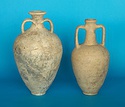
| Marcie Handler ... A deposit of six amphorae and one micaceous water jar was excavated between 20 June and 6 July 2005 in the area north of Wall K. The neck and one handle of one of the amphorae (BZ 1213) had been poking ... Ca. 1st c. A.D ... We removed two layers of fill in the area around this amphora, the first of which (lot 1540) was highly contaminated and contained material dating from the Late Geometric through the Byzantine periods. ... Along with the one whole amphora (BZ 1213), two mended amphorae (BZ 1262 & 1263) and the micaceous water jar (BZ 1264), there were also in-situ fragments of three other amphorae, but the necks, handles, and/or bases of these amphorae were missing and the vessels were therefore not mended (the fragments of these three amphorae can be found in the pottery tins).
NOTE: This deposit was first excavated 1-2 August 2001 as a "Late Roman layer with complete vessels" (elev. 53.040-53.370 masl, J/17,18-1/6,8). ... The remaining fragments of amphora BZ 756 can be found in the pottery tins BZ 1540-1541. |
| James Artz Pirisino Daniele Kylindreas Miltiades ... Excavation in Room 3 of ΒΘ West revealed 5 ceramic vessels in a row against the eastern face of Wall 12. 3 complete vessels (ΒΘ 122, 124, and 125) were catalogued, along with the base of a plain glazed ... 9th-11th c. A.D ... The primary types of glazed Byzantine pottery found in the fill included green and brown painted ware, plain glaze ware, Constantinople white ware, and monochrome glaze.
... A plaster layer was exposed and removed over the course of several baskets in the southern half of the eastern portion at an average elevation of 53.883m, and ceramic material from these layers date from the late 11th-early 13th century AD. ... Plain glaze ware; Constantinople white ware; monochrome glaze; green and brown painted ware; combed ware; ridged ware; gouged ware; amphora toe; incised coarse ware; Roman lamp fragment and red wares; classical red and black glaze (including geometric, archaic, and classical); coarse base with strange shape, handle and neck close to base; coarse handles, bases, rims, and body sherds; micaceous body; cooking ware, including joining lid fragments; painted and unpainted plaster; roof and floor tile fragments; pithos lid, rim and body fragments; worked stone; stone revetment; bone; metal; glass |
|
|