|
|
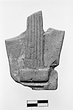
| First interpretation: in relief, a column, with incised fluting, and a square abacus.
Broken at bottom and upper right (or lower left) corner. The upper and side edges finished. The sides of the column ... 3-12 March 1934 ... ADDENDA: A kithara with five incised strings. |
First interpretation: probably from a miniature couch or stool.
Preserved is the upper part of one leg, with moulded ring below the cross piece and a curved horn-like projection above. The horizontal member ... 5 April 1938 ... Kithara Fragment |
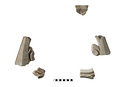
| Five fragments.
The larger fragment, c), is broken at both ends, as is the scroll underneath. Part of the finished top is preserved. It is flattened and well dressed at the back. The front has a raised ... 17 June 1931, 3 July 1931 ... Interpreted as a Kithara of Apollo Patroos S 2154.
... In the box with them are two fragments, none of the same marble and thus probably form the same kithara. Also in the box is one fragment of a volute in Pentelic marble, presumably from another kithara, unumbered. |
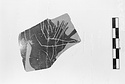
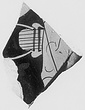
| Wall fragment from a thin-walled closed vase; broken all around. Male figure standing to right, kithara in hand. An upright object in the background.
Hasty incision; applied white for the suspension cord ... 18 June 1937 ... Male figure standing to right, kithara in hand. An upright object in the background.
Hasty incision; applied white for the suspension cord of the kithara. |
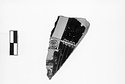
Wall fragment. Glaze fired reddish (drawing) and bluish (background). Max. dim. 0.105.
Kithara-player (part of neck, his head [now missing] thrown back, body, right arm and hand with plektron, left hand) ... Ca. 440-430 B.C ... Max. dim. 0.105.
Kithara-player (part of neck, his head [now missing] thrown back, body, right arm and hand with plektron, left hand) to right, dressed in a chiton. All of the kithara, except the tips of the arms, remains, as well as the sash hanging down and most of the strap used to steady the instrument. ... The artist forgot to include the strings of the kithara. Preliminary sketch. |
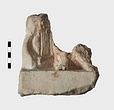
| Base with two male feet and part of kithara, probably Apollo.
Unfinished. Mortar clings to it.
Pentelic marble.
Cf. Hesperia 29 (1960), p. 370, n. 7. Finished LRFW (Late Roman Fortification Wall) Core, ... 27 June 1959 ... Base with two male feet and part of kithara, probably Apollo.
|
| Some of floor and about half foot preserved. Small low ring foot.
Part of body and kithara of a komast, left.
Relief contour.
Space inside foot reserved, except outer edge. Pit in bedrock; Stoa colonnade ... 6 May 1954 ... Part of body and kithara of a komast, left.
|
A figure semi-draped reclines on a couch, a kithara at his left side.
Head of figure and lower part of couch missing.
Red paint on flesh, white on couch and drapery.
Coarse buff clay.
ADDENDA: Blue paint ... 6 May 1937 ... A figure semi-draped reclines on a couch, a kithara at his left side.
|
Wall fragment with return. Thin glaze on inside. Max. dim. 0.055.
Youth (head) to left, with head thrown back. Relief contour: chin.
Dilute glaze: muscles.
The position of the youth's head and his open ... Ca. 480-470 B.C ... Another possibility is the cradle-kithara as played by the komast on Harvard 1959.188 in the manner of the Pig Painter (ARV2 566, 8; Addenda 261). It is not likely that he plays the standard kithara, for if he did, his face would overlap one arm of the instrument. |
| Broken all around.
From a large kithara. Part of the left arm, of the left strengthening piece and of the crossbar with four strings and pegs preserved. Relief contour.
Pinkish-buff clay. Excellent black ... 18 May 1953 ... From a large kithara. Part of the left arm, of the left strengthening piece and of the crossbar with four strings and pegs preserved. |
Wall fragment of stand with bands of glaze on inside. Max. dim. 0.06.
Kithara-player. All that remains is part of his instrument: the tip of one arm, a bit of the support; half of the crosspiece with ... Ca. 480-470 B.C ... Max. dim. 0.06.
Kithara-player. All that remains is part of his instrument: the tip of one arm, a bit of the support; half of the crosspiece with the start of four strings and their tuning knobs. |
Shoulder and body fragment. Glaze fired greenish in places. Max. dim. 0.115.
At the left, the right half of a kithara, including some of the sash, held by someone (now missing). At the right, a woman ... Ca. 460-450 B.C ... At the left, the right half of a kithara, including some of the sash, held by someone (now missing). |
Seated woman (Muse).
A left hand, with a sleeve above, rests on a column-like object; between thumb and forefinger a bulbous object; behind, spiral raised ring; in front of hand to right, shallow horizontal ... 8 February 1935 ... ADDENDA: A right hand rests on a kithara. |
| For detailed description see H. A. Thompson's article in ArchEph (1953-1954), pp. 30-44.
Cf. A 41 for fragments of kithara. Catalogued 1961. Found in 1907 ca. 20.00m. south of Temple of Apollo Patroos ... 1907 ... A 41 for fragments of kithara. |
Shoulder fragment with very thin red glaze on inside. Max. dim. 0.111. Prange, Niobidenmaler, p. 216, cat. no. G 57, pl. 21.
Apollo and Artemis. At the left is the upper part of one arm and the end of ... Ca. 450 B.C ... At the left is the upper part of one arm and the end of the crosspiece of the god's kithara. Facing, on the right, is Artemis (most of head, her hair bound with a triple fillet) holding a branch of laurel. |
Eight non-joining fragments: a with most of body and handle, start of neck; b, part of trefoil mouth and start of handle; g, ring base. The rest are wall fragments. Thin, dull, brownish black glaze on ... Early 4th century B.C ... Choes and Anthesteria, p. 91, no. 233 bis.
Kithara-player. Only fragments a and d preserve part of the figures. ... He wears a long belted garment and holds a a kithara in his left hand, the plektron in his right. ... White: flesh of Nikai; sash of kithara, ribbons hanging down from it; platform; wreath held by right Nike; wreath of right youth. |
Wall fragment of stand with part of black band on inside. Glaze flaked here and there. Max. dim. 0.082. LIMC II, 1984, p. 200, no. 85, s.v. Apollon.
Apollo. The fragment preserves the chin, neck, long ... Ca. 460-450 B.C ... At the right, part of one arm and a little of the sound box of his kithara. Preliminary sketch. |
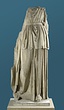
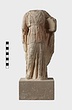
| Draped standing figure wearing long chiton with overfold, and a heavy cloak at the back. In the left arm part of a rectangular object: kithara (lyre?).
The weight is on the left leg, the right knee bent, ... 6 April 1937 ... In the left arm part of a rectangular object: kithara (lyre?).
The weight is on the left leg, the right knee bent, and the foot drawn back slightly.
|
| a) Two fragments of rim.
b) Two fragments of rim barely joining.
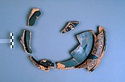
a), c), d), e) are fragments, broken all around, preserving red figure rim pattern. Thickened rim with convex outer face, grooved above ... 27 June-5 August 1972 ... A fifth non-joining fragment gives part of the tondo with the top part of a kithara. |
Wall fragment. Max. dim. 0.058.
Wooly satyr (torso, start of arms, legs, and tail) to right. White: tufts of fur.
The satyr is dressed in the costume of Papposilenos and is closest to the satyrs on the ... Ca. 420 B.C ... This scene depicts three men dressed as satyrs, each playing a kithara and singing. |
|
|