|
|
| Dorothy Burr Thompson ... Grave 22 in notebook. No offerings. Disturbed grave of baby ... LH IIIC/EPG (date uncertain) |
| Eugene Vanderpool ... Grave (E.L. Smithson: Grave III: SM).
The close proximity and similarity of this tomb and tomb M 16-17:1 strongly suggests that they were intentionally laid out in relation to one another and were contemporary ... Late Mycenaean/Submycenaean-Earliest Protogeometric ... Smithson considered Tomb 1 as containing the mother of the infant inhumed in Tomb 2.
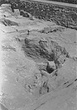
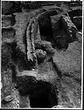
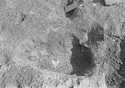
The tomb consisted of a rectangular pit cut into bedrock to a preserved depth of 0.30m. ... Fragments of a coarse basin, were intentionally broken and placed above teh tomb as a cover, spanning the full length of the pit. Within the pit, the skeleton of a fetus or newborn infant was placed on its back in an extended position, head to the south. |
| Eugene Vanderpool ... "Submycenaean" grave into Mycenaean gully.
Rectangular trench cut partly in bedrock, partly through Mycenaean domestic filling. No pottery catalogued ... Late Helladic IIIC-Early Protogeometric |
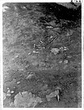
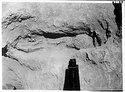
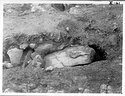
| Dorothy Burr Thompson ... Circular cutting. Grave 24 in notebook. In some records as Grave IV bis. Baby's bones: discarded. No offerings. Negs. KK 99, KK 100, X-61 ... LH III/EPG (date uncertain) |
| Eugene Vanderpool ... Infant grave near Phaidon street cistern. No offerings.
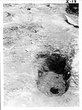
Roughly rectangular, almost elliptical cutting in bedrock, measuring 0.70m long, 0.35m wide, and 0.40m deep, oriented south-southwest to north-northeast ... Late Helladic III C/Early Protogeometric (date uncertain) ... Infant grave near Phaidon street cistern. ... Roughly rectangular, almost elliptical cutting in bedrock, measuring 0.70m long, 0.35m wide, and 0.40m deep, oriented south-southwest to north-northeast. The skeleton of what was stated to be a "newborn infant," head to the south-southwest, was laid out within the pit and covered by a stone slab.
|
| Dorothy Burr Thompson ... Grave 26. In some records as Grave I ter. Bones discarded.
Notebook says: child bones (no skull), no offerings.
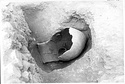
Circular cutting in bedrock, about 3m south of D 6:3. Neg. KK 234 ... LH III/EPG (date uncertain) |
Rodney S. Young ... Grave 17 in notebook. No offerings.
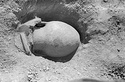
Amphora containing skeleton of small child was laid on its side in pit. RSY
Lot Β 304 Fill over Grave 17 ... Early 6th century B.C (?) |
Rodney S. Young ... Shallow round pit scraped out of bedrock. Grave 18 in notebook. The confusion here is that P 5347 found in the grave was catalogued in B' but the large bowl fragment (P 6482) was catalogued in B (see nb ... 700-650 B.C. |
| Rodney S. Young ... Grave 9 (E.L. Smithson: Grave XVIII: PG). Bones discarded.
JP
Roughly circular pit, about 0.59m in diameter, cut into soft bedrock to a depth of 0.42m. Tomb encountered only about 0.12-0.15m below the ... Protogeometric |
Grave 2 in notebook. The burial was destroyed by the digging of Pit A, at the edge of which was found a mass of sherds belonging to the grave amphora. Among the sherds were found small cups, fragments ... Late Geometric |
Rodney S. Young ... Grave 1 in notebook. Slightly disturbed by the digging of Pit A.
A large oil jar/amphora lay on its side with a flat stone stopping its mouth. The three small vases offered at the burial were found, together ... Ca. 600 B.C. |
| RSY Grave 51.
The grave lay on the slope of the Areopagus in Roman house O, just east of the line where the hillside is scarped for the foundation of the west wall of the house.
Cutting:the pit cut in ... Archaic period/6th or 7th c. |
| Rodney S. Young ... Grave 19 (In some records as Grave VIII). No remains, no burned matter or traces of burning.
JP
A small cutting with a single offering. The pit may have been for a simple child/infant inhumation, with ... Early Protogeometric ... Grave 19 (In some records as Grave VIII). ... JP
A small cutting with a single offering. The pit may have been for a simple child/infant inhumation, with the human remains totally dissolve or disintegrated. ... The floor of the pit comprised unhewn fieldstones packed closely together. |
|
|