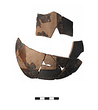
Eleven pieces comprising two non-joining fragments. To Young's publication of six pieces are now added five more, two of which help to complete to inscription.
Part of the side wall with reserved panel ... 600 B.C ... Kerameikos VI, 2, pp. 272, 326.
... But the tau after Δί may represent an elision of τεinstead of τοιin which case the title may belong to another deity mentioned in the missing part of line 2. Hemberg shows that Apollo receives the title Anax in Homer and Classical literature far more often than any other deity, and since, like Zeus, Apollo was worshipped on Mount Hymettos (Pausanias, I, 32,2), it is possible that the inscription is a dedication to both deities.
... Jameson ,δράω should have more force, referring possibly to the performance of a rite, as it does in I.G., I, 4. The length of the lacuna at the end of line 2 and beginning of line cannot be determined but it seems clear that we are dealing with amore complex text that one involving the simple fact of writing.