|
|
"Oinophorus Well".Tiled well in House H (diameter 0.80m, water level -4.70m). Height of tiles 0.64m Heavy well deposit; lamps,, type XXVII; many basket-handled water jars; oinophoros with labors of Herakles ... Use filling of early 2nd-mid.-3rd c. A.D. |
| Grave V, under room 18 in House 3, plus burned deposit at 94/IΘ. Identified as sacrificial pyre by SIR on Agoraios Kolonos:
In southeast corner of house 3. 35 artifacts, bone and charred material in pit, ... Ca. 300-275 B.C ... Grave V, under room 18 in House 3, plus burned deposit at 94/IΘ. Identified as sacrificial pyre by SIR on Agoraios Kolonos:
In southeast corner of house 3. 35 artifacts, bone and charred material in pit, in floor sequence. |
| Pyre in Horos Terrace Trench, East end, set into Strosis 5.
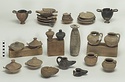
In room 1 (court), near north wall. Concentration in stratum, no pit discerned; described as a "little nest of pots" within layer V (Lot ΜΣ ... 350-325 B.C ... Concentration in stratum, no pit discerned; described as a "little nest of pots" within layer V (Lot ΜΣ 115), which overlay the hard strosis 5, the uppermost preserved floor of the house. ... The pyre postdates the second phase of the house and may be associated with its abandonment. |
No period of use. Below the upper (Early Roman) dump extending down to ca. 6.10m. was a dumped fill of broken pottery in great quantity, including a high proportion of red-figured fragments. Masses of ... Ca. 430-400 B.C.
Late 1st c. B.C.-mid 1st c. A.D. |
Evidence of stratification into five layers, although joins between the layers. Layer VI added when the construction of the Roman building above required it. No subdivisions assigned.
Flask-shaped cistern ... Early 3rd-late 2nd c. B.C ... It was put in to fill the cistern immediately after Layer II, and having settled, was later supplemented with layers IV and V, in close succession ... Layer V: consisted of much heavy pottery, lead, metal slag, amphora fragments, SAH's ... Layer VI: Supplemental filling prior to construction of Roman house |
|
|