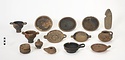
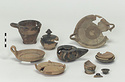
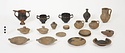
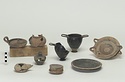
|
|
House C, Room 4 (Pottery dump of stamnos wall and fill below floor). Coins:
1 July 1947 #13
2 July 1947 #1
Coins from House IV:
14 May 1947 #1-#2
19 May 1947 #6-#7
20 May 1947 #32 ... First half 3rd c. B.C ... Hesperia 20 (1951), pp. 136 (plan), 183, 277 where House C=House P. |
Exploration of area of small early house walls on the NW slopes of Areopagus. Considerable deposits of late 6th-early 5th c. B.C., but some later (all periods) and some early levels, disturbed.
Objects ... Late 6th-Early 5th c. B.C ... Exploration of area of small early house walls on the NW slopes of Areopagus. ... Objects P 14805, P 14939 and P 14940 are noted on deposit nbp. |
Fills from construction and reconstruction of a house. "Brown House" = House A (RSY Hesp. 20) (and pit under Layer 4) in the industrial area west of the Areopagus.
Under the original floor of this house ... Second half of the 5th. c. B.C ... Fills from construction and reconstruction of a house. "Brown House" = House A (RSY Hesp. 20) (and pit under Layer 4) in the industrial area west of the Areopagus.
Under the original floor of this house were sherds including two red figured pieces (P 17137, P 19880). The filling of the floor levels of the house after its plan was changed and it was reconstructed yielded fragments of various coarse amphoras and black glazed table ware; four sherds incised with the letter kappa suggest that this is the initial of the owner of the house of the second period.
|
House N, Room 4: Fillings in and over floors (Layers 7 and 8). Lower level probably antedating the building of the Great Drain in this area; the upper level apparently contemporary with remodeling of the ... 425-400 B.C ... House N, Room 4: Fillings in and over floors (Layers 7 and 8). Lower level probably antedating the building of the Great Drain in this area; the upper level apparently contemporary with remodeling of the house at the time of drain construction.
... Hesperia 20 (1951), p. 204 = House C, Room 5. |
Early Roman pit at P/7-6/4,6
layer Ia in Room 7 of Greek House δ. Black earth fill with much carbon.
Plaster, nails, glass, bones (also bones from deposit P 6:4).
Coin
5 June 1971 #395 ... Early Roman ... Early Roman pit at P/7-6/4,6
layer Ia in Room 7 of Greek House δ ... Plaster, nails, glass, bones (also bones from deposit P 6:4).
Coin
5 June 1971 #395 |
| Well in East Colonnade of Roman House H. Diameter 0.80m, lined with field stones set in mortar. used as a cistern as well.
No useful pottery dates. Capital from colonnade A 3866 and part of shaft found ... 29 July 1970 |
| Well in West Colonnade of Roman House H. Covered by a large handsome marble well-head, apparently reused. Cut through bedrock. Diameter ca. 1.20m, water at -3.60m.
Two distinct POU fills. One at ca. -4.50m ... June-August 1970 ... Well in West Colonnade of Roman House H. Covered by a large handsome marble well-head, apparently reused. ... A.D., reflecting period of use of the house ... It became one small sack after the 5 pots were inventoried, JJ, July 2010, p. 2373. |
Fillings associated with early houses on the lower north slopes of the Areopagus; various levels and dates.
Both houses were built in the 6th century B.C. and destroyed by the Persians; both also have ... 6rd c. B.C.-3rd c. A.D ... Southwest House, Rooms I-VIII, 42-55/ΚΖ-ΜΖ:
The earliest house had a court on the west with a Well (B) and two small rooms at the north. ... The latest period of the house is the Herulian destruction.
Central House, Rooms IX-XI, 42-55/ΙΖ-ΚΖ
From 1957 excavations of these houses see P 25888, P 25895, L 5298. |
Rectangular Pit under House L, Room 2. Rubbish pit belonging to second phase of house ... 4th. c. B.C. |
| Pyre in layer "9d" in SW corner of Room 6 of Greek House δ. Ashes and fragments of small bones ... Ca. 225 B.C. |
Archaic house with Distyle Porch (= Building J) in southeast of section: packing beneath floors (Layers a and b of Tholos Trench S.Layer b=Beneath original floor dated to ca. 500 B.C.
Layer a=Between original ... 6th-early 5th c. B.C. |
Amphora dump at P/2,3-6/6,8.
Layer "8b" in Room 6 of Greek House δ.
Trench cut into lower levels next to west wall of Room 6. Fragments of amphorai, tiles.
No coins ... Early Hellenistic ... Amphora dump at P/2,3-6/6,8.
Layer "8b" in Room 6 of Greek House δ.
|
House R, fill under drain tiles and fillings associated with house K in industrial area, including what was C 19:15, plus C 19:16 and
C 19:17.
a) House built as dwelling in second half of 5th.c.
b) Used ... Ca. 5th and 4th c. B.C. |
| Herulian Debris in a house on the lower slopes of the Hill of the Nymphs: House P = South House; Room 2 = Dining Room; Room 3 = Kitchen; Room 18; Room 23; Room 24. Coins:
9 August 1947 #1-#37, #47-#49 ... Mid 3rd c. A.D ... Herulian Debris in a house on the lower slopes of the Hill of the Nymphs: House P = South House; Room 2 = Dining Room; Room 3 = Kitchen; Room 18; Room 23; Room 24 ... The destruction debris from some of the rooms of this house was originally indexed separately, but after it became clear that the filling is one and the same they were combined under a single group number. |
Early Roman pit at P/3-6/6,7
Layer 4a in Room 6 of Greek House δ, area P/2,3-6/6,8.
Pit in NW corner of Room 6 bounded by walls of Room to North and West, cut into preexisting layers to east, cutoff by ... 17 May 1971 ... Early Roman pit at P/3-6/6,7
Layer 4a in Room 6 of Greek House δ, area P/2,3-6/6,8.
|
Filling over drain from East Room of Archaic Fountain House. Lot T 16, fill e.
Τ 1567 (SS 11587) and Τ 1734 (P 22538) from upper disturbed fill (p. 2448) ... Late 5th. into 4th c. B.C ... Filling over drain from East Room of Archaic Fountain House ... Τ 1567 (SS 11587) and Τ 1734 (P 22538) from upper disturbed fill (p. 2448) |
Well in Court J, House of Greek Mosaic ... Early 4th c. A.D. |
Stroses I, II, III, IV in Court J (below marble chip layer), House of Greek Mosaic.
No independently datable objects. Estimated Grid ... Early 3rd c. B.C. |
Cistern at 53/ΝΕ, bottle-shaped, stucco-lined, in the east aisle of the peristyle of Roman House H (courtyard of Greek House G, just west of andron).
Lower diameter 2.73m.
Homogenous fill all apparently ... Into early 2nd century B.C. |
From kiln in house of 7th c. B.C. (=Building A), to southeast of Tholos. Tholos Trench U, furnace ... 675-625 B.C. |
House A destruction debris over floors. All floors (rooms 1-7) dug in 1939. Re-examination of House A in 1967 (nbpp. 648 ff.). Coins:
27 February 1939 #5-#9
7 March 1939: #1
9 March 1939 #4-#6
11 March ... First half 3rd. c. A.D ... House A destruction debris over floors. ... Re-examination of House A in 1967 (nbpp. 648 ff.) ... Container 660 not specifically mentioned as destruction debris but catalogued finds indicate so in context field (e.g. P 25560)[PAF]. |
| Pyre in layer 2a in Room 9 SE of Greek House δ. Sand, gravel, ashes, iron nails, carbon, some bones partially cut away by foundation trench of SYPE wall.
Coin
1 July 1971 #459 ... 260-200 B.C. |
Pocket in cobble paving in road west of Fountain House ... 1st c. A.D. |
House N, room 6=House T: Pit with Kalikia in Room 2W. Roughly rectangular pit, length 7.10m., possibly dug to obtain clay for flooring in nearby houses ... Ca. 500-480 B.C. |
House C, Room 5, small hoard. Deposit created by A.W. and first appears in his thesis (Biblio. below).
"Another small hoard or purse of Herulian date", A.Walker (1980), p. 127. Coins:
23 June 1947 #7-#13 ... Ca. 267 A.D ... House C, Room 5, small hoard. ... "Another small hoard or purse of Herulian date", A.Walker (1980), p. 127. |
Pit in House N, Room 2 (RSY, House C). Filling thrown in behind the west wall of the Great Drain South at the time of the building of the drain and the extension of House C.
Cf. Hesperia 20 (1951), pp ... Ca. 430-410 B.C. |
| Pyre in House C, Room 8 (RSY=Pyre 6).
Near east corner of room 8. Artifacts, burnt bone, burnt sticks, and large cinders in a shallow pit dug into surface of layer 3, and covered by layer 2. Some cinders ... 350-325 B.C.-end of 4th c. B.C. |
House K: Brown fill (publ. House U). Filling between terrace wall and house wall at the extreme west end of the Areopagus; a brown gravelly filling of early Roman date found here undisturbed but occurring ... Early Roman |
Deposit alongside Greek House I, perhaps giving the construction date of the second phase. Deposit list title it as : outside of east wall of Roman House H ... Last quarter of the 4th c. B.C. |
"Oinophorus Well".Tiled well in House H (diameter 0.80m, water level -4.70m). Height of tiles 0.64m Heavy well deposit; lamps,, type XXVII; many basket-handled water jars; oinophoros with labors of Herakles ... Use filling of early 2nd-mid.-3rd c. A.D. |
| Pyre(?) in House N, S.W. Room. (=House C, Room 10)
In room 10. Vessels from an earlier pyre were found dispersed in the makeup of the latest "floor" in the room, with tile fragments trodden into its surface ... First quarter of the 4th c. B.C. |
Silt fill of early road drain to North of SW Fountain House. Coins:
10 August 1961 #5 ... 325-275 B.C. |
Upper fill early Roman. Lower fill latest Hellenistic.
No house walls clearly associated with it, and apparently no attempt made to assign it to any particular house. Subdivisions:
.1=Upper fill
.2=Lower ... Late Hellenistic-Early Roman |
Well in the industrial area west of the Areopagus.
A flask-shaped cistern in House H with a dumped fill of the late fifth century brought from elsewhere and evidently deposited sometime in the 3rd c. B.C ... Ca. 420-400 B.C. |
House N, Room 4, Pit through layers 5-6. Debris filling, mixed context. Estimated Grid ... Late 4th. c. B.C. into early 3rd c. B.C. |
Well in Room 5 of Roman House H.
Under cement border of andron of Greek House G. Diameter 1.10m, cut through bedrock. water at ca. 3.55m. Hand or foot holes along one side.
0-7.25m crushed bedrock fill ... 5th c. B.C ... Well in Room 5 of Roman House H.
Under cement border of andron of Greek House G. ... There is no intrusive period of use of fill, though P 28780 and P 28781 from near bottom suggest a date of ca. 500 B.C. for the lower fill. |
A well in House T, Room 2W (Publ. House D), industrial area west of the Areopagus. Lower filling of dug bedrock including a small amount of pottery of the Geometric period. Gravelly filling in collapsed ... 3rd. quarter of 8th. c. B.C. |
| North of House G (RSY=Pyre 13).
Concentration of artifacts, small pieces of bone, and burnt material in stratum, no pit discerned. The pyre is cut by the trench of a wall of a Roman house to north. It ... 290-250 B.C. |
Area I; layer I. Soft, loose destruction fill of Street Drain in front of Greek House δ. Represents closing of drain in preparation for construction of Basilica. Top elevation 55.40m at west, 55.96m at ... 1st c. A.D. |
Cistern in Room 12, House C=House N.
Simple flask-shaped chamber with draw shaft, in House M, Room 1; no tunnels. Excavated as single fill, but later analysis of material suggested two fills. Coins:
24 ... 4th. c. B.C. |
Debris filling in a pit cut in bedrock at W side of House H, Room 10 ... Ca. 425-400 B.C. |
| Pyre in north central room of house, measuring 0.50m east-west by 0.35m north-south. Pottery, bone, and burnt material in pit dug into layer IIb (crushed bedrock floor: lot Ω 464, 4th c.) and covered by ... 350-325 B.C. |
| Pyre in House C, Room 12 (RSY=Pyre 9) in the industrial area west of the Areopagus.
Notebook refers to House N.
Beside west wall of room 12. Pottery, burnt bone, and cinders in a roughly round pit; disturbed ... Ca. 250 B.C. |
| Pyre in House N, room 4 (RSY=Pyre 7), in the industrial area west of the Areopagus.
Pottery, mall pieces of calcined bone, log, wood cinders, and charcoal in diamond-shaped pit in floor sequence. The pyre ... Late 4th-early 3rd c. B.C. |
| Pyre in layer 8a in SW corner of Room 7 of Greek House δ.
Oval pyre; 0.60 (n-s)x 0.35 (e-w).
The pyre was covered by the surface of layer 8 and extended slightly into layer 9 below it. Small bone fragments, ... 325-300 B.C ... Pyre in layer 8a in SW corner of Room 7 of Greek House δ.
Oval pyre; 0.60 (n-s)x 0.35 (e-w).
... No pottery remaining, bones in plastic bag in tin 212 (deposit P 6:3). |
| Located in House H, Room 13 on the lower northwest slope of the Areopagus ... Late 2nd c. B.C. |
East-West Street (63-64/ΙΣΤ, etc.)
Packing in line of ancient east-west street along Areopagus north slopes.
Lower fills, predominantly late 6th-early 5th c. B.C.
Middle fills, last quarter of the 5th ... Various levels and dates |
Pit along house wall foundations to south = footing trench. Uncertain context, possibly no later than ca. 425 B.C ... 450-400 B.C. |
"South Triangle" abandonment filling over Brown House (House A) in the industrial area. Layers 1-3 and layer 4, to floor of second period. As late as the 3rd. c. B.C. but composed largely of earlier material ... 3rd c. B.C. and earlier |
| A tile lined well under Room I of Byzantine House.
A concrete shaft belonging to the mill cut off the top of the well and left in place 3 complete sets of tiles and most of a fourth set. All but the lowest ... 17-18 c. A.D. |
| Disturbed pyre dispersed in fill of Room 5, House D.
Pyre pots in very fragmentary condition were noticed by Barbara Tsakirgis in later analysis of pottery that had been excavated in 1938; no mention of ... 14 June 1938 |
South House, Room 12, over pebble mosaic floor. Herulian destruction debris in a house. Coins:
29 April 1956 #1-#7
2 May 1956 #1-#3
9 May 1956 #1
26 May 1956 #1-#4
2 June 1956 #1-#4 PD 1350 ... 9 May 1956 |
Lower levels of cistern to N. of House of Greek Mosaic.
Connected by tunnel to another chamber that was apparently cleared by Wilhelm Dorpefeld in the 19th c. Roman fill in mouth. Coins:
6 July 1964 # ... Ca. 325-290 B.C. |
| Well at 99/ΜΕ.
Just outside of SE corner of Fountain House. This well was used in at least two periods; the marble well curb of the second period, certainly Byzantine, was found in place. The fill was ... 5 May 1952
5-14 July 1952 ... Just outside of SE corner of Fountain House. This well was used in at least two periods; the marble well curb of the second period, certainly Byzantine, was found in place. ... Fills associated with the well see p.1268, Lot Τ 28g |
| Mycenaean grave to west of House N, room 5, with the burial of two young children. Rough rectangular cutting in soft stereo (0.95x0.64x0.28), lying under the western wall of a Geometric house, contained ... Myc. III C:1 |
Cistern System in East Portico.
Drawshaft with two blind tunnels, in court of House of the Greek Moisaic; partially excavated by Dorpfeld. No legible coins or amphora handles. Coins:
26 June 1964 # ΔΕ3 ... 2nd c. B.C. |
| Grave V, under room 18 in House 3, plus burned deposit at 94/IΘ. Identified as sacrificial pyre by SIR on Agoraios Kolonos:
In southeast corner of house 3. 35 artifacts, bone and charred material in pit, ... Ca. 300-275 B.C. |
Well in house R of industrial area west of the Areopagus. This well, originally tiled, was abandoned and filled at the time of the conversion of the house into a stone-cutters' workshop.
Tiled well but ... Ca. 425-400 B.C ... Well in house R of industrial area west of the Areopagus. This well, originally tiled, was abandoned and filled at the time of the conversion of the house into a stone-cutters' workshop.
... In addition to P 18556 and P 18605, it produced 28 loomweights, a combination which suggests that some of the dowry of the lady of the house was thrown into the well. |
| Above bedrock in N.W. corner of room S, House of Greek Mosaic. Contents suggest "saucer-pyre" ... Late 4th-early 3rd c. B.C. |
Well (diameter 0.98m) in House H, Room 13.
Two dumped fills apparently of the same date, but separated by a clay deposit of over 2.00m.
Cf. Hesperia 20 (1951), p. 253. (noted) Subdivisions:
.1=Upper ... Ca. 425-400 B.C ... Well (diameter 0.98m) in House H, Room 13.
... Hesperia 20 (1951), p. 253. (noted) |
Layer 7 in South Peristyle of court of Roman House Ε. Irregular cutting in bedrock with sand, gravel, fallen bedrock. Some burning ... 275-250 B.C. |
| Pyre in House N, room 2, layer 5 (RSY=Pyre 8).
Near northern corner of room 6. Artifacts, bone, burnt logs, and cinders in square pit dug from level of layer 5, through layers 5 and 6; thin clay floor ... 325-300 B.C. |
| Pyre in Room 8 of Roman House H. Concentration of artifacts, bone, and flecks of carbon in stratum, no pit discerned. the pyre lay within a red fill apparently contemporary with it, but with some later ... 300-290 B.C. |
Cistern at 72/ΛΘ. Under NW corner of Roman House H. Stucco-lined, bottle-shaped cistern, poor condition. Diameter at bottom -2m.
Two tunnels, one leading east, one west, ca. 1.65m high and 0.80m across ... 150-110 B.C. with a few earlier pieces |
No period of use. Below the upper (Early Roman) dump extending down to ca. 6.10m. was a dumped fill of broken pottery in great quantity, including a high proportion of red-figured fragments. Masses of ... Ca. 430-400 B.C.
Late 1st c. B.C.-mid 1st c. A.D ... Masses of broken mud brick and numerous roof tiles show that this dump was debris from some house or shop.
Objects P 9255-P 9258, P 21333, SS 11145 are from the lower filling, but from immediately below the later drains and belong to their context.
Objects P 34998 and P 34999 are from this deposit but no fill indicated. |
A strosis into which were set the foundations of house of 7th c. B.C. to SE of Tholos (=Building A and Trench W, layers h + i) ... 8th-7th c. B.C. |
A well in room A of the Archaic House. Well with very irregular outline, cut down in the bedrock some 10m NE of the Tholos. Its filling yielded a handful of plain potsherds and the oinochoe P 13256 of ... Sub-Mycenaean(?) ... A well in room A of the Archaic House. Well with very irregular outline, cut down in the bedrock some 10m NE of the Tholos. Its filling yielded a handful of plain potsherds and the oinochoe P 13256 of an advanced Late Helladic III shape. |
| Pyre in House T (= House D), Room 2 (5th c.) and fill east of pyre.
Earlier than the other pyres of this house.
Pottery, slivers of burnt bone, and heavy deposit of carbonized material and cinders in ... Ca. 420-410 B.C. |
Well E (diameter 1.10-1.20m) just outside the northwest corner of the southwest Fountain House.
Dug initially as a pit (J 15:2) partially covered by an early Roman wall ... Early 7th c. B.C. |
Greek House J, under room 8 of Roman House H.
Typical though very fragmentary pyre pottery lay dispersed in a stratum over bedrock with pottery ranging from the 5th to the mid-3rd c.
In same general area ... Early 4th c. B.C.? |
This shaft in the NE corner of House A, Room III, depth of one tile, is perhaps connected with drain A. Coins:
13 May 1940 #1-#13
14 May 1940 #2-#101 ... Early 3rd. c. B.C. |
| Pyre in House T, Room 2 through floor of second period (RSY=Pyre 5) in the industrial area west of the Areopagus.
4th. c. BC.
Concentration of artifacts, burnt bone, and charcoal in floor makeup consisting ... 375-350 B.C. |
| "Koumanoudes' Well.
Tile-lined well (diam. 0.85m) at SE corner of courtyard of Roman House E, at top built wall of stones and mortar, bedrock at bottom. Coin
7 August 1971 #495-#500
13 August 1971 #507 ... 28 July-6 August 1971 |
Scarp S of SE Fountain House (and vicinity)
No info for this deposit No deposit list and S.E. fountain or S.W. fountain?
Asterisk: O-Q 16-17* |
"Red earth": Herulian destruction debris over Roman House and east of cistern B. Coins:
30 May 1935 #1-#8
31 May 1935 #1-#15 Sherds stored in container Lot ΠΘ 4b ... 27 May 1935
31 May 1935
3 June 1935 |
| Pyre 2 in Central House, Room X, under strosis 9. Signs of burning, carbonized food, animal bone.
In room south of courtyard. concentration of artifacts, bone, and charred material in floor makeup, no ... 290-275 B.C ... Pyre 2 in Central House, Room X, under strosis 9. ... The alternative is to downdate the floor, which is difficult to reconcile with the other stratigraphy in the house. the date of the pyre indicates that it could be associated with the abandonment of the house, which took place in the first half of the 3rd c. ... Hesperia 20 (1951), p. 122 ff. |
Diameter 0.95m; water level -9.10m.
Plais shaft cut in stereo from bottom of slender flask-shaped cistern. Scanty fill from house destruction in 5th c. A.D.; Christian lamps; unfinished statuette of Castor ... Late Roman |
Wells at 24/ΙΓ at 26/ΙΑ near the SW corner of the market square, about 10m west of the Southwest Fountain House (the party wall between them broken through in antiquity). ... Ca. 500 B.C ... Wells at 24/ΙΓ at 26/ΙΑ near the SW corner of the market square, about 10m west of the Southwest Fountain House (the party wall between them broken through in antiquity). ... Coins:
20 July 1932 #1
P 16811 and P 16812 may be assigned either to G 15:1 or to G 15:2. |
Well on lower slopes of Areopagus.
Diameter ca. 1.50m. Dumped filling of 8th c. at the top. Fill mostly Geometric but containing bits of later (even Roman) pottery. Perhaps cleaned out and refilled with ... 730-700 B.C. |
| Pyre 1 in Central House, Room XI, strosis 3. Sacrificial pyre with characteristic small vases amid carbonized twigs and bone.
Near north side of courtyard. This pit was cut slightly into strosis 3 (lot ... 1st quarter 4th c. B.C. |
| Grave over drain A1 (House A). Date based on the fact that the lopas has the upturned handle and the flat rather than domed lid, not found in examples from the later pyres. LT
West of House C. Pottery ... First half of 4th. c. B.c. |
| Pyre in Room 1, area west of street (RSY=Pyre 11).
Early in the third quarter of the 4th. c. B.C.
In courtyard. Artifacts, bone, and cinders in irregular pit in floor sequence. The pit had been dug into ... 350-330 B.C. |
| Sacrificial pyre, disturbed; a small pyxis (P 14864) is close to that from B 18:4. First half of 4th. c. B.C., perhaps first quarter.
West of House C. Pottery and cinders in pit in stratum. The pyre was ... First half 4th. c. B.C ... Sacrificial pyre, disturbed; a small pyxis (P 14864) is close to that from B 18:4. ... West of House C. Pottery and cinders in pit in stratum. ... Construction of a Roman house had removed all trace of earlier structures here. |
| Pyre in House D, Room 4 (RSY=Pyre 4) in the industrial area west of the Areopagus.
Notebook refers to House N.
Pottery belongs late in third quarter of the 4th. c. BC. Pyre burned near beginning of last ... 350-300 B.C. |
Diameter 0.80m. Water level -2m. Tiled well; height of tiles 0.67m. well in court (Room 3) of House N.
Late Hellenistic destruction fill (Pergamene etc) to -7m;
Sand without a well deposit (lamp Type ... 1st c. B.C. to 1st c. A.D. |
Wells at 24/ΙΓ at 26/ΙΑ near the SW corner of the market square, about 10m west of the Southwest Fountain House (the party wall between them broken through in antiquity).
Use filling middle to third quarter ... Ca. 550-525 B.C. |
A well (diameter 1m) in the industrial area west of the Areopagus, in the area later occupied by House C. Water level 1.50-2.m Dumped filling of broken bedrock with considerable fragmentary pottery in ... Ca. 500-480 B.C. |
Child's burial in south wall of Marble Worker's House.
Bones examined 20 June 1975 and found to be an immature animal, not human (canid-puppy?).
Identified as pyre by SIR. Set into a shallow roughly ovoid ... Late 4th c. |
Cistern C (pit) in West Room of late Roman House.
Mixed dump of material, with a little Classical, much Roman dating at least as late as 3rd century A.D., and large amount of late Hellenistic. Coins:
1 ... Late Hellenistic and Roman |
Pit in House T, Room 3 (through layer 6), in the industrial area west of Areopagus. Very likely pit may have been respectable archaic context, but nothing to go on beyond the two catalogued pieces (LT ... Ca. 500-480 B.C. |
Dealer's Dump at 10/Θ.
Debris filling beneath a modern house floor, apparently from the shop of an antiquities' dealer; otherwise unrelated to the Agora area. Compare similar dumps, K 14:1 and N 10:1 ... Modern context |
| A compact group of four complete vases and a lamp, found on a house floor; possibly the remains of a sacrificial pyre but without evidence of burning or the characteristic votive vases.
Layer II, "nest ... 425-400 B.C ... A compact group of four complete vases and a lamp, found on a house floor; possibly the remains of a sacrificial pyre but without evidence of burning or the characteristic votive vases.
... The deposit dates near the end of the first phase of the house, but before the early-4th c. rebuilding. ... See also P 17211 (ΞΞ 171) from Layer II but not from the nest of pots. |
| Pyre in House T, Room 1, Layer 5-6 (RSY=Pyre 3) in the industrial area west of the Areopagus.
First quarter 4th. c. B.C.
Artifacts, bone, and cinders in pit in floor sequence. The pyre was found in digging ... 400-375 B.C.(?) |
| (RSY=Pyre 2). Pyre in the industrial area west of the Areopagus, in House B. In northern corner of room. No pit discerned. A deposit of small stones (a marker/) lay 0.30m above the level of the pyre, ... Third quarter of the 4th. century. |
Plaster dump at Q/2,5-6/7,9.
Layer 5 in "Wall Painted Room" of Roman House ε. Layer resting on bedrock and covered partially by good strosis (55.26m.). Fill was red with mudbricks, tiles, much plaster ... Late 1st-early 2nd c. A.D. |
"Fauvel Collection"
Collector's dump? Debris in the cellar of a modern house, probably once that of F.S. Fauvel.
The collection included vases of all periods, from Geometric to Turkish; a number of the ... Modern Context |
A filling lying over a cobbled floor in a house-complex on the lower north slopes of the Areopagus.
Area in front of E-W retaining wall, just above cobble pavement, disturbed by coins and pottery as late ... 375-275 B.C. |
| RSY Grave 51.
The grave lay on the slope of the Areopagus in Roman house O, just east of the line where the hillside is scarped for the foundation of the west wall of the house.
Cutting:the pit cut in ... Archaic period/6th or 7th c. |
| Cistern and well in Marble Worker's House. Coins:
5 August 1968 #1-#6 (#5 and #6 disintegrated. Missing 19/7/1973)
6 August 1968 #1bis-#25 (#5 in Lot 503 not a coin but bronze bits of nail. #6 not a coin ... 325-275 B.C. |
Connected with G 14:3.
There was a layer of Late Roman fill. It rested over a layer of 2nd c. B.C Hellenistic and then another of 4th c. B.C Hellenistic; the passage between the two cisterns contained ... Late Hellenistic |
|
|