|
|
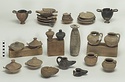
| Grave V, under room 18 in House 3, plus burned deposit at 94/IΘ. Identified as sacrificial pyre by SIR on Agoraios Kolonos:
In southeast corner of house 3. 35 artifacts, bone and charred material in pit, ... Ca. 300-275 B.C ... Grave V, under room 18 in House 3, plus burned deposit at 94/IΘ. Identified as sacrificial pyre by SIR on Agoraios Kolonos:
In southeast corner of house 3. 35 artifacts, bone and charred material in pit, in floor sequence. |
Located in Room IV, strosis 3, of SW House. Archaic, later disturbed, filling in and over undug well. See also L-M 17-18:1 where objects SS 14318 and T 3576 are actually from the filling over the undug ... 6th-5th c. B.C ... Located in Room IV, strosis 3, of SW House. Archaic, later disturbed, filling in and over undug well ... See also L-M 17-18:1 where objects SS 14318 and T 3576 are actually from the filling over the undug well, i.e. strosis 3, Room IV in Southwest House. |
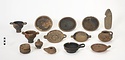
| Pyre in House C, Room 8 (RSY=Pyre 6).
Near east corner of room 8. Artifacts, burnt bone, burnt sticks, and large cinders in a shallow pit dug into surface of layer 3, and covered by layer 2. Some cinders ... 350-325 B.C.-end of 4th c. B.C ... Pyre in House C, Room 8 (RSY=Pyre 6).
... Artifacts, burnt bone, burnt sticks, and large cinders in a shallow pit dug into surface of layer 3, and covered by layer 2. ... These strata lay above the first floor of the third phase of the house. The hard baked floor of the pit indicated burning in situ, with charred sticks 0.06 and 0.10m in diameter preserved; some of the pottery is burnt. |
Pocket in cobble paving in road west of Fountain House ... 1st c. A.D. |
Pit at 59/ΞΕ (SW corner of House D). Mixed fill ... 1957 |
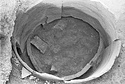
| A tile lined well under Room I of Byzantine House.
A concrete shaft belonging to the mill cut off the top of the well and left in place 3 complete sets of tiles and most of a fourth set. All but the lowest ... 17-18 c. A.D ... A tile lined well under Room I of Byzantine House.
A concrete shaft belonging to the mill cut off the top of the well and left in place 3 complete sets of tiles and most of a fourth set. |
| Located in House H, Room 13 on the lower northwest slope of the Areopagus ... Late 2nd c. B.C. |
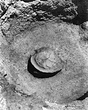
| Above bedrock in N.W. corner of room S, House of Greek Mosaic. Contents suggest "saucer-pyre" ... Late 4th-early 3rd c. B.C. |
| Well in West Colonnade of Roman House H. Covered by a large handsome marble well-head, apparently reused. Cut through bedrock. Diameter ca. 1.20m, water at -3.60m.
Two distinct POU fills. One at ca. -4.50m ... June-August 1970 |
Well in Room 5 of Roman House H.
Under cement border of andron of Greek House G. Diameter 1.10m, cut through bedrock. water at ca. 3.55m. Hand or foot holes along one side.
0-7.25m crushed bedrock fill ... 5th c. B.C. |
| Pyre in House T, Room 2 through floor of second period (RSY=Pyre 5) in the industrial area west of the Areopagus.
4th. c. BC.
Concentration of artifacts, burnt bone, and charcoal in floor makeup consisting ... 375-350 B.C ... Pyre in House T, Room 2 through floor of second period (RSY=Pyre 5) in the industrial area west of the Areopagus.
4th. c. ... The pyre was partly covered by a pebble floor associated with phase 3 of the house, but the fill in which it was found cut through a floor associated with the second phase, and it predates the abandonment of the house substantially. |
| Stephen G. Miller ... Irregular circular tomb (Diam. 2.20-2.60) with blocked dromos to northwest. Top of tomb lost in Archaic grading of area, center disturbed by Byzantine pit, overbuilt by northern-eastern walls of Room 3 ... LH III ... Top of tomb lost in Archaic grading of area, center disturbed by Byzantine pit, overbuilt by northern-eastern walls of Room 3 of Roman House E.
|
Early Roman pit at P/7-6/4,6
layer Ia in Room 7 of Greek House δ. Black earth fill with much carbon.
Plaster, nails, glass, bones (also bones from deposit P 6:4).
Coin
5 June 1971 #395 ... Early Roman |
Well south of the apse of Room 3, Roman House H. Cut through bedrock, diameter ca. 1.15m, stopped at ca. -10.80m because of danger of collapse. Water at very top, up to bottom of parapet between well and ... 2nd-4th c. A.D ... Well South of the Apse of Room 3, Roman House H |
| Sacrificial pyre, disturbed; a small pyxis (P 14864) is close to that from B 18:4. First half of 4th. c. B.C., perhaps first quarter.
West of House C. Pottery and cinders in pit in stratum. The pyre was ... First half 4th. c. B.C ... West of House C. Pottery and cinders in pit in stratum. The pyre was excavated in two parts: the first in 1939 (A 18:3) and the second in 1940. ... Construction of a Roman house had removed all trace of earlier structures here. |
| Pyre in Horos Terrace Trench, East end, set into Strosis 5.
In room 1 (court), near north wall. Concentration in stratum, no pit discerned; described as a "little nest of pots" within layer V (Lot ΜΣ ... 350-325 B.C. |
| (RSY=Pyre 2). Pyre in the industrial area west of the Areopagus, in House B. In northern corner of room. No pit discerned. A deposit of small stones (a marker/) lay 0.30m above the level of the pyre, ... Third quarter of the 4th. century. |
| Pyre in north central room of house, measuring 0.50m east-west by 0.35m north-south. Pottery, bone, and burnt material in pit dug into layer IIb (crushed bedrock floor: lot Ω 464, 4th c.) and covered by ... 350-325 B.C. |
Fillings associated with early houses on the lower north slopes of the Areopagus; various levels and dates.
Both houses were built in the 6th century B.C. and destroyed by the Persians; both also have ... 6rd c. B.C.-3rd c. A.D ... Southwest House, Rooms I-VIII, 42-55/ΚΖ-ΜΖ:
The earliest house had a court on the west with a Well (B) and two small rooms at the north. ... Coins:
18 March 1958 #1
8 April 1958 #1-#2
9-10 April 1958 #1-#3
10 April 1958 #1-#2
21 April 1958 #1
22 April 1958 #1-#6
24 April 1958 #1-#7
25 April 1958 #1-#5
26 April 1958 #1-#17
3 May 1958 #1-#4
5 May 1958 #1
6 May 1958 #1-#2
7 May 1958 #1-#3
12 May 1958 #1-#3
13 May 1958 #1 ... See also L 17:3 where objects SS 14318 and T 3576 are listed as part of the well deposit but are actually from the filling over the undug well, i.e. strosis 3, Room IV in Southwest House (nbp. 1393). |
| A well in the courtyard (Room 8) of a Byzantine House of Period II. The well was covered by a large squared poros wellhead and a marble puteal (apparently neither inventoried). Within the well shaft, the ... 14 July-9 August 1989
2-13 July 1990 ... A well in the courtyard (Room 8) of a Byzantine House of Period II. ... Coins:
2 July 1990 #131
3 July 1990 #157
12 July 1990 #159
13 July 1990 #160, #216
2 August 1990 #254 (Coin missing) March 2001 |
|
|