|
|
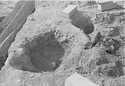
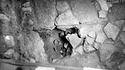
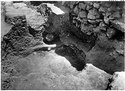
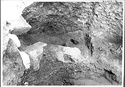
| Hole in bedrock; dumped filling used in leveling.
Probably a natural water line, tending to wash out, has been cut back for various purposes, and finally all filled in to make level bedding for 4th c., ... Ca. 350-270 B.C ... Hole in bedrock; dumped filling used in leveling.
|
Scanty filling over bedrock ... Latest 6th c. B.C ... Hole |
Irregular depression in bedrock (ca. 7x5m), ca. 2m deep; area south of E-W Late Roman wall. Dumped filling apparently intended to level off the area. Coins:
11 March 1952 #10
12 March 1952 #1-#5
13 March ... Ca. 400-325 B.C ... Fourth Century Hole |
Pocket of soft fill in bedrock at corner of Late Roman house, with a hoard of lead tokens. No pottery catalogued.
Herulian debris: cf. D 10:1, D 11:7 Coins:
25 May 1935 #8 Estimated Grid
No pottery catalogued ... 25 May 1935 ... Hole ("Cistern") B |
Upper fill (top to around 4.50m.) was in a pit of large dimensions above the preserved well shaft. From the bottom and shaft proper no catalogued pottery. No tiling in place in well but fragments of tiles ... 3rd-4th c. A.D ... Late Roman Hole |
Hole at 65/ΚΔ; small cutting in bedrock with scanty pottery ... 450-400 B.C ... Hole at 65/ΚΔ |
Great Hole at 33/Ζ = Area of early wells Some of the objects may have come from N 18:7 or from a neighboring 7th c, well, not separately cleared, but no definite association is possible ... 7th-5th c. B.C ... Great Hole at 33/Z |
In Southeast House, Room E. The inventoried material consisted entirely of loomweights, all of the 4th c. B.C ... 5th-4th c. B.C ... Hole in Southeast House, Room E |
Refuse pit in rock by heavy wall on West Street ... Ca. 500-480 B.C ... Hole by Heavy Wall on West Street |
Hole in bedrock; small amount of debris filling ... Last quarter 5th c. B.C ... Hole in bedrock; small amount of debris filling. |
Well (Hole) at 19/Ι(ΙΑ). Collapsed well creating a hole above; mixed fill in hole, early Byzantine in well proper. Coins:
26 April 1934 #12
27 April 1934 #28
28 April 1934 #38
1 May 1934 #3 ... Early Byz ... Well (Hole) at 19/Ι(ΙΑ). Collapsed well creating a hole above; mixed fill in hole, early Byzantine in well proper. |
Containers 1-ca. 139. The well shaft broken out into a large hole so that no sequence could be observed ... Mixed post-Herulian ... The well shaft broken out into a large hole so that no sequence could be observed. |
| Rodney S. Young ... Grave 2 in notebook (E.L. Smithson: Grave XV: PG). Urn cremation (trench-and-hole), adult female.
JP
It consists of a roughly rectangular pit or trench cut into bedrock to a depth of 0.35m., measuring ... Late Protogeometric ... Urn cremation (trench-and-hole), adult female.
... The trench was oriented east-west, urn-hole to the east. The fill of what remained of the pyre trench contained much burned debris, especially in the western part of the tomb. The urn-hole, cut to a depth of 0.62m., measured roughly 0.40m in diameter. the urn-hole itself, but not the rectangular trench of the tomb, was sealed by a large, flat stone, broken in situ. |
Cistern System #1a: Shaft (Manhole) at 10/ΞΗ (10-11/ΞΖ-ΞΗ). Filling consistently late Hellenistic in hole and in passage; probably 1st c.
B.C. Coins:
26 May 1936 #1 ... 110-75 B.C ... Filling consistently late Hellenistic in hole and in passage; probably 1st c.
|
| Gerald V. Lalonde ... Urn cremation (trench-and-hole), adult female with fetus/neonate. One box with burnt animal bones is stored with the skeleton AA 302 in drawer 97.
Objects also recorded frm Section ΣΤ. PD 1692, PD 1807 ... Early Geometric II, 850 B.C ... Urn cremation (trench-and-hole), adult female with fetus/neonate. |
| Rodney S. Young ... Grave 3 in notebook (E.L. Smithson: Grave XIII: PG). Urn cremation (trench-and-hole), adult female.
JP
Rectangular trench, measuring approximately 1.10x0.45m, but which may have been larger, cut through ... Late Protogeometric ... Urn cremation (trench-and-hole), adult female.
... The roughly circular urn-hole was located to the east; the bedrock dipped sharply along the west side of the grave. Much of the trench and the upper part of the urn-hole were destroyed by Classical and Hellenistic builders. |
| John Travlos ... (Grave XXXII: EG) Urn cremation (trench-and-hole). Published as cremation burial of a warrior.
The tomb was probably originally oriented north-south, with the urn-hole at the south end. The north side ... Transitional Early Geometric II-Middle Geometric I ... (Grave XXXII: EG) Urn cremation (trench-and-hole). Published as cremation burial of a warrior.
The tomb was probably originally oriented north-south, with the urn-hole at the south end. ... The original dimensions of the tomb are lost, but the urn-hole had a diameter of approximately 0.70m and a preserved depth of at least 0.63m.
|
| Grave 1 in notebook (E.L. Smithson: Grave XXV: PG). No remains. Probable trench-and-hole.
JP
Roughly circular pit measuring 0.39m in diameter cut into bedrock to a depth of 0.72m. Pyre refuse-described ... Late PG/EG I ... Probable trench-and-hole.
JP
Roughly circular pit measuring 0.39m in diameter cut into bedrock to a depth of 0.72m. Pyre refuse-described as "ashes and cinders etc"- was encountered throughout the tomb pit, below, around and above the urn. although there is no specific mention of a trench, Young's description of the tomb suggests that a rectangular trench, with a maximum length of about 0.80m and a preserved width of ca. 0.60m, was cut through earth into bedrock. consequently, the tomb appears to be a classic example of an Athenian trench-and-hole, oriented east-west,with the urn-hole at the east. |
| Hole (Well) and adjoining water channel with 4th c. pottery, probably a dumped fill.
At a depth of about -5.70m we started yielding some very crude potsherds, clearly not made on the wheel (maybe Prehistoric) ... Prehistoric-Roman ... Hole (Well) and adjoining water channel with 4th c. pottery, probably a dumped fill.
|
| Rodney S. Young ... Grave 6 in notebook (E.L. Smithson: Grave XXII: PG). Bones discarded. Urn cremation (trench-and-hole).
JP
Roughly rectangular trench cut through hard earth into bedrock to a depth of about 0.35m, approximately ... Late Protogeometric ... Urn cremation (trench-and-hole).
JP
Roughly rectangular trench cut through hard earth into bedrock to a depth of about 0.35m, approximately 1m long and 0.50m wide. Trench oriented southeast-northwest, with the urn-hole adjoining the southeast corner. ... The urn-hole (diameter ca. 0.34m and about 0.35m deep- was evidently cut after the fire had subsided, not quite deep enough to conceal the full height of the cinerary urn below the floor of the trench. |
| Rodney S. Young ... Grave 7 in notebook (E.L. Smithson: Grave XXI: PG). Bones discarded. Disturbed and damaged cremation (originally trench-and-hole), the east end cut away, probably contained the burial urn.
JP
It consisted ... Late Protogeometric ... Disturbed and damaged cremation (originally trench-and-hole), the east end cut away, probably contained the burial urn.
... The east end where the cinerary urn would have originally been located in an urn-hole, was almost completely cut away by the Hellenistic water channel that skirted the tomb to the south. evidence of heavy burning, in the form of reddened earth, was noted on the ground around the mouth, rim, floor and three sides of the trench. The preserved east end, built up from redeposited green schist bedrock streaked with reddened earth, may have been a barrier between the destroyed urn-hole and the pyre trench, constructed after the fire had subsided. |
Tile-lined Well in Room 2 of Street Stoa (5/8-13/13), ca. 0.64m in diameter. Tiles set in pairs for each circuit, tops carefully lettered for placement, one hand-hole per tile. Actual well earlier (?) ... 21-26 June 1972 ... Tiles set in pairs for each circuit, tops carefully lettered for placement, one hand-hole per tile. Actual well earlier (?) |
Same filling as Theseion Street Deposit D 7:2 but separate list.
Perhaps also P 7904. Area disturbed by Turkish (50-56/ΜΓ-ΜΣΤ).
This is 3-4 m. west of Hephaisteion, and the hole was probably filled at ... Ca. 500-470 B.C ... This is 3-4 m. west of Hephaisteion, and the hole was probably filled at the same time as D 7:2 and formed part of that tramped area, although 20m distant. |
One of two late wells [the other at 59/ΙΗ] cutting the line of the east wall of the peribolos and the line of the Byzantine enclosure. The shafts of the two were close together and in their upper parts ... Turkish ... The shafts of the two were close together and in their upper parts they had collapsed into each other so that the upper part was dug as a single big hole. The shafts separated at about 2.50m. |
| Hole at 57/ΛΣΤ = Pottery Dump at 57/ΛΣΤ. May well have accumulated on the spot where it was found, its fragmentary state being attributable to the later rubble wall laid over it.
Cf. also P 19982 (ΟΟ ... Ca. 400-375 B.C ... Hole at 57/ΛΣΤ = Pottery Dump at 57/ΛΣΤ. |
Cistern System #1e: Shaft at 11/ΞΑ.
Agora XXIX: "Well (not cistern shaft, as in Agora XII) ... Communicates with water system through small hole (see C 8:1) probably fortuitously. Single fill, mostly of ... 350-300 B.C ... Communicates with water system through small hole (see C 8:1) probably fortuitously. |
Well at 73/Μ on the lower northeast slope of the Areopagus.
Diameter of 0.90m. It seems to have been abandoned because of the very soft stereo that kept falling in from all sides. Many pieces of terracotta ... Ca. 430-420 B.C ... Handmade birds with outstretched neck and wings ranging in length from 0.056 to 0.046m. each is pierced with a hole through which a string for suspension must have passed. |
| Homer A. Thompson ... Cremation burial (trench-and-hole) under S. edge of E-W Street, northern burial. In some records as Grave XLVII.
The western part of the offering trench of the tomb was lost to a Turkish cess pit, and ... Middle Geometric I ... Cremation burial (trench-and-hole) under S. edge of E-W Street, northern burial. ... What survived was the south and east section of the original grave, including a strip of the pyre trench, reddened from burning to a depth of 0.05m, and below it a shallow urn-hole, roughly square, ca. 0.60m to the side, cut through earth almost to the level of bedrock, to a depth of about 0.30m.
The urn-hole was dug only deep enough to accommodate the cinerary urn to its shoulder; the burning suggests a north-south orientation with the cinerary urn at the south or southeast corner.
|
| Eugene Vanderpool ... Mycenaean Chamber Tomb.
Although badly disturbed at various times in antiquity, it was clearly a chamber tomb with the chamber little more than a cubby-hole at the end of a steep dromos, entered at the ... Myc. III A-B ... Although badly disturbed at various times in antiquity, it was clearly a chamber tomb with the chamber little more than a cubby-hole at the end of a steep dromos, entered at the north by two steps, and with the stone blocking-wall preserved for a few courses. |
| Homer A. Thompson ... Cremation burial (trench-and-hole) under S. edge of E-W Street, southern burial. In some records as Grave XLVI.
Neat trench, rectangular as preserved, but may have originally been square, cut partly through ... Early Geometric I ... Cremation burial (trench-and-hole) under S. edge of E-W Street, southern burial. ... Be that as it may, a deep, circular urn-hole was cut into the southeast corner of the pyre trench to a depth of 0.45m below the level of the floor, and measuring 0.35m in diameter.
|
| Dorothy Burr Thompson ... Grave 1. Urn cremation (trench-and-hole), adult female 30-40 years old).
Mentioned as Grave XVII in Deposit list.
Consisted of a roughly circular pit, approximately 0.30-0.40m in diameter, cut into ... Late Protogeometric ... Urn cremation (trench-and-hole), adult female 30-40 years old).
... A few remnants of a stone packing beside the urn-hole, on the north side, probably once continuous with the packing around the urn, contained a few burned sherds, clearly pyre debris.
|
| Evelyn Lord Smithson ... Grave 3: (Grave XXVII: EG). Urn cremation (trench-and-hole), adult male. Carbonized figs and grapes included in inventoried objects (no number). [JP]
"Craftsman-Warrior" tomb: combination of weapons and ... Early Geometric I ... Urn cremation (trench-and-hole), adult male. |
Well in house R of industrial area west of the Areopagus. This well, originally tiled, was abandoned and filled at the time of the conversion of the house into a stone-cutters' workshop.
Tiled well but ... Ca. 425-400 B.C ... Tiled well but Instead of the usual lunate lifting-hole, common in the fourth century and thereafter, it has a large square lifting hole (A 1370). |
| Dorothy Burr Thompson ... Grave 2. Urn cremation (trench-and-hole). In some records as XXIII.
Variously labeled as grid 7/Δ, 7/Γ and 7/Γ-Δ.
Rectangular pyre trench cut through earth into bedrock, with only the lowest 0.04m surviving ... Transitional Late Protogeometric/Early Geometric I ... Urn cremation (trench-and-hole). In some records as XXIII.
... The urn-hole was located at the east end of the pyre trench; its diameter and depth were not recorded, but judging from the cover stones the pit probably measured just under 0.50m in diameter and was about 0.35m deep. |
| Margaret Crosby ... Grave 1 (Grave XXVI: EG) Urn cremation (trench-and-hole), adult male?
[JP]
Boots or Booties Grave. Near the west branch of the Great Drain, about 100m to the southwest of the Agora horos inscription ... Early Geometric I ... Grave 1 (Grave XXVI: EG) Urn cremation (trench-and-hole), adult male?
... A deeper hole at the southwest corner of the pit, going to a total depth of 0.80m, served to hold the amphora containing the ashes, which was placed upright in it and packed around with small stones to keep it in place. Rough walls of dry stone were built up to east and west of the deep hole containing the ash-urn; these served to support the ends of slab of a bluish-grey limestone placed as a cover to protect the amphora with its ashes. |
| Rodney S. Young ... Destroyed urn cremation. No remains. Originally assigned as part of Tomb C 9:14 (Grave 7)
JP
"Large fragments of an urn were found in the packing of a Hellenistic water channel which cut through a LPG ... Final Mycenaean/Submycenaean ... Originally assigned as part of Tomb C 9:14 (Grave 7)
JP
"Large fragments of an urn were found in the packing of a Hellenistic water channel which cut through a LPG burial area and obliterated the urn and urn-hole of LPG grave C 9:14." |
Packing under cobblestones 7 or 8 meters west of the Temple of Hephaistos. A similar filling found in a small hole in bedrock three or four meters north of the Temple. The high quality of the pottery from ... Ca. 500-440 B.C ... A similar filling found in a small hole in bedrock three or four meters north of the Temple. |
| RSY Grave 51.
The grave lay on the slope of the Areopagus in Roman house O, just east of the line where the hillside is scarped for the foundation of the west wall of the house.
Cutting:the pit cut in ... Archaic period/6th or 7th c ... The side of the pithos which lay upward had been crushed in by pressure from above, but all the fragments were found inside where they had fallen, and there was no evidence that any hole had been made for the insertion of the body.
|
|
|