|
|
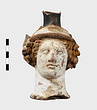
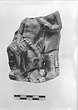
Female head from plastic vase. Large rosette earrings.
Firm pinkish-buff clay. Traces of black glaze and finished surface behind head show part of vase. Traces of white on face. 4th c. B.C. to early Roman ... 30 April 1957 |
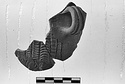
Mended from two pieces. The forepart of the vase is preserved, showing the face of a woman crowned by a wide spout. The hair of the woman is drawn down over the ears in regular waves. Her features are ... 15 June 1933 |
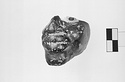
Only a fragment preserving part of the frontal roll of hair. Hair indicated by nodules covered with purple paint; the kerchief in applied white.
Black glaze on inside along upper edge as preserved. Marble ... 13 March 1937 |
Small face, broken behind.
The hair smooth on top, bunched over the ears.
Black glaze on top suggests from a plastic vase. Oinochoe deposit, earth.
End of 3rd c. B.C. 1749 Leica ... Publication: ca. 400 B.C. |
Plastic head vase. Fragment includes right eye and a little of the head and hair above. White wreath on head.
Buff clay. Good black glaze. The white on the eyeball well preserved; worn on the wreath ... 4 September 1953 |
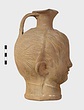
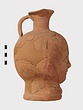
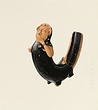
Neck with small trefoil mouth, and handle; chipped. In front, on neck, plastic head modeled at same time as pitcher, with additional plastic ornaments of headdress added by applique.
Traces of white paint ... 30 May 1951 |
| Handle, mouth, chip from bottom, part of diadem(?), and some curls, missing. Head inclining towards her proper left. Heavy spreading neck with Venus rings indicated; full mouth, long nose. Most of forehead ... Beginning of 4th c. B.C. |
| a) Preserves nose, mouth, chin, left cheek and left eye. White for teeth and iris of eye. Black glaze inside and out.
b) Preserves some of top of head and stubs of ring handle. Glaze on exterior and most ... May 1940 |
Fragment broken all around. Part of forehead with taenia and fruits.
Pinkish-buff clay. Red glaze, worn.
ADDENDA "Knidian" fabric (JWH). West gully. 368 Leica ... 26-27 March 1959 |
Lower end only preserved. Head of a bull. Pair of grooves between head and vase proper, red.
Metallic black glaze. Pnyx Street. 261 Leica ... December 1932 |
Broken away at neck.
Head of child with curly hair and a braid from front to back across the top of the head. A finished hole at the back of the neck.
Dull red glaze, inside and out.
Most probably from ... 22 April 1937 |
Mouth of jug and part of left side of the moulded head preserved. A small jar in the form of a negroid(?) head with curly hair. The round mouth of the jug projects from the top of the skull. Made in a ... 8-17 June 1933 |
Broken all around. One curling horn, with the ear and a little of the fleece preserved.
Very hard dark gray clay with lustrous orange surface.
Cf. P 25609.
ADDENDA Roman Knidian [JWH]. Well, box 2 ... 2 July 1947 |
Fragment from one side of lower part of vase preserves much of the face and neck of a woman; broken along brows, at left side of face and at base of neck; at right side, broken along edge of mould. Nose ... 5-7 July 1949 |
Broken off below and behind.
Head with bored eyes.
Remains of red glaze wash inside and out.
Pinkish clay.
From a plastic lamp. In mixed late Roman fill. Leica, LXIV-78 ... 6 May 1936 |
Back missing, and broken off at neck.
Eyes pierced; hair hardly indicated.
Poor red glaze.
Buff clay.
ADDENDA: C. Grandjouan: From a plastic lamp. Well. Leica, LXIX-23 ... 30 May 1936 |
Only front half of head remains.
Negroid features; pierced eyes.
No traces of paint.
Brick red clay. From wall trench of Late Roman Building, east side. 374 Leica, LXIX-22 ... 31 May 1946 |
Broken behind.
Face framed by heavily waved hair surmounted by a thick fillet or cap, a projection at the back above (for handle ?). Eyes pierced.
Considerable remains of white over, on headdress and neck ... 2 May 1939 |
Broken above and below. Head and neck of a figure, and neck of vase preserved. Wreathed head with curling locks hanging over shoulder. Stub of handle at back.
Much white, and some yellow over it, on ... March 1939 |
| Complete. Head of a child; above, short neck, trefoil mouth and ribbed handle. A string around the neck is tied in an Isis knot. The vase is moulded in two pieces, front and back; the seam shows down the ... 21 April 1937 |
| Fragments from the face and back of the head and the trefoil mouth missing. Restored in plaster. From the same mold as P 10244. Black on the eyebrows and lids, and for a ring on the center of the forehead ... March-May 1937 |
Top and handle missing. Wreath chipped. Plastic rhyton representing a Silenos head. Thick hair and beard, wreath on head, short slightly upturned nose. Detailed cold work: irises and pupils depicted. There ... 26 July 1972 |
The left half of a seated figure, head and feet missing.
Buff clay; traces of white paint on figure; black on back. Byz. fill. Leica ... 1 April 1936 |
Part of left side preserved, from nose to back and top of head to breast.
Mouth missing.
Curly hair and huge coiled horn. Large vent in top of head, and pierced lug on back for suspension.
A well modelled ... 21 May 1936 |
Broken at top and bottom. Neck decorated on one side by moulded, plastic head. Figure wears elaborate headdress consisting of a wreath of leaves above which there is a curved crown with a loop on either ... 2 August 1973 |
Left arm and shoulder; the head broken off at the neck. Mold made, the inside left uneven with dull red paint on the upper part.
Glaze on the outside silver black to red. Disturbed area. Leica ... 28 February 1933 |
Chest and head, with start of back, preserved; face broken off; ears chipped. Stumps of wings behind neck.
Black glazed, with bands of West Slope decoration. Brown wash inside. Great Drain, sand fill ... 24 May 1939 |
Head of child from small lekythos with trefoil mouth. Wears thick wreath, and wreath of leaves, over curly hair. Yellow, probably from hair, washed over face. Probably child Dionysos.
Black glaze on lekythos ... June 1947 |
Part of the relief on the front preserved: a hydrophore. Her left arm and shoulder and most of her head and the jar on it preserved. Ample traces of white; on the background some robin's egg blue over ... 24 March 1939 |
Part of neck and front of vase preserved. Lekythos neck glazed black. Head and chest of a nude youth with long flowing hair, probably reclining; arms broken off. Traces of white around face. Under Building ... 9 May 1949 |
Fragment, probably from neck, with ends of pointed leaves(?) in relief. Possibly from a head-vase, with ends of locks of hair.
Clay yellow-brown to reddish-brown; outside covered with black to brown paint ... 11 May 1939 |
| Mended from several fragments; the top of the vase, with the head of the seated figure, and the head, shoulders and right arm of the standing figure, missing, together with most of the back of the vase ... 16 February 1932 |
Missing are handle, spout, and chips from nose and elsewhere. Moulded sheep, head turned slightly right. Lying down, with legs tucked under. Fleece indicated by indentations. Handle at middle of back, ... 21 July 1970 |
| Part of the neck of a lekythos, with one handle attachment preserved; glazed. On the front, a plastic female figure, partly draped, winged, with hands clasped above the head.
Traces of white on the figure ... 7 March 1939 |
| Large chips missing; about three-quarters preserved; mended and restored in plaster.
Medallion: rosette, from which spring two rows of small pointed ribbed leaves and a third row of small lotus leaves ... 5 May 1971 ... Courby (1922), Vases Grecs a Reliefs, p. 344, no. 26); woman with child in one hand, pulling drapery over her head with the other; Satyr; old man, partially nude, standing by a tree; woman lifting a child over her head; each group appears two times.
|
Woman kneeling on her right knee and bending forward. Head, arms, knees and toes of right leg missing. She wears a chiton. On her right shoulder rests the hand of another draped person who formed the right ... February 1955 |
| From a mould-made pot, with a small vertical handle, double-grooved. Uncertain representation. Light red clay; dull red glaze outside and dripped inside.
a) Side wall (corresponding to fragment b) preserving ... 13 June 1935, 10 March 1952 |
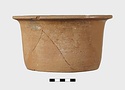
| Several pieces, including chunks from sides and rim, missing. Flat bottom; straight sides; flat-topped projecting rim.
Orange-buff clay. Light slip. Surface much worn.
On side wall, just below rim, a ... 9-12 February 1937 ... Athens New Style coin Head (1888), BMC Attica, pl. 12:8, dated ca. 90 B.C. ... ":
Among the great variety of late Hellenistic vases mended during the winter from the contents of a cistern found on the North Slope of the Areopagus (cistern at 75/ΟΑ) is one piece of peculiar interest. ... The New Style coins on which the type appears are dated by Sundwall about 40 B.C., and so postdate the seal by some years (Head (1911), Hist. |
The upper part broken off, including the figure's head and the neck of the pot. Semi-draped reclining figure, the body twisted to its left; a phiale in the right hand, fruits and flowers in the bent left ... 18-21 October 1947 |
| Mended from several pieces; the upper part of the tail at the back missing; also the right arm and chips. The body roughly cylindrical in section; semi-circular in shape. One end is closed by a plastic ... 20 March 1934 |
| Mended with P 30561. Moulded forefront of animal figure with small section of back of piece. Panther head with one ear missing on long vertical neck ending at body where beginning of forelegs project out ... 5 July 1973 |
| Preserved are upper right corner (BE 103) and joining section to lower left (BE 61). Broken diagonally above, at left side, and below.
Votive relief with simple fillet and ovolo molding above. Narrow frame ... Late 5th c. B.C. (410-400 B.C. ?) ... In upper right corner, low relief profile female head facing left and wearing a veil which flutters back behind her. ... Similar representations on vases of the early and middle fourth century (cf. ... The scenes on the vases have sometimes been connected with the cult of Aphrodite and Adonis (cf. |
| Broken just below the boy's left shoulder, and diagonally from his chin to the back of his head. The boy wears a wide fillet with zigzag and dot decoration; a single line on his shoulder seems to belong ... 16 May 1933 ... Broken just below the boy's left shoulder, and diagonally from his chin to the back of his head. The boy wears a wide fillet with zigzag and dot decoration; a single line on his shoulder seems to belong to a cloak. ... Richter; see Caskey, Vases in the Museum of Fine Arts, pl. |
The front part of the foot broken away, and the ring handle. Mould-made pot in the shape of a sandaled foot, the top of the pot being just above the ankle. The top covered, and pierced to form a strainer; ... 21 July 1947 |
| Missing are head of plastic figure, tips of wings, left forearm of figure and assorted minor chips. Elaborately moulded base pierced by small hole at center of underside and at top of base in front of ... 26 July 1971 |
Wall fragment from the receptacle of a rhyton(?). Max. dim. 0.063.
Maenad (most of draped legs, hanging leg of her nebris), probably dancing to right. Above her right thigh at the break is a bit of reserve ... Probably early 5th century B.C ... The shape of the horn is that of a cow, but cow-head rhyta known to me are quite different and considerably later than 1673: Paris, Petit Palais 371 (ARV2 777, ---, 1) and New York, M.M.A. 06.1021.203 (ARV2 777, ---, 2; Paralip. 417, 2; H. ... Hoffmann, "Rhyta and Kantharoi in Greek Ritual," Greek Vases in the J. Paul Getty Museum 4 [OPA 5], pp. 131--166. I have not seen the Harvard dissertation by Marion True: "Pre-Sotadean Red-Figure Statuette Vases and Related Vases with Relief Decoration" (cited by Hoffmann, p. 134, note 27). |
Wall fragment. Reserved band on inside near top. Glaze fired greenish. Max. dim. 0.11.
B, youths. Most of filleted head and upper part of body of one standing to right, clad in a himation, facing another ... Ca. 430-410 B.C ... Most of filleted head and upper part of body of one standing to right, clad in a himation, facing another (hand). ... Shapiro, Art, Myth, and Culture: Greek Vases from Southern Collections, New Orleans 1981, pp. 80--81, no. 30; Matheson, p. 394, cat. no. |
| Fragment of rim and side mended from five pieces. Preserved of the figured scene are most of the head and the upper part of the body of a flute player and the face, crown of the head, left shoulder and ... August-September 1932 ... Preserved of the figured scene are most of the head and the upper part of the body of a flute player and the face, crown of the head, left shoulder and upper left arm of a man. ... The artist responsible for these vases seems to have a preference for repeating the obverse design on the reverse. |
| Mended from many pieces; much of the boy's back and part of his right side missing. The hair hangs in a mass of conventionalized curls nearly to the middle of his back. The hands are lightly clasped, with ... Ca. 530 B.C. |
Floor fragment with stem and start of fillet. Incision at edge of fillet. Max. dim. 0.069.
I, runner (head, upper part of right arm, right leg from the knee down and left foot missing) to right. In his ... Ca. 520 B.C ... I, runner (head, upper part of right arm, right leg from the knee down and left foot missing) to right. ... This feature is difficult to detect in photographs, and therefore one is dependent upon first-hand observation of the vases or careful and detailed descriptions of them. ... Beazley (Vases in America, p. 6) adds two others: Munich 2590 by Phintias (ARV2 24, 12; Paralip. 323, 12; Addenda 155) and an unattributed cup contemporary with Psiax, Compiègne 1106 (CVA, Compiègne 1 [France 3], pl. 13 [111]:10). |
Mended with the missing pieces restored in plaster and painted, notably part of the bowl and lip, all of one handle, and part of the foot. Two incised lines on stem. Glaze misfired reddish and greenish ... Ca. 510-500 B.C ... I, nude youth (part of head and legs missing) kneeling to right. ... Smith (Catalogue of the Greek and Etruscan Vases in the British Museum III, London 1896, p. 59) suggests that the object may be a discus.
|
| Single fragment of the upper body of a red-figured chous or oinochoe.
Depicted are a figure of a flute-player and a satyr-player, both only partially preserved. The former stands to the left: his face, ... 23 June 1997 ... In his right hand the actor holds out a full satyr-head mask, shown in profile and facing towards him; his left arm is upraised.
... For similar R-F depictions on Attic vases, see J.D. Beazley in Hesperia 24 (1955) 305-319, esp. 314 f. and pls. 86-88.
|
Lower half of body, all of torus foot, start of handle B/A. Strengthened with plaster. Thin reddish glaze on inside. Misfired reddish in places on outside. Pitted here and there. P.H. 0.035. R. R. Holloway, ... Ca. 440-430 B.C ... He faces a man (head, shoulders missing) who sits on a klismos dressed in a himation and holds a staff. ... At the left, Nike (lower part of himation and chiton, feet) flies to right toward a musician (head, shoulders missing) who plays the aulos (most of each pipe). ... The drawing is not as crisp and as sure as it is on vases by the Peleus Painter himself, and the drapery does not relate as well to the figures. |
Mended with small missing pieces restored in plaster and painted. Lower part of body, all of foot missing. Thin glaze, reddish in places, abraded in others. P.H. 0.23; max. diam. 0.235; diam. of mouth ... Ca. 480-470 B.C ... Kilmer, Greek Erotica on Attic Red-Figure Vases, London 1993, cat. no. ... A (illustrated), woman (feet missing) in a chiton leaning over to right arms outstretched toward a phallos-bird standing to right with head turned back. B (part illustrated), woman in chiton, probably running to right, head turned back. |
| The end of the spout, fragments of the wall and about two-thirds of the rim missing; restored in plaster.
Squat pear-shaped jug on ridged flaring ring foot; narrow neck; broad round mouth with down-turned ... 12 May 1939 ... At the base of the handle, a satyr-head mask. The maker's name was inscribed in the mould, the letters alternating with the ornament on the shoulder, upside down with respect to the pot: ΑΡΙΣ [ΤΩΝ]
Flaky gray micaceous clay; dull black glaze badly worn.
... Delos, Courby (1922), Les Vases Grecs a Reliefs, pl. |
| A small fragment from the side and a chip from the rim are missing. The bowl has an offset rim, flat, with two mouldings below: one wide, one narrow. Between two raised ridges under the main zone is a ... 13 May 1933 ... At the head of the procession: Dionysos in a car drawn l. by two goats; a maenad carrying a thyrsos on her l. arm behind the goats to l. ... A nude boy standing l. loads a tray on the head of a small boy r. with raised arms. ... Walters (1896), BM Vases, IV, p. 251 ff. and pl. |
Eight non-joining wall fragments, a and b with rim and strengthened with plaster. Band on inside at rim, a narrower one 0.068 below rim. Glaze fired red on inside, slightly misfired below figures on outside ... Ca. 460-450 B.C ... At the left is Menelaos (head with Chalcidian helmet, part of shoulders with flaps of corslet, a little of his round shield seen from the inside) standing to right, facing Apollo (head with laurel wreath, left shoulder with himation), who probably stood frontally, head turned to left. ... Then comes Helen (top of head, a little bit of fillet at break) followed by Eros (head, fingers, start of wings) flying behind her. ... Helen runs to right, looking back, because what remains of her fillet indicates that her head faced left. All that remains of Aphrodite on fragment b (a + b) is the top of her head with stephane. |
Mended with small missing pieces restored in plaster and painted. Lip offset on inside; foot offset on underside. Glaze slightly abraded on handles. H. 0.074; diam. of rim 0.18; W. with handles 0.238; ... Ca. 510-500 B.C ... Kilmer, Greek Erotica on Attic Red-Figure Vases, London 1993, cat. no. ... Around his head is a wreath. Next comes a satyr (hands, feet, part of each leg missing) standing frontally, right leg in profile, his head turned toward the shaggy goat (head missing) he tugs at. ... Around the head of each satyr is a wreath. |
Two non-joining fragments. Fragment a comes from the lower part of the vase; fragment b is a shoulder fragment. Glaze on b is slightly abraded; streaky and pitted on inside. P.H. a) 0.175; max. dim. b) ... Ca. 420 B.C ... At the far left of fragment a, a youth (torso, legs) restrains a bull (head, part of rump missing) as it charges to right, preceded by a woman preserved from the waist down, also moving to right. ... He holds a torch in his left hand, as does the youth behind him (head, shoulders, right arm missing), who stands beside an ithyphallic herm decorated with a kerykeion. ... All these vases are dated in the early fourth century (Metzger, p. 354); thus, 118 seems to be one of the earliest if not the earliest example of this subject. |
Mended from many fragments, with missing pieces restored in plaster and painted, notable among them the left horizontal handle and part of the wall below it. Glaze fired greenish around left handle; abraded ... Ca. 430 B.C ... Three women, one frontal, head to right, facing one in profile, a third to right, looking back. Each wears a chiton, the first carries a folded himation, the second holds the kolpos of her chiton between her teeth as she ties her belt, the third also wears a himation and has a sakkos on her head. 1 and 2 each have fillets with leaves around their heads. ... Trendall, The Red-Figured Vases of Apulia, Oxford 1978, p. 21, no. 94); also 836; P 30054 (Hesperia Suppl. |
Ten non-joining wall fragments, three (a, e, and g) of flaring rim, flat on top. Bands of glaze on inside. Glaze has a slightly greenish cast on c, f, and j. Est. diam. of rim at outer edge 0.25; P.H ... Ca. 510 B.C ... Fragment a preserves the wreathed head of Apollo and a little of his back with himation. He faces to right, holding his kithara (tip of left arm projecting above his head, right arm with part of support, crosspiece, and strings). ... Above the figures, an upright chain of encircled palmettes interrupted above the head of Apollo by a lotus flower that indicates where the pattern started and ended. |
Fifteen non-joining fragments of wall, P 18278 b--c and P 19582 a--d of torus rim with zone of ornament below. Glaze mottled here and there; has a greenish cast in places; abraded in part on rim. Max ... Ca. 480 B.C ... P 19582 j (illustrated) shows the filleted head of the hero bent downward, his right hand resting against his forehead, the elbow on his thigh. ... He stands frontally, head turned to right. ... Perhaps it is one hanging on the wall above the head of Achilleus or slightly in front of him.
|
Four non-joining fragments of rim and neck, P 25978 a preserving the spiral of one handle, P 28759 with start of shoulder. Two small fragments (P 25978 b and c) give a bit of the flange of a handle and ... Ca. 500-490 B.C ... Around the head of each figure is a wreath. ... It preserves a youth (head, left shoulder and arm, right knee and most of right foot missing), kneeling to left, torso in back view, a club in his right hand. ... For encircled palmettes on the necks of red-figured volute-kraters, cf. the following, all in the upper zone and all in reserve, not black glaze: one by the Nikoxenos Painter, Munich 2381 (ARV2 221, 14; Addenda 198); another akin to him, Toronto 959.17.187 (ARV2 223, ---, 2; Paralip. 346, 2); two by the Karkinos Painter: New York, M.M.A. 59.11.20 (ARV2 224, 1) and New York, M.M.A. 21.88.74 (ARV2 224, 2; Addenda 198).
234 probably belongs among those vases akin to the Nikoxenos Painter rather than those by the painter himself or in his manner. |
|
|